


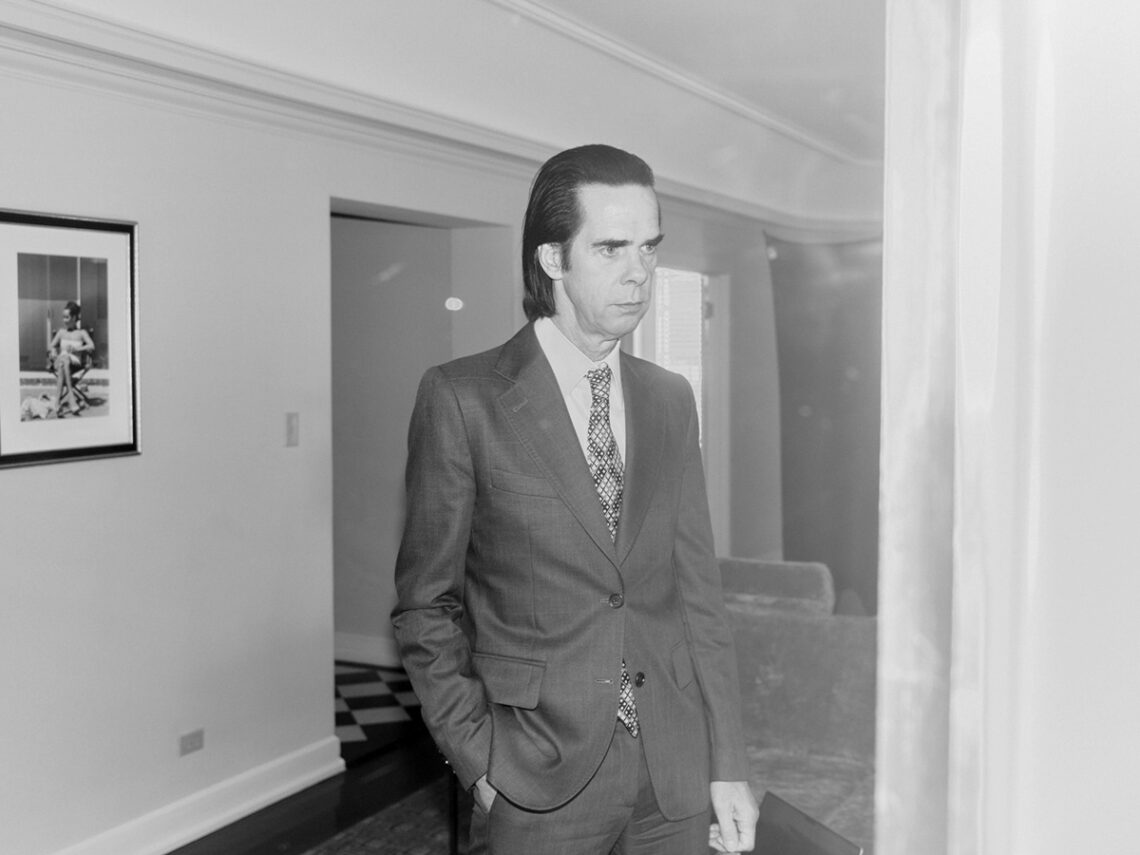
Nick Cave discusses meaning behind the title of his new album ‘Wild God’

It’s mere days until the release of Nick Cave and the Bad Seeds’ new album, Wild God, on August 30th. Following on from the moving 2019 release Ghosteen, the record promises to see Cave wade further into epic contemplations of spirituality and life – much like a poem that helped inspire the album’s title.
Cave began working on the new album on New Year’s Day in 2023. Having previously talked about his meticulous process, which he treats like a full-time job and goes to work at each day, the album slowly but surely came together across the year. Recording took place between Miraval Studios, Provence, and Soundtree in London, with Cave and his right-hand man Warren Ellis helming the production.
In his own words, Wild God is Cave’s most spontaneous and unrestrained album yet. He said, “There’s no fucking around with this record. When it hits, it hits. It lifts you. It moves you. I love that about it.”
Across the teaser tracks, ‘Wild God’, ‘Frogs’ and ‘Long Dark Night’, a grand sound has been revealed with the songwriter’s now signature mix of poetic and biblical references.
Furthermore, the topic of spiritually has been finding its way into Cave’s music more over recent years. In the wake of the death of his son, Arthur Cave, in 2015, the musician has spoken at length about his complex relationship with religion and faith. He claims he’d stop short of calling himself a Christian, but regularly goes to church. Of prayer, he remarked, “it is not so much talking to God, but rather listening for the whispers of his presence.”
This nuanced take on what God is or isn’t, or what Cave perceives God as, seems to populate the new record, as suggested by its title. However, in a recent addition of his Red Hand Files newsletter, a fan pointed out a link to a poem by Tom Hirons titled, ‘Sometimes a Wild God’.
“I came upon my ‘Wild God’ entirely independently of your ‘Wild God’,” Cave wrote to the fan, separating his own title from the poem, but jokingly added, “Perhaps the same ‘Wild God’ was just ‘doing the rounds’ looking for someone new to write about him!”
However, Cave became aware of Hirons’ poem at the perfect time. “We had finished the mixing, felt we had an excellent record, and were pretty pleased with ourselves. Warren asked me what we were going to call the record. I had three ideas, which were titles of songs on the album, ‘Conversion’, ‘Joy’ and ‘Wild God’,” he explained.
“We both agreed that this was a powerful and mysterious title for an album,” Cave continued. “I googled Wild God in case some other band had called their record something similar.”
That’s when he stumbled across Hirons’ poem, first published in 2015. “I read the poem to Warren,” Cave continued. “‘Great poem,’ said Warren. ‘Yes,’ I said, ‘amazing poem. Beautiful poem.’”
While Hirons poem didn’t inspire Cave title, his discovery of the piece which contains it’s own unique and layered contemplations on religion, seemed to serve as a sign that the title they’d picked was right.
Addressing the poet directly, Cave wrote, “Tom, I have often returned to your poem since that rainy afternoon in Cassadaga. It is a beautiful, deep, raw thing, full of unruly life, and I feel a genuine connection to it.” He said, “Reading it is a particular pleasure because it gives weight to my own ‘Wild God’, pouring meaning into it and deepening and intensifying it, and I find reading your poem aloud and listening to my song at the same time to be a powerful experience.”
Tom Hirons – ‘Sometimes a Wild God’:
Sometimes a wild god comes to the table.
He is awkward and does not know the ways
Of porcelain, of fork and mustard and silver.
His voice makes vinegar from wine.When the wild god arrives at the door,
You will probably fear him.
He reminds you of something dark
That you might have dreamt,
Or the secret you do not wish to be shared.He will not ring the doorbell;
Instead he scrapes with his fingers
Leaving blood on the paintwork,
Though primroses grow
In circles round his feet.You do not want to let him in.
You are very busy.
It is late, or early, and besides…
You cannot look at him straightBecause he makes you want to cry.
Your dog barks;
The wild god smiles.
He holds out his hand and
The dog licks his wounds,
Then leads him inside.The wild god stands in your kitchen.
Ivy is taking over your sideboard;
Mistletoe has moved into the lampshades
And wrens have begun to sing
An old song in the mouth of your kettle.‘I haven’t much,’ you say
And give him the worst of your food.
He sits at the table, bleeding.
He coughs up foxes.
There are otters in his eyes.When your wife calls down,
You close the door and
Tell her it’s fine.
You will not let her see
The strange guest at your table.The wild god asks for whiskey
And you pour a glass for him,
Then a glass for yourself.
Three snakes are beginning to nest
In your voicebox. You cough.Oh, limitless space.
Oh, eternal mystery.
Oh, endless cycles of death and birth.
Oh, miracle of life.
Oh, the wondrous dance of it all.You cough again,
Expectorate the snakes and
Water down the whiskey,
Wondering how you got so old
And where your passion went.The wild god reaches into a bag
Made of moles and nightingale-skin.
He pulls out a two-reeded pipe,
Raises an eyebrow
And all the birds begin to sing.The fox leaps into your eyes.
Otters rush from the darkness.
The snakes pour through your body.
Your dog howls and upstairs
Your wife both exults and weeps at once.The wild god dances with your dog.
You dance with the sparrows.
A white stag pulls up a stool
And bellows hymns to enchantments.
A pelican leaps from chair to chair.In the distance, warriors pour from their tombs.
Ancient gold grows like grass in the fields.
Everyone dreams the words to long-forgotten songs.
The hills echo and the grey stones ring
With laughter and madness and pain.In the middle of the dance,
The house takes off from the ground.
Clouds climb through the windows;
Lightning pounds its fists on the table
And the moon leans in.The wild god points to your side.
You are bleeding heavily.
You have been bleeding for a long time,
Possibly since you were born.
There is a bear in the wound.‘Why did you leave me to die?’
Asks the wild god and you say:
‘I was busy surviving.
The shops were all closed;
I didn’t know how. I’m sorry.’Listen to them:
The fox in your neck and
The snakes in your arms and
The wren and the sparrow and the deer…
The great un-nameable beasts
In your liver and your kidneys and your heart…There is a symphony of howling.
A cacophony of dissent.
The wild god nods his head and
You wake on the floor holding a knife,
A bottle and a handful of black fur.Your dog is asleep on the table.
Your wife is stirring, far above.
Your cheeks are wet with tears;
Your mouth aches from laughter or shouting.
A black bear is sitting by the fire.Sometimes a wild god comes to the table.
He is awkward and does not know the ways
Of porcelain, of fork and mustard and silver.
His voice makes vinegar from wine
And brings the dead to life.

Never Miss A Beat
The Far Out Music Newsletter
All the latest music news from the independent voice of culture.
Straight to your inbox.