


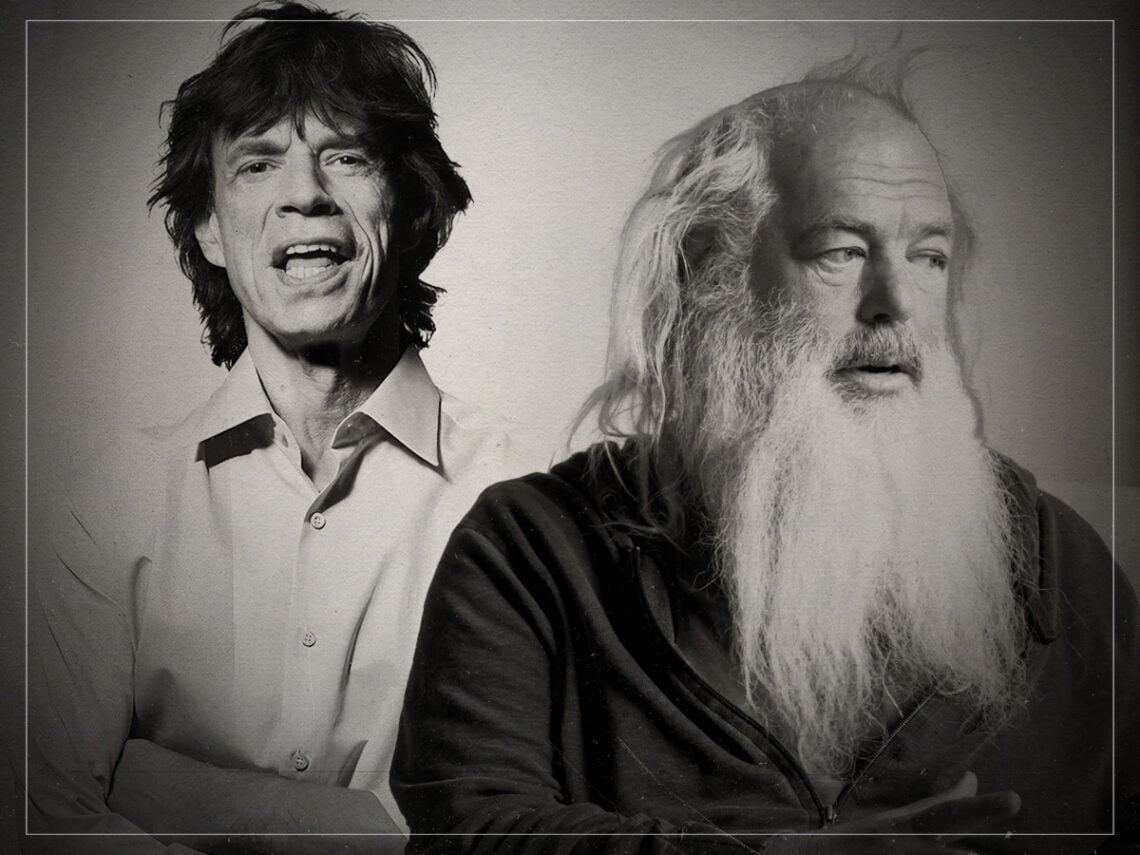
Why Rick Rubin could never click with Mick Jagger: “A tug of war”

The main ingredient behind every Rick Rubin project is being able to click with everyone that he works with.
He never claimed to be a musical savant every time he worked in the studio, but even if he didn’t know the difference between what an augmented ninth chord and a thirteenth chord was, it didn’t matter so long as he had the right tools when judging what a song needed every time he entered the studio. Sometimes he would have people that were on his same musical wavelength, but sometimes even the biggest stars didn’t see the same thing that everyone else did in the bearded rock legend.
Granted, it’s a little bit hard to see what the fuss is about when all you’re seeing is Rubin standing there behind the board half the time. His strong suit was in having the best ears in the business, and even if he didn’t have the knowledge of how to write songs, his greatest strength was in letting bands do their own thing. It was about their career at the end of the day, and that’s probably why he could work around people as diverse as Slayer and Johnny Cash. It was about everything being sparse, but not everyone was looking to get back to their roots, either.
Linkin Park had already been making music that traced all the way back to the days of Mike Shinoda listening to Public Enemy when Rubin began working with them, but when the producer got the call from Mick Jagger, he wasn’t exactly on the same page with the Stones frontman. Jagger wanted the opportunity to get outside of his comfort zone, but that’s not always what Rubin thrived on whenever he made a record.
Every band should want the chance to try things that they had never thought of before, but Jagger certainly picked the wrong person if he wanted his music to sound more current. Rubin didn’t care about playing to trends by any stretch, and since Jagger was doing everything he could to rid himself of any Stonesy sounds in his arsenal, Rubin didn’t think that he was capable of making something that was a complete bait-and-switch.
Even when talking about working on Wandering Spirit later, Rubin wasn’t exactly in love with the idea of making an experimental record, saying, “I think he very much wanted to make a Mick Jagger solo record that was not like The Stones. And I think there’s just a Stonesiness around him that comes naturally. If he writes a song that sounds like it could sound like a Stones song, it wouldn’t feel good to change it for the sake of changing it. I would say that it was a bit of a tug of war, that album.”
But Jagger is one of the few cases where someone is almost cursed to be identified with their band until the end of time. It’s kind of hard to sidestep any kind of association with The Stones when your lips are the goddamn logo of the band, and even if Jagger felt that Rubin was the right guy, he wasn’t going to be the one giving the thumbs-up when trying to get him to sound like whatever flavour of the day was happening at the time.

That didn’t stop Jagger from doing the same thing in The Stones, though. There were plenty of opportunities for him to explore new territories, and even though ‘Might As Well Get Juiced’ was novel for its time, it’s not exactly the best example of what the band could sound like when they took a chance or anything.
It’s one thing to come to someone like Rubin for guidance whenever making a record, but the one thing that Rubin prioritised before anything else was being a straight shooter. He was going to give his honest opinion no matter who was on the other side of the glass, and even if they didn’t take his advice every single time he listened to their tunes, he was going to make sure the artists got what they wanted at the end of the day.
