


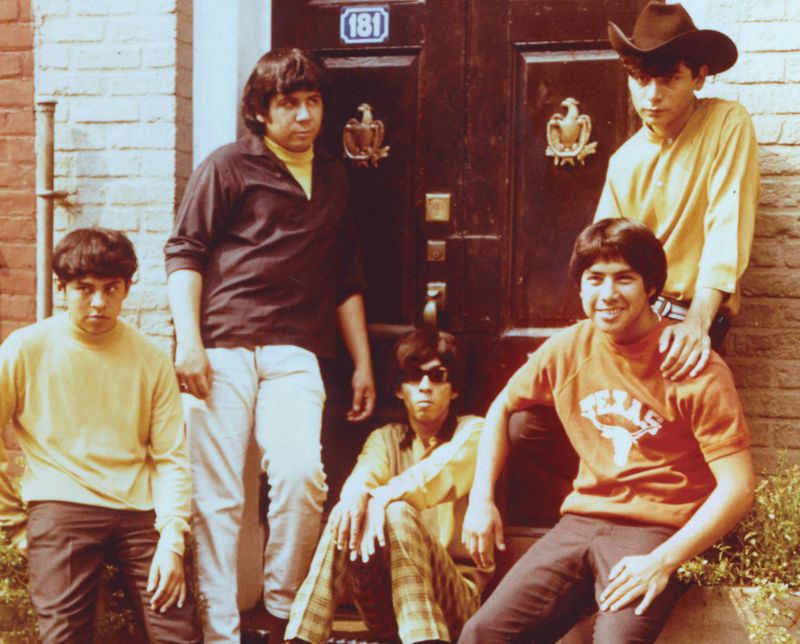
The murder that almost derailed Question Mark and the Mysterians

Fittingly, for a band named Question Mark and the Mysterians, the legendary garage rock band have successfully managed to maintain a level of intrigue and mystery around their work. Often deemed a one-hit wonder, their standout track, ‘96 Tears’, changed the face of rock music forever, acting as inspiration for the later punk rock movement. However, as Question Mark himself has revealed, the hit song was nearly snuffed out by the conflict in Vietnam and the murder of a music mogul.
The 1960s garage rock scene was the precursor to punk and alternative rock music. Characterised by distorted guitars, basic song structures and raw energy, the genre produced a plethora of young bands that have since been lost to obscurity. Of course, some garage tracks have been more enduring than others, with ‘96 Tears’ definitely falling into that category.
Built around an improvised riff on an electronic organ, the track feels like a sleazy reimagining of a 1950s rockabilly tune. Although the group failed to follow up on this chart-topping hit, the impact of ‘96 Tears’ was huge. Covered by everybody from Aretha Franklin to Primal Scream, the song was also name-dropped in the classic punk anthem ‘Human Fly’ by The Cramps.
Very little is known about The Mysterians or their frontman – at least, not much is known for sure. As Question Mark has pointed out, the countless blog posts and web pages dedicated to the band are fraught with inaccuracies and myths. In more recent years, Question Mark (also known as Rudy Martinez), has appeared in interviews to set the record straight on the story of the infamous garage rock band. However, given Martinez’s endearing habit of telling rambling, Grandpa Simpson-esque tales, his attempts to create a definitive history of the band have not been hugely successful.
Nevertheless, Martinez has revealed some interesting, often unbelievable, facts surrounding his pioneering proto-punk group and their best-known track. Starting out, like many bands, by doing cover songs, The Supremes’ ‘Stop! In the Name of Love’ is a notable example. Martinez and his group soon found an ability to write improvisational lyrics on the spot. The Michigan band formed in 1962, but it was not until 1966 that they got into the studio, recording two tracks, ‘Are You For Real’ and ‘I’ll Be Back’. Recorded as an audition for an independent label, both tracks feature the same kind of blistering organ-driven garage rock that made ‘96 Tears’ so loveable, but it turns out that the songs were nearly never released.
Although the songs were fantastic and likely would have made it to the charts, the band were plagued with problems during this period. For starters, drummer Robert Martinez and guitarist Larry Borjas were drafted to go fight in Vietnam. It is not easy to maintain a successful rock band when the backbone of your group is fighting a war halfway across the world, but it becomes even harder when the owner of the recording studio you use gets murdered. “The studio owner got shot in the head,” Martinez nonchalantly explained, “We got the master tape, but he got shot in the head.”
If the band members did not have that master tape, it is likely that their demos would have been lost forever, and the group would have probably disbanded. The frontman claims that the setbacks they faced pushed them on to write an original song, “because it cannot end like this”, he said. That track, which was born out of the murder of their studio owner and the drafting of half the group, soon became the unforgettable ‘96 Tears’, and the rest is history.
