


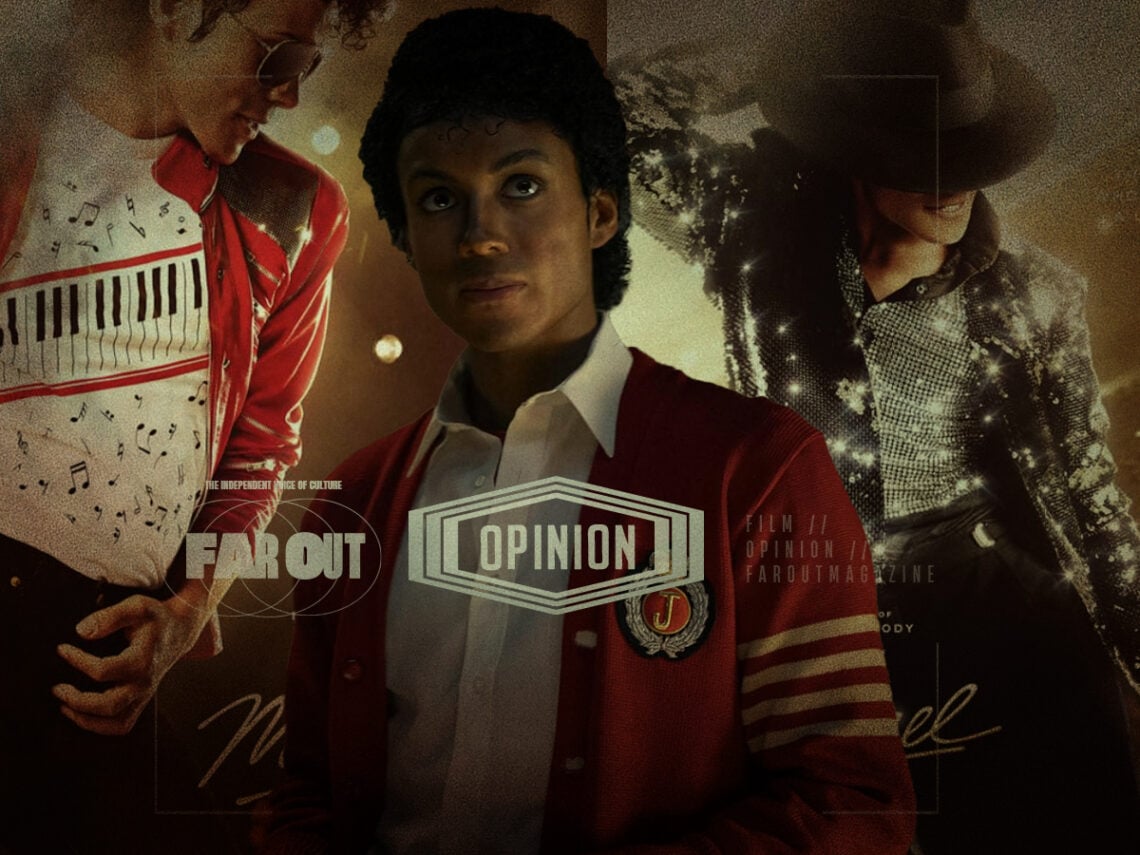
‘Michael’ is like watching the first 10 minutes of a horror movie

Contrary to what you may have heard, the new Michael Jackson movie isn’t terrible.
The performances are mostly excellent, if a little hammy; the script is not as clunky as it could have been, and, not surprisingly, the music is second to none. As I sat in the cinema watching it, though, all I could think was, “Wouldn’t it be nice if this were the real story?”
Beginning with the formation of the Jackson 5 in the 1960s, Michael follows the youngest member of the group from his difficult childhood as a singing prodigy to his evolution into a wildly successful solo performer while trying to liberate himself from his abusive father. Featuring a slew of lengthy concert performances, it ends with his 1988 Bad tour when he was at his least complicated peak of his fame.
Six of Jackson’s family members – five of his siblings and one of his children – are executive producers of the movie, and the singer’s nephew, Jaafar Jackson, portrays him. The Jackson estate is a co-investor in the production and stands to earn 25% of the profits, according to Forbes. Based on the staggering box office numbers of its opening weekend, this film is going to earn truckloads of cash, possibly more than Bohemian Rhapsody did eight years ago.
Based on the heavy involvement of the Jackson family, it is hardly surprising that the movie portrays him as an otherworldly talent whose only fault was being too kind. We see him cuddling animals (“they aren’t my pets; they’re my friends,” he tells his mother), solving Los Angeles gang violence with a dance off, and having a rom-com-worthy meet-cute with his attorney (who is a real-life producer on the film). At one point, his mother seems to suggest that he might be the second coming, and by the end of the movie, he bravely takes up the challenge and says he’s ready to do what he was put on the Earth to do.
There are also many scenes in which Michael is kind to children. In one of them, he visits a boy in hospital. Sitting next to the child’s bed, Michael is a warm, angelic presence, evoking smiles and even laughter. Then the scene cuts to Michael’s bodyguard, who stands outside the room, watching the interaction through a large window. It’s a defensive camera angle if ever there was one. The bodyguard may as well turn to the audience and say, “See? He wasn’t molesting kids. I was watching”.

And that’s the problem with Michael. During his lifetime, the King of Pop faced a steady stream of allegations about his relationship with children, especially after a high-profile 1993 lawsuit brought by the parents of a boy who accused him of sexual abuse. In the early 2000s, Jackson admitted in the ITV documentary Living with Michael Jackson that he sometimes shared a bed with the many young boys who visited him at Neverland Ranch. In 2003, the singer was arrested and charged with further allegations of child sexual abuse. All of these cases were either settled out of court or ended in an acquittal, and Jackson vehemently denied any hint of wrongdoing.

There is a long and terrible history of Black men in America being falsely accused of sexual violence, and the late 1990s and early 2000s were a cesspit of tabloid impunity. In that light, it makes sense that many Jackson fans would stick by the King of Pop and ignore the steady drumbeat of accusations, especially when many of the children who spent time with him claimed that he was never inappropriate with them. Since the singer’s death in 2009, however, it has become much harder to ignore the evidence.
In 2019, the documentary Leaving Neverland was released by HBO, and it shook the Jackson legacy to its foundations. The four-hour miniseries centres on two men, Wade Robson and James Safechuck, who allege years of sexual abuse by the singer. Robson claims that the abuse began when he was just seven years old. The starkness of this documentary, with its focus on these two men and their stories, is the most powerful account of the allegations against Jackson, far more convincing than the most sensationalised tabloid headline.
Part of its power comes from the complexity of the men’s feelings towards the singer. “He was one of the kindest, most gentle, loving, caring people I knew,” Robson says. “He helped me tremendously. He helped me with my career. He helped me with my creativity. With all those sorts of things. And he also sexually abused me for seven years.”

Child abuse is not always violent in the classic sense of the word. The whole point of grooming is to gradually gain trust and establish a relationship with a child in order to abuse them. Robson’s recollections of Jackson and his continued love for him are in keeping with what the public saw: a man who surrounded himself with children in order to do over the childhood that was stolen from him by early fame and by an abusive father.
Jackson’s friends and fans denounced the documentary, but it wasn’t simply a formality that the singer’s estate sued HBO, claiming that its one-sided nature interfered with the ongoing litigation the estate was waging with Safechuck and Robson. As part of the suit, HBO agreed to remove Leaving Neverland from its platform, and it is now nearly impossible to find, in the US and elsewhere.
One of the reasons the documentary had such a seismic impact (at least in the short term) is that it forced people to re-evaluate what they already knew. At a ten-year remove from Jackson’s dramatic death of an overdose and the tabloid frenzy that hounded him in his later years, it was much harder to ignore the facts that were never argued over – that he surrounded himself with young boys, that he admitted to sleeping in their beds, and that he was accused, on multiple occasions, of molesting them.
People will simply have to make up their own minds about whether Jackson actually did abuse those children, but it is hard to imagine anyone watching Leaving Neverland with an open mind and concluding that Jackson was not a paedophile. When combined with what we know about him, these first-person accounts feel like the final piece of a puzzle that we already understood, deep down. No wonder the Jackson estate was so adamant to have the documentary buried.
Michael ignores this part of the story the way a child who covers their eyes and shouts over their parents ignores the inevitability of going to school. There are plenty of Jackson fans who have been doing this, and there will now be an entire generation of young music enthusiasts who will learn about the King of Pop through this estate-funded biopic and conclude that he was, in fact, a victim, a genius, and nothing else.

There will also be people who bring up the old argument about separating the art from the artist, not understanding how irrelevant it is here. You can listen to Michael Jackson’s music to your heart’s content, free from guilt, if you’re able to. He changed pop music. His artistry as a songwriter, singer, and performer is threaded through the DNA of pop culture. Go ahead and enjoy it. But a biopic, by definition, is about the life of a person, not just the art, and there is no separating them.
To tell the story of Michael Jackson is to tell the uncomfortable story of a once-in-a-century talent and victim of abuse who damaged himself and the most vulnerable people around him. This is hard to reconcile, but it seems undeniable. Watching Michael is like watching the first ten minutes of a horror movie, when an idyllic neighbourhood in an idyllic town blossoms with happiness and peace. You can turn off The Wicker Man or The Stepford Wives before the proverbial shit hits the fan, but chances are, you’ll be left with a lingering sense that you’re missing something.
The filmmakers behind Michael seemed to intuit this. The original script reportedly included the 1993 lawsuit, though it was allegedly skewed to suggest that Jackson was falsely accused (per The Guardian). Due to an overlooked clause in the lawsuit that stated that the boy could not be mentioned in any future movies, the production underwent extensive reshoots to the tune of $15 million. Now, the film ends with a title card reading, “His story continues,” which is such a ludicrous understatement that it may as well be a punchline.
A sequel may be in the works, according to a Lionsgate executive, which poses some pretty big questions. This movie ends just before Jackson transitioned from uncontestable prodigy to, at best, a notoriously eccentric recluse who dangled babies out of windows. On one level, it will be fascinating to see how the clash between financial incentive and legacy preservation is resolved. On another, the real story of Michael Jackson begins and ends with childhood tragedy, and attempting to turn that into glitzy entertainment is tough to stomach.
