


Mark Jenkin on ‘Rose of Nevada’, the valuable limitations of shooting on film, and the mystery of cinema: “I don’t understand film on almost every level”

The new film from Cornish auteur Mark Jenkin begins with the impossible return of a fishing boat, the titular Rose of Nevada, that was lost at sea with its crew three decades before.
Time slips and blurs when two local men – a young family man played by George Mackay and a mysterious drifter played by Callum Turner – are recruited to take the vessel back out to sea. When Nick (Mackay) goes below deck, he sees a sentence etched into the headboard of his bed: “Get off the boat now.” When they return to port a few days later, they discover that their sleepy village is now the bustling fishing port of 30 years before.
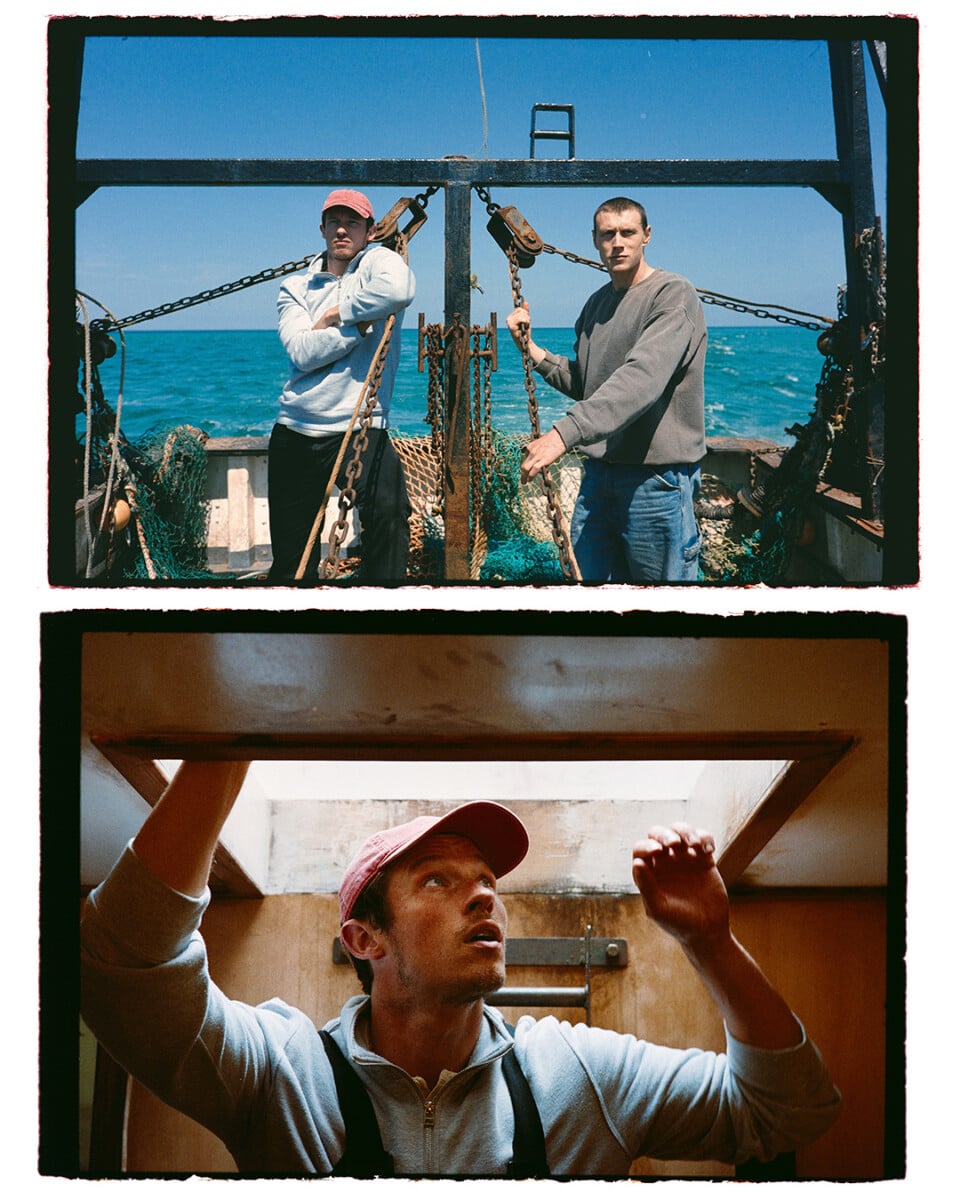
The word “auteur” is thrown around far too liberally, but how else is one to describe Jenkin, who isn’t just the screenwriter and director of his films, but the cinematographer, editor, sound designer, and composer, too? He shoots exclusively on film, using a 16mm wind-up Bolex that produces images that leap from the screen with tactility. Every frame is a crucial element of the whole, even if the audience has to find the meaning between all the juxtapositions. Close-ups of tree bark, rusty metal, and a jellyfish floating languidly in the turquoise water act as the establishing shots in Rose of Nevada, establishing a sense of place and the passing of time more deftly than a simple wide shot of the port.
All of the sound, including dialogue, is added in post-production, and Jenkin uses this to create soundscapes that tell a story unto themselves. The sound design bleeds into the score, turning the action into its own form of music – the metronomic thrum of a clock, the keening of a boat’s hull, the shredding of metal against metal. It gives the impression that the world is teeming with life, if only we’d stop to listen.
Speaking from a hotel in Belfast, where he is reaching the end of a preview tour of the film, Jenkin insisted that his approach to the sonic element of his work has more to do with his own limitations than his artistry. “I’m a bit self-conscious about describing myself as a musician or a composer,” he said, “So I’m quite happy to bury quite a lot of the score within the sound design.” Recently, he was extracting the score for the soundtrack release but found himself adding some of the effects back in. For him, the two are inseparable. “Ian [Wilson, the film’s supervising sound editor] was joking with me that I was the only composer he’d worked with who was asking for the music to be turned down in the mix.”
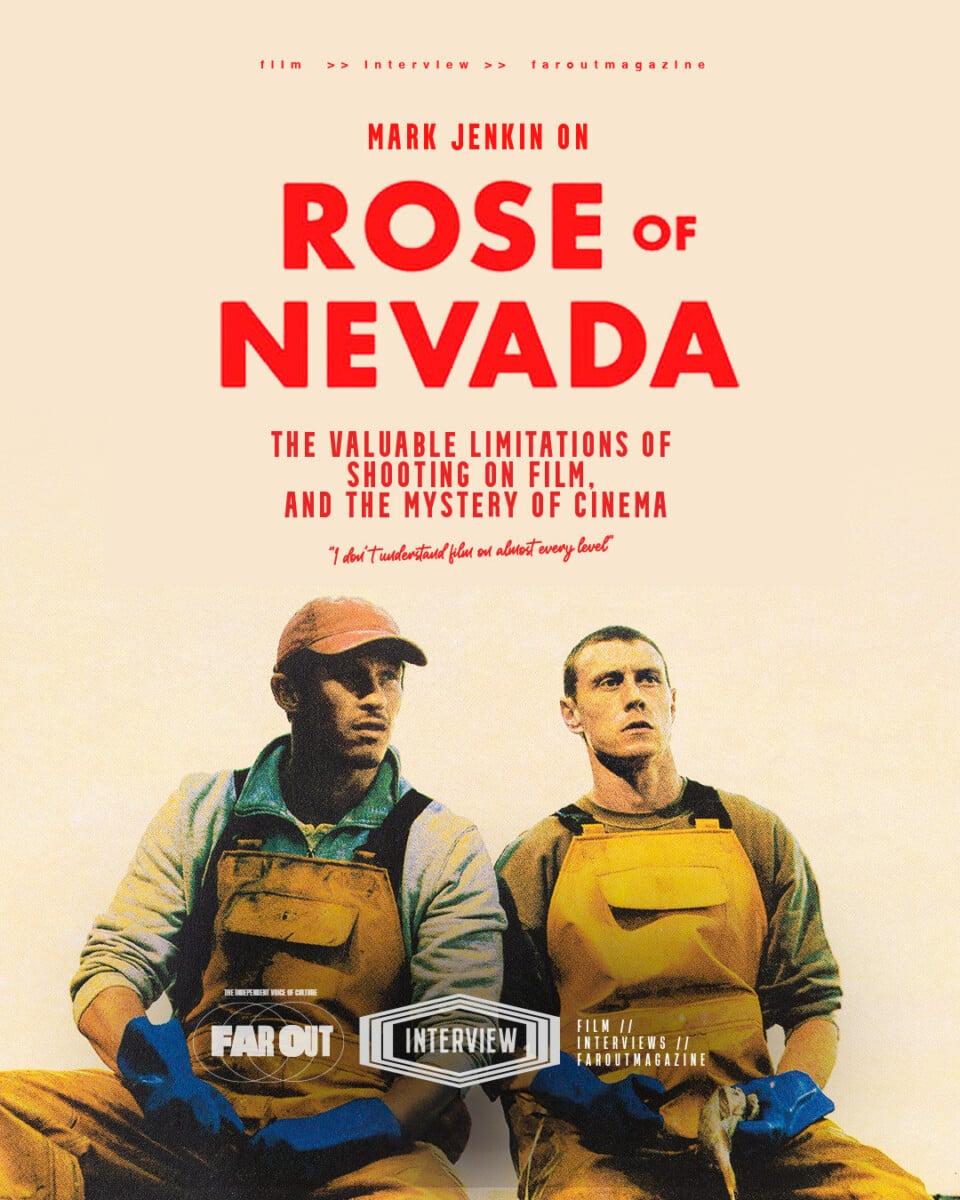
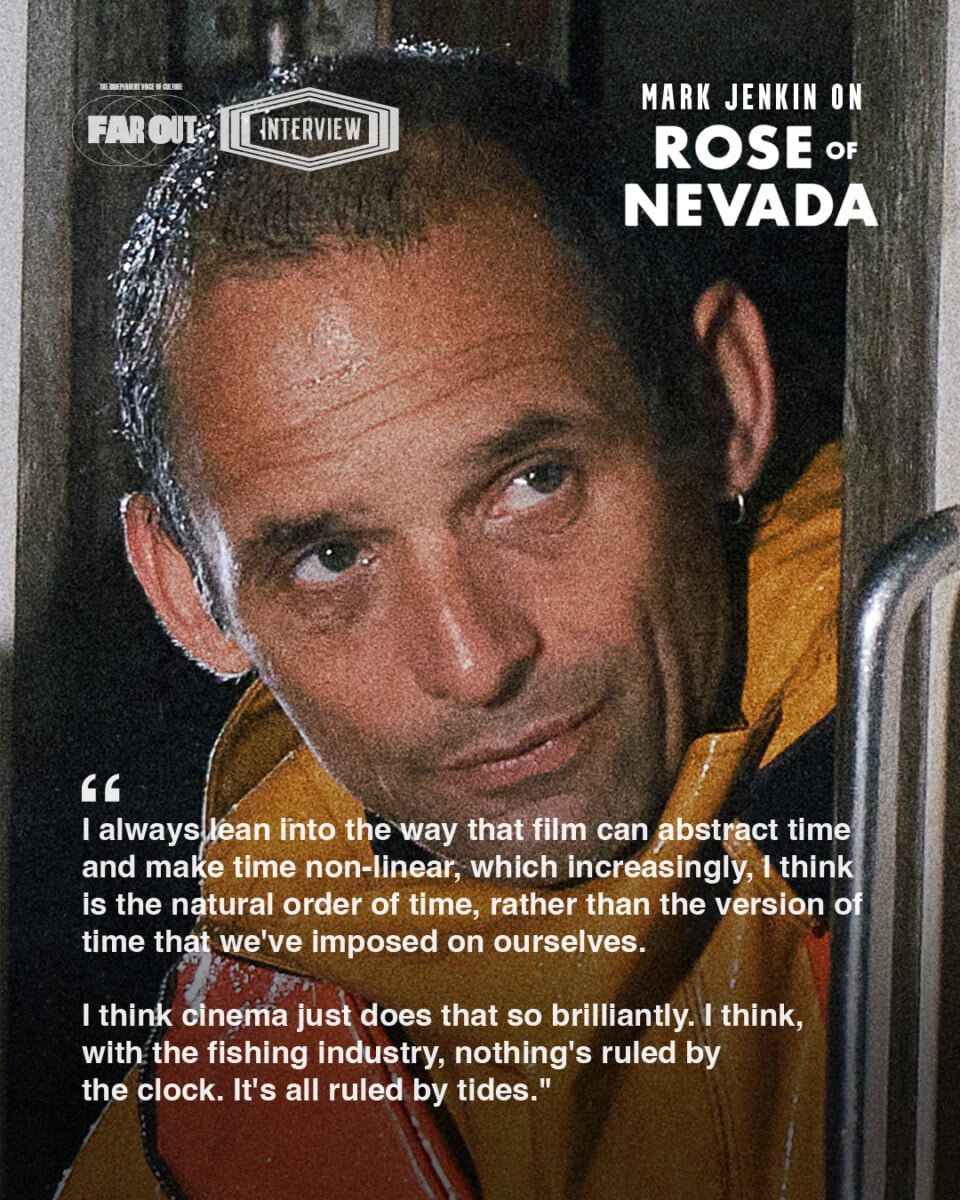
The slippery nature of time is present in all of Jenkin’s features, first with 2019’s Bait, in which the past and present collide, and then in 2022’s Enys Men, in which it bleeds into the past in a nightmarish loop. But in Rose of Nevada, as the men find themselves lost in the village of 30 years before, time is particularly present. “I always lean into the way that film can abstract time and make [it] non-linear,” Jenkin said, “Which increasingly, I think is the natural order of time, rather than the version of time that we’ve imposed on ourselves.”
This isn’t science fiction, though, no matter what genre labels may be placed on it. Instead of being a mere plot device, Jenkin’s evocation of time has a way of inviting the audience to a greater level of engagement. There is no exposition or easy explanations. The mystery is established, the characters navigate their new reality, and the audience is allowed to contemplate the implications. “You have to set out your terms as a filmmaker to the audience early on,” Jenkin explained. “The more as an audience member I’m asked to do, the more that’s expected of me, the more respected I feel. I might sit forward on my seat a little bit rather than laying back and letting it wash over me. I’ll lean forward because I know I’m going to have to contribute to the film. They’re the films that I like watching, so they’re the films I like making as well.”
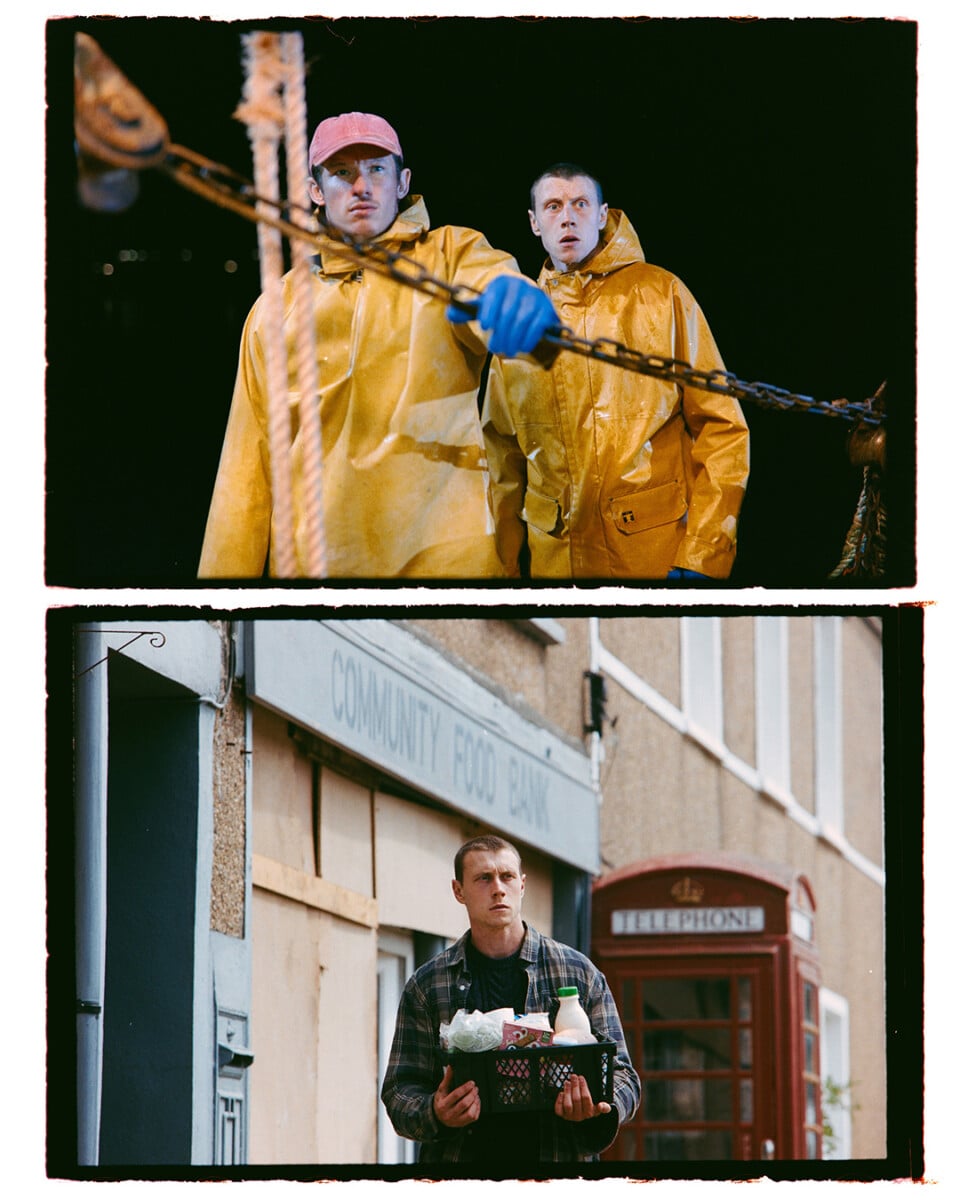
For all its artistry, though, Jenkin’s work is rooted in the familiar rhythms and friction of modern life. His first feature, Bait, focused on the clash between locals and tourists in a Cornish fishing village. In Rose of Nevada, Mackay’s Nick picks up food for his family from the food bank and returns to his wife and daughter to find water dripping through the ceiling. When he goes to investigate, he falls through the roof, sealing his watery fate. Financial necessity drives him out to sea, even as he can’t bear to leave his family behind.
The stakes of the work are made clear when the Rose gets caught in a storm. It’s an exhilarating, dizzying, cacophonous scene, and there is almost no dialogue. The boat tips and judders and takes water, and the skipper (a fantastically grizzled Francis Magee) falls overboard trying to release a line that has gotten caught in the propeller. Shooting a scene like that on film and with a small budget is not for the faint of heart. They did it in a harbour with wind and rain machines and water whooshers, with the boat tied up against a wall.
Jenkin couldn’t get the wide shots that he’d envisioned (it’s expensive to create a full panorama that looks real, he explained), so he broke the scene down in his mind and filmed the individual shots that he could splice together to give the impression of seafaring disaster. Instead of seeing the boat tossed wildly in the waves under a stormy sky, we see mugs falling from the walls below deck and smashing against the floor, waves crashing across the bow, and an axe slicing through the offending rope. Instead of seeing the catastrophe from a distance, the audience is placed in the centre of the chaos, with all the disorientation and terror that it brings.
This process of turning constraint into creative potential is at the heart of Jenkin’s ethos as a director. He described travelling with a Super 8 camera to the hotel where he’s currently staying to capture the atmosphere of the place. He took a walk without the camera first to identify three shots that he wanted to take, then returned with the camera. He only brought a certain number of film cartridges with him, he explained, and each of them is only two and a half minutes long.
“I wanted to try and capture my experience with as little material as possible,” he said. “Part of that is because the film is expensive, and part of it is I just can’t carry much film with me. So it becomes a huge limitation, which then engenders the creativity.” He shoots on his iPhone sometimes, too, he said, but unless he puts that footage on Instagram, “I’ll never look at it again because it has no value to me.”
For Jenkin, shooting on film is an aesthetic choice, of course – the grain has a certain look to it that cinephiles have been drooling over for more than a century – but it’s also a deliberate method of self-limitation. Those limitations of budget and material necessitate their own aesthetic. That opening montage of the jellyfish and the metal is an obvious example. We don’t see an establishing shot of the harbour, we see a succession of objects at close range that set the scene through inference and mood that makes us feel something, not simply know it.
“Quite often I’ll see films that I think are shot on film… and then I’ll look it up to find out if it’s shot on film, and the act of doing that sometimes makes me think, ‘What’s the point of shooting that on film if I couldn’t tell it was shot on film?’” Jenkin said. “You hear a filmmaker saying, ‘I wanted to shoot on film because I wanted it to feel like a certain era or I wanted to invoke some sort of feeling by shooting on film this specific way.’ And you look at it, and you think, ‘Well, you haven’t, you just shot it. There hasn’t been any thought about how to shoot it.’”
He’s noticed a distinct lack of enthusiasm for talking about how shooting with film will affect a movie. “You can spend weeks and months and years arguing over a bit of dialogue,” he said, “But you never have those long conversations in development about form… It’s sort of felt like you’re fetishising equipment. But I just think it’s a mechanical art form. If you’re not interested in the nuts and bolts and the formal way of making a film, then you might as well be writing short stories.”
Despite a renewed interest in shooting blockbuster movies on film (Christopher Nolan, Ryan Coogler, and Paul Thomas Anderson are just a few of Hollywood’s celluloid devotees), it’s hard to think of a director who utilises the form as exhaustively as Jenkin. He admits that he wouldn’t know where to begin with a digital camera, perhaps because of its relative lack of limitations. So much of his artistry comes into play in the piecing together of the film as well. It’s not just the look of the footage, it’s how he stitches his few, carefully chosen images together and layers in the sounds. For him, film is the medium, not just the material.
There is no director working today whose movies make a better case for the supremacy of film, and yet, Jenkin is more than happy to admit that he doesn’t know the first thing about how cinema works. “I don’t understand film on almost every level,” he said. “I don’t understand how our suspension of disbelief is so strong that we can go into a completely artificial environment and watch an artificial world thrown up on a screen and yet still feel so emotionally attached to what we’re looking at… It’s either a sign that we’re incredibly intelligent or incredibly thick. I don’t know which one it is.”
Rose of Nevada is in cinemas from April 24th and on BFI Blu-ray and BFI Player this summer.
