


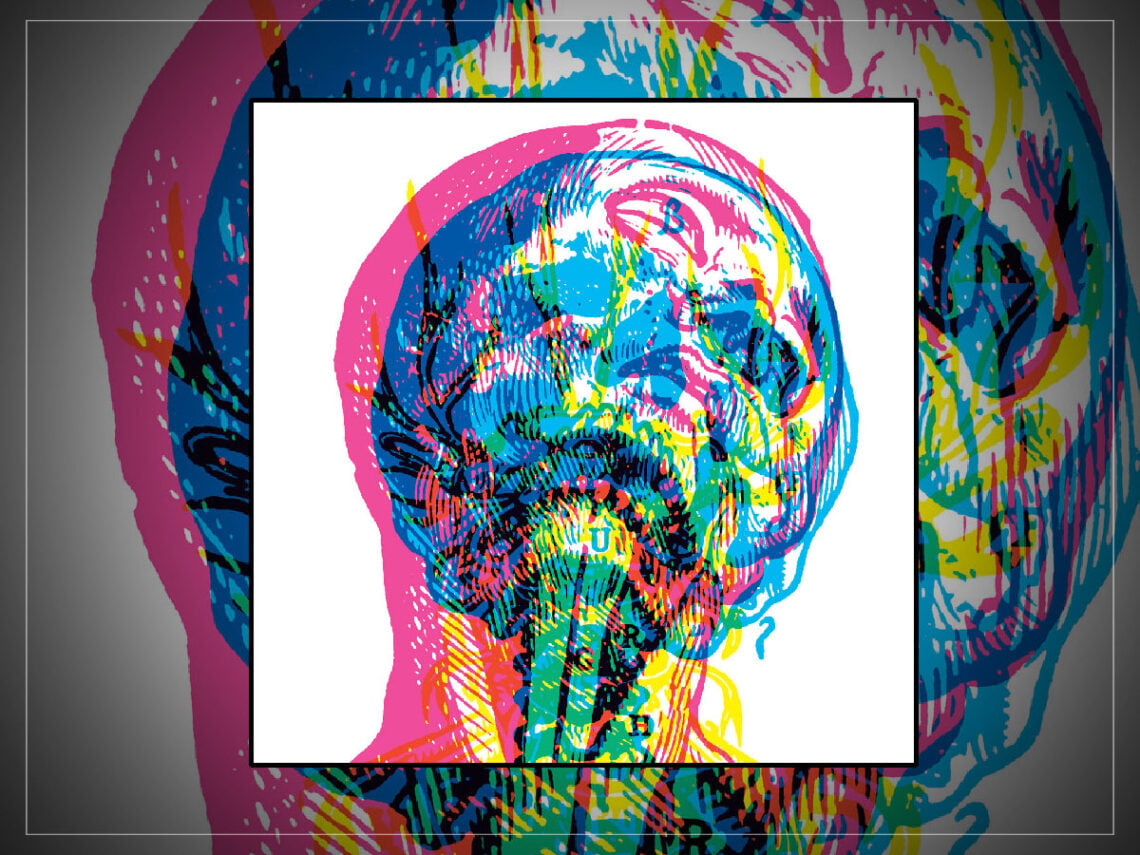
Mandy, Indiana – ‘URGH’ album review: Clear-cut commotion in a time of crisis

On their second full-length, which doubles as their Sacred Bones debut, Franco-British four-piece Mandy, Indiana have made a disparate, yet impressively streamlined, noise-rock nexus in a world fast slipping from our understanding.
The Skinny: On their 2023 debut album, I’ve Seen a Way, Mandy, Indiana, consisting of vocalist Valentine Caulfield, guitarist and producer Scott Fair, synth player Simon Catling, and drummer Alex Macdougall, somehow wound their way up on the FIFA soundtrack. Their distinct French-led noise-rock, scrutinised at an unprecedented scale, stuck them with an oddball label. It’s one they remain committed to on a phenomenal follow-up that blows any previous criticism out of the water.
URGH throbs with carefully curated commotion as an artistic rendering of the visceral throngs of discomfort. ‘Ist halt so’ touches upon the urgency of protest movements, referencing the genocide in Gaza in a way that isn’t gestural, but instead indicative of URGH’s own politics, one of concurrence to the atrophying global stage. There is no turning away from a pursuit in fear of getting it right. Mandy, Indiana, has traversed every boundary and come across the edge.
Though Caulfield’s vocals are a clear album standout, they never vie for too much attention in a musical economy already primed to sound its fullest with the least possible moving parts; on ‘A Brighter Tomorrow’, for example, with a melodic, moaning cadence, Caulfield collects the slower energy and charges it with a delirious disconcertment. In comparison, on ‘Dodecahedron’, Caulfield delivers a more emotionally sincere performance, which magnetically ties the disparate influences together. As such, rapper Billy Woods’ surprise appearance on ‘Sicko!’ feels a little misplaced in the overall project, but is at least more than most on the album, ready for the dancefloor.
In this way, one of the album’s biggest feats is its spatial awareness, its internal geopolitics, as the four-piece wrote most of the album during an intense residency at an eerie studio house on the outskirts of Leeds, then recorded across Berlin and Greater Manchester, and on the first track, we are thrown headfirst into the spatial matrix of the new order: a tormented, industrial pummel introduces an idea of the metropolis, while experimental percussion shudders beneath, Berlin-style EDM swirls in and out of focus, and, curiously, a string segment sticks the landing with an air of disorientation. Maximalist production bombastically juxtaposes minimalist songwriting.
The band recorded in unfamiliar territories, sure, but the disorientation stretched into the physical: Caulfield was diagnosed with a rare eye issue, which had caused her to lose the majority of vision in one eye during the making of the record, while Macdougall described his playing as a means of “survival” over an intense three-day recording session. The doomsday clock is ever later, the world is nearing its edge; so too are the people in it.
The noise-building also reflects our new habits of consumption; deconstructed feedback loops unfurl on ‘Life Hex’, while the band’s only English-speaking song, closer ‘Curser’, struggles to assert vocal dominance over a trenchant synth siren. From here, a friction explodes the meaning outwards, at once fragmenting a tenacious palette and exposing our distraction to the othered symbol, the siren sound, to the song’s meaning, one of toxic boy’s club culture.
In the album’s final moments, we hear one last repetition from Caulfrield: “They’re all fucking crazy man,” she spits, after which the song stops dead, and the album ends. Who are “we”, who are “they”? A statement uttered by most for infinitely different contexts simultaneously unites, disturbs, and disconnects the language from its hermeneutic power. What is left? A confrontation of crisis. Finally, a band has been brave enough to capture it.
The Verdict: A parlay into oblivion, or more aptly a confrontation of crisis, URGH, as its namesake suggests, is reactive: an injection of disgust or fatigue, a response to the crossing of a boundary, an expression for when our usual polite codes won’t quite do it anymore, and all hell must break loose.
Defining Track: ‘Life Hex’
Release Date: February 6th, 2026 | Producer: Scott Fair | Label: Sacred Bones

Never Miss A Beat
The Far Out New Music Newsletter
All the latest New Music from the independent voice of culture.
Straight to your inbox.