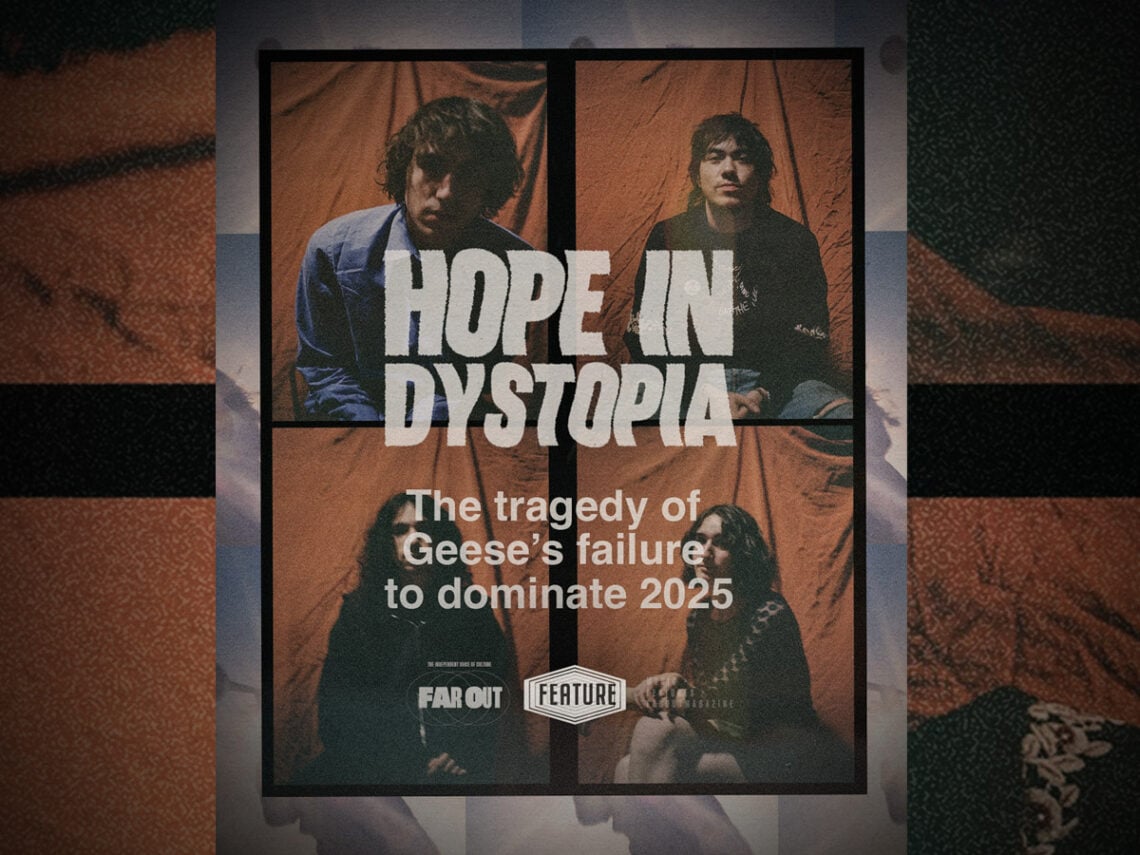
Hope in dystopia: The tragedy of Geese’s failure to dominate 2025

Geese presently generate 1.8 million monthly listens on Spotify. Cameron Winter gets 1.2m. Three million in total is far from shoddy, but it is one million less than Thousand Foot Krutch. It’s also half of what Mud get, less than a third of what Sixpence None the Richer get, and it is only 2.5% of The Weeknd’s total.
Nevertheless, it is the year of Geese. The New Yorker asserted that they “won 2025”. Such headlines celebrating them feel vital for the whole music ecosystem, hailing the arrival of alternative music’s new heroes, necessary frontrunners hopefully drumming up a movement behind them… but the facts are inescapable: Sign Crushes Motorist get 17% more plays than ‘the new saviours of indie’.
So, how have they seemingly dominated 2025 for so many of us? Why is this not ratified by the stats? And what does any of this mean? I spoke to algorithm experts and psychologists to find out. They left me dismayed, but Geese gave me hope…
In short, the bulk of the population has stopped discovering new things. I texted my pal recently. We’re the same age. We both grew up on the Arctic Monkeys. He’s the best musician I personally know. In short, he’s the perfect candidate to be all aboard the Geese train. But at some point around the advent of social media, our cultural lives diverged.
I’m not even sure who he’s into these days. So, when I asked if he’d ever heard of Geese, it came as little surprise when he replied, “Can’t say I have, but I’m pretty sure you’re getting mixed up with the name of a bird”. He’s usually funnier. But bad puns aside, how can you have Chris Murphy of Sloan comparing the rise of Geese to that of Nirvana, and yet a 33-year-old indie fan who plays part-time in a band has never even heard of them?

Simply put, my friend’s algorithm is now different to mine, and seemingly, Chris Murphy’s. Therefore, his reality is too. We now spend 40-47% of our time looking at screens. And these screens, and the content they share, are not collective. Half of our waking hours are unique to us.
Well, not that unique, of course, you’ve clearly seen the year of Geese unfold, too. But for my friend, it has been the year of Sam Fender since the birth of his second child about three years ago. He’s too busy to find new cultural experiences himself, and he’s too tied to a pre-constructed algorithm for them to find him.
This means that even Geese, the band ‘who won 2025’, only won it within a specific discrete feed. Their rise was comparable to Nirvana’s explosion, and that proved so joyously refreshing that everyone from Billy Corgan to Marc Maron and Nick Cave all went cockahoop about the new kids in town – but this feverish whirlwind of adulation was like a heatwave in Vanatu to my friend, wrapping up warm in Newcastle. So distant that he didn’t even notice it. Very few people actually did. Three million monthly listens is the sad proof of that. They were a frenetic explosion for a fraction of likeminded populace.
If you break down the maths of the matter and say that fans currently enamoured by the supposed biggest thing since Nirvana listen to Geese/Winter 15 times per month, a fair number to equate to modern music’s latest ‘saviour’ rupture, then that means that there are roughly 200,000 folks worldwide who exhibit behaviours that align with the narrative of Geesemania.
That’s not many.
And these people are scattered across continents. Yet, they are also connected by algorithms. In the process, their realities become distorted from the truth that surrounds them. ‘How can Geese not be huge?’ they ask, ‘My feed is blowing up with them. Their poster is all over the London underground for God’s sake!’ But right next to that poster was another for JP Cooper that you never noticed. Someone with a different feed did.
And based on the data, you could argue that there’s more than double the amount residing in that particular bubble, believing JP’s had a huge breakthrough year, too. Yet, if a friend texted me saying, “Have you heard of JP Cooper?” I’d probably reply, “The unsolved mystery hijacker guy?”
Why is this a major problem?
I spoke to the algorithm expert, Dr Nick Seaver, and he laid out the first issue with the bulk of our culture coming from algorithms. “The criticism is that these systems are fundamentally conservative because they are based on data that has existed in the past, so they are always going to be repeating the past to you. But it’s not obvious where the new stuff comes from,” Seaver explains.
“In theory, we are technically conservative as humans – when we’re looking for new stuff, we’re not usually looking for something that isn’t like anything we’ve ever seen before.” So, in short, it’s almost a miracle that the monumental noise (for about 200,000 people) surrounding Geese managed to break through. After all, the band have been around a while, and though there’s certainly been buzz over previous releases, you’d be hard-pushed to say it was enough to overhaul a conservative recommender ecosystem.
And as Seaver hinted, most people aren’t truly looking for Geese. Culture that we already know, inherently, has a comforting appeal. “Research shows that repeated exposure to the familiar can reduce cortisol, our primary stress hormone, which explains why comfort media is so often revisited,” the psychologist, Dr Michael Swift, explains.
Stress is abundant in modern society. In a dystopian, cyclical loop, it’s constantly further reinforced by the same screens we spend 40-47% of our time turning to for relief. Take my aforementioned friend, for instance: he’s got a new mortgage (then he reads about the impending AI-driven economic crash) – his kids are screaming, so he calms them with an iPad (then he reads about how it’s frying their brains) – he flicks on the TV for some escapism (only to find out Russian planes have breached NATO airspace). It’s never fucking ending!
Is it any surprise that when he takes out his phone in the sanctuary of the bathroom, his immediate thought is to soothe his cortisol with something safe, comforting, and knowable, rather than seeking out the caterwauling wail of the latest indie hero, of which he has already seen about seven come and go in his hectic 33 years? It was Brat summer last year, and he didn’t leave his feed to find out what that was about, either.
Yet, there is a dark side to this deeply human behaviour that algorithms are unfortunately amplifying. As Dr Swift explains, “Leaning too heavily on one comfort album can narrow our cultural diet, limiting opportunities for novelty, which is crucial for psychological growth.”
In order to be truly healthy, we need to experience something new every now and again. And that’s even more true for society at large.

Why do Geese offer hope?
That’s why, although the books might have been cooked by press pronouncements over Geese’s popularity and wider impact, for three million folks, there was something truly hopeful about the hubbub. It wasn’t just the fact that they offered up a brilliant, unique album worthy of recognition, but that those folks, in turn, noted the vital need for this newness and celebrated it unguardedly.
The late philosophy professor, Mark Fisher, noted, “There can be few who believe that in the coming year a record as great as, say, the Stooges’ Funhouse or Sly Stone’s There’s A Riot Goin’ On will be released. Still less do we expect the kind of ruptures brought about by The Beatles or disco. The feeling of belatedness, of living after the gold rush, is as omnipresent as it is disavowed.”
That sentiment – that it is utterly unthinkable that the new Beatles will come along in 2026 – has felt eerily exacting for too long. Because with this sedate acceptance of diminishing returns disappears the chance for culture to drive change. It did that in the days of The Beatles. It hasn’t done it since. While that might be largely circumstantial, the extent of the acceptance outstrips that.
And while the figures pale in comparison, the slight whiff of mania about Geese/Winter, borne out of how joyously unique their music has proven, offers a glimmer of hope that we’re ready to embrace novelty, revere art, and find a semblance of communal culture-driven transfiguration once more… even if it is only confined to a niche echo-chamber presently.