


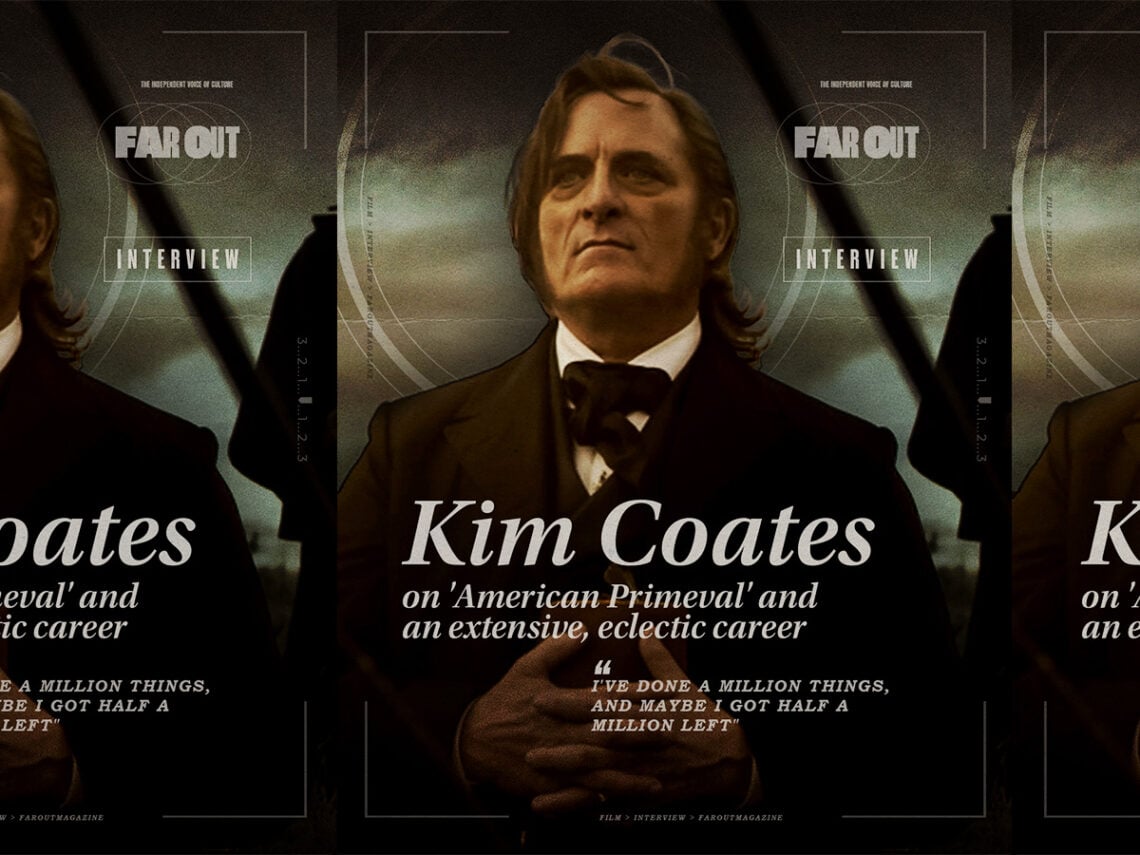
“I’ve done a million things, and maybe I got half a million left”: Kim Coates on ‘American Primeval’ and an extensive, eclectic career

If you’ve watched a movie or TV show at any point in the last 30 years, then there’s a high probability you’ve seen Kim Coates onscreen at least once, with the veteran character actor becoming a ubiquitous presence across film and television, working alongside some of the biggest names in the industry.
Tony Scott’s The Last Boy Scout, Kevin Costner’s Waterworld, Michael Bay’s Bad Boys and Pearl Harbor, Ridley Scott’s Black Hawk Down, Prison Break, Smallville, and, of course, Sons of Anarchy are just a very small sampling of Coate’s most notable credits, with his latest role plunging him into America’s past in the Netflix series American Primeval, created by The Revenant writer Mark L Smith and directed by Lone Survivor‘s Peter Berg.
Unfolding during the height of the Utah War in 1857, the blockbuster-sized series explores the fight to seize control of the American West, with Coates cast as Brigham Young, the religious leader and politician who was the first governor of the state and the second president of The Church of Jesus Christ of Latter-day Saints after founder Joseph Smith. A grim, gritty, and unflinching snapshot of a time period that shaped the nation’s future, Coates kept the character close to his heart for longer than he’d initially imagined.
“I got offered Brigham Young in November 2022, if you can believe it, and we started filming in February 2023, and we had to stop filming in July 2023,” he said. “Thank goodness my part was done with that long, blonde, crimson, crazy freaking hair. So I was done, but because of the actors’ strike, we had to wait seven more months before they could get back at it and finish the whole thing off in March/April 2024. So here we are, in 2025, and it seems like I’ve been having this guy in my head for a long time.”
Relative to the number of characters he’s played, Coates hasn’t embodied a huge number of real-life figures like Young. Bringing somebody like that to life required a different approach to building a character compared to other roles where the people he played were entirely fictional and created on the page.

“This is completely different,” Coates explained. “Whether you know anything about Mormonism or the Book of Mormon, or Joseph Smith, this guy really lived. He really had 57 wives by the time he died at 77 years of age, and he was the one who was responsible for making sure that the Mormon way of life and the Mormon religion continued after the death of Joseph Smith. So I was scared shitless.”
“When Peter Berg offered me Brigham Young, I went, ‘What? Are you kidding?’ When I read the scripts and looked at Brigham Young and what he looked like at age 56, I could see he had blue eyes. He had a stare that could go right through you. He was a little shorter than me, a little heavier than me, but by the time I dyed my hair and read all the biographies, autobiographies, and novels on him, I felt like I could start to process who he might be.”
“I was in it,” he declared. “I was in it big time, and I’m not religious at all. I’m a very spiritual man. I believe in something out there, but I have no time for organised religion. But to be offered this part and to bring truth to this part as best I could was a challenge, and I was really grateful for the chance, and I’m really glad it turned out.”
One challenge actors can face when playing a real person is the lack of material available. Coates may have read books on Young, but did the lack of first-hand accounts detailing his cadence, personality, or physicality pose any issues? Or, in a strange way, did having less to work with give him more to work with in terms of putting his own stamp on the character?
“There’s no art, there’s no audio, there’s no film, there’s no anything on him other than the paintings and the odd photograph,” Coates acknowledged. “I think it was the second prophet after Brigham Young died in the early 1890s that there was the first audio recording of him talking at the pulpit. And I remember when Judy Dickerson and I, the vocal coach, started really getting into how he might sound.”
Coates called the recording “paramount” to his process because “all these men, all these apostles of the Mormon religion, they all came from Pennsylvania and New York and southern Canada.” Beyond that, Coates enjoyed the “freeing” aspect of having a semi-blank slate to work with before using the character’s appearance as his entry point into crafting his performance.
“Once I got all that down, I really got to think about the biblical sense, how he thinks he’s God, how he was protecting his flock,” he offered. “It was very freeing to bring my take on him because no one knew how he really was other than what I read. I had a lot of help with the books I read. After that, you’ve got to throw it all out, and it’s just got to be Kim Coates playing Brigham Young. And I guess I did alright.”
One of American Primeval‘s biggest selling points, for both its cast and captive audience, is the immersion: almost the entirety of the series was shot on location with practical sets and minimal visual effects, something that Coates relished as an actor who wasn’t so much turning up on set as walking into a living, breathing world.
“I was in luxury,” he remarked of having it a lot easier than several of his castmates. “I was on this incredible 17-hand high horse called Phoenix, surrounded by Mormon militia. I barely got dirty. I was the puppet master, in a way. Brigham Young: he orchestrated this. Whether you want to believe he completely orchestrated the Mountain Meadows Massacre or had something to do with it, or maybe you believe he didn’t have anything to do with it at all. That’s up to you. But the physicality, I have to say, I don’t know how they did it. There’s no CGI; there’s no special effects.”
“I mean, maybe there’s a couple with the bows and arrows,” he clarified. “But other than that, there was no green screen. There’s no soundstage. They were out there. We were all out there, and that fort, Fort Bridger, was built to the exact dimensions of that fort back in 1857. They made sure it was built the same with all the things they read and all the photos they had. That was the real deal.”

“I’ve done, as you know, a million things: movies, TV, stage, and maybe I got half a million left, we don’t know. But I have to tell you, I’ve never, ever been in something that’s been this physical and this palpable. When you’re watching this, you feel what those people are feeling. I’m just very proud to be in something that was that physically demanding. To get it up on the screen was a very hard, hard, hard thing to do. And Peter did it, and I’m just so proud to be in it with him.”
The world of American Primeval is far from black-and-white, but clad all in black and constantly lurking in the shadows of the story even when he’s not onscreen; there’s more than a hint of Dracula about Coates’ performance as Young. It was intended as a compliment, and thankfully, the actor was in full agreement.
“Well, thank you, brother. I agree. I’ve been saying that,” he concurred before revealing his expertise on the subject. “I’m stealing what you just said. I’ve been talking about it. I have this sneaking suspicion. I mean, I’ve been in Dracula. I’ve played Dracula on stage. Dracula is hardly in the play, but they talk about him. And when he is on stage? Forget about it. You can’t take your eyes off him.”
“Brigham Young, I did not play him as a villain,” he elaborated. “I did not play him any other way than what was written and what I learned from him in all the books I read; that’s what I was giving truth to. So people can have their own opinion, but I agree. There’s no question about it.”
He might tick a lot of the boxes associated with an antagonist, but it’s unfair to call Young the villain of the piece. In fact, American Primeval doesn’t really have one. Instead, the series is about the characters doing what they think is best for the future of their people, regardless of who they are or what they have to do.
“Your observations are dead on, like, dead on,” Coates approved. “How did anyone survive in 1857 in America? How did anyone survive? The Mormons are looking for a place to live where they can do their thing. They were trying to survive and just go their little niche nook of America and just do their thing. That’s what they wanted. They didn’t want to bother anyone. They wanted to do their own thing, and so they were being persecuted. There’s no question about how they survived and how they wanted to do it their own way.”
“Their beliefs at the time were way, way to the opposite of that Christian one-wife thing that was going on in America. And the Native Americans? I mean, they’ve been brutalised since Columbus, since way back in the day. So how they were trying to survive is just something that all of us have read a little bit about. I’m a history major, so I know a lot about it. I don’t know how they could even live as the white man continued to move West. It must have been very difficult and very horrifying and scary and different, but that was America. It was just a violent, violent time, no question about it.”
Throughout his career, Coates has played many memorable parts in many memorable projects. American Primeval‘s Brigham Young is merely the latest addition to the collection, but the character actor extraordinaire accepts that one role has exceeded the others in terms of getting him recognised and stopped in the street.
“Before Sons of Anarchy: ‘Oh, you’re the guy in Waterworld. Oh, you’re the guy from The Client.’ Oh, you’re the guy from Goon. Oh, wait a minute: Pearl Harbor, Black Hawk Down. Didn’t you get cut in half?’ But it was always, ‘You’re that guy’. But once Sons opened, I became Kim Coates.”
“I think I had no idea of the power of television,” he suggested. “I was never really searching for a regular on TV, and to finally say yes to playing Tig Traeger was a change of pace for Kim Coates because I had no idea. That show: millions and millions of people around the world continue to watch it. I can’t go anywhere without Tig. I would say that Tig Traeger from Sons of Anarchy, Bad Blood. I’m very proud of Bad Blood. I mean, I’ve done so much for Netflix, right? Godless, Scott Frank, incredible limited series. You know, 11 or 12 Emmy nominations. I think we won four. Not that it’s about that, but why not?”

“I’m very, very happy to be recognised. I love my fans,” although there is a caveat. “Just don’t bother me when I’m eating dinner.” It’s been over a decade since Sons of Anarchy ended, and thanks to streaming, the show continues to win new converts every year, longevity that Coates could have never predicted.
He’d never revisited the motorcycle drama until co-star Theo Rossi started the Reaper Reviews podcast, where he and Coates rewatched the series from start to finish. “It blew my mind,” the actor confessed. “I finally understood why it was so popular. It was so, so different.”
“Kurt Sutter and his crazy writing, which turned out to be just so unbelievably violent, and yet, people could not get enough of it. The whole Hamlet-esque ending in the storyline. I’m still surprised that people are finding it for the first time because I was lucky enough to be on a massive hit television series. It went on for seven years. That was very rare.”
Going even further back, Coates’ first major Hollywood blockbuster was 1991’s The Last Boy Scout, in which he gets a memorable death scene at the hands of Bruce Willis. Working with an A-list action star and a director like Tony Scott, with Joel Silver as the producer and Shane Black on scriptwriting duties, was about as big as it got at the time, which wasn’t lost on the actor.
“I just finished Broadway,” he recalled. “I took over for Aidan Quinn playing Stanley Kowalski in A Streetcar Named Desire for three or four months. Then Hollywood discovered me, and I’ve never looked back. Bruce Willis, we know what he’s going through now, and it’s just so, so tragic and so sad. To work with him a couple of times like I did and get to know his family and his daughters, I’ll never forget that time.”
“And he was a massive movie star, just a massive movie star. And he is today, but back then, he was a massive movie star. To work with him and do that scene: ‘Touch me again, and I’ll kill you’. ‘Boom-ba! Oh, baby!’ It’s been a really good run for Kim Coates, that’s for sure.”
Several years later, he’d pull his weight in launching one of the modern era’s most successful careers. After all, Will Smith had never played the leading role in a movie and never starred in an action flick before taking top billing in Bad Boys. Who’s ass does he hand to them in the opening scene to immediately establish his action-hero credentials? That’s right: Kim Coates.
“Yes! He should be calling me and thanking me,” came the enthusiastic response. “I’ve done three or four movies with Michael, and I had turned that movie down. I was going to play a different part. I was going to play like a second-leading bad guy. I’d been offered another movie at the time with Jon Dahl directing, and it just seemed to be the better thing for me to do. And so, I wasn’t in Bad Boys.”
Obviously, he was, and he’d made quite the impression on its director. “Months go by, and I get a call from my people saying, ‘The movie doesn’t work at the beginning. It doesn’t work. They want to reshoot the beginning. Would you? Would you?’ I went, ‘Of course I would’. And we were in LA for a day and a half filming that little beginning sequence. It was a fun, fun day.”
Unfortunately, no walk down memory lane would be complete without bringing up Battlefield Earth. Widely regarded as one of the worst movies ever made, Coates played Carlo in the notorious critical and commercial disaster, which he’s adamant is nowhere near as bad as everyone says it is.
“I don’t think about Battlefield Earth that much,” which is fair enough. “You know, that book was on the number one bestselling list in the early ’80s. It wasn’t about Scientology. It was really a great science-fiction book, even though we know who wrote it. So that’s fine. So you do the movie. Roger Christian? What an incredible human being. Directed that thing beautifully. Wasn’t the greatest film. Yeah, there’s no question.”
“But it wasn’t as bad as people say it was,” came the addendum. “There’s no way it was as bad as people say it was. We got a raw deal. The press was all over it early. They wanted to crush it. John Travolta was on a high; they didn’t want to get too high. That’s what the press does. They find something, and they freaking stick a knife in it right away. I don’t talk about it much. I don’t think about it much, but I don’t mind when people bring it up because it wasn’t as bad as people said.”
With extensive experience across stage, film, and television dating back decades, Coates has pretty much seen and done it all. However, if someone asked him which performance they should watch first to get the definitive Kim Coates experience, it comes burdened with bad news because it wasn’t recorded.
“You can’t because it’s already been done. It’s on stage. I did a Mark Rylance play by Jez Butterworth called Jerusalem. Butterworth did not give out the rights to anybody. And there were producers in Toronto in 2017, and they wanted me to play Rooster, the lead. And I said, ‘I read it and didn’t understand it’. It was crazy. It was long. It was funny. It was my daughter Brenna who said, ‘Dad, you have to play this guy’. And so I did, and you couldn’t get a ticket. It’s the most emotional thing I’ve ever done in my life. And to meet Mark, hang with him, have dinner with him, and have him pass the baton to me was something I’ll never forget.”

“And then a movie? King of Sorrow. Damian Lee. Brilliant, brilliant Canadian artist, writer, and director. Cast in the lead of a real cop, a bit of a dirty cop, but he wants to save the streets from the crime and drugs, and what I went through to do that film.” Unfortunately, despite featuring a personal favourite performance by Coates, he doesn’t think anywhere enough people saw it.
“It was too powerful and too crazy for the Toronto Film Festival at the time, which was sad. I can’t tell you the amount of character actors like me around the world that people haven’t seen. We won the Pasadena Film Festival for King of Sorrow back in the day, but Toronto said no. I’ve never forgotten that fear they had in not releasing that film at that time because it was radical and brilliant, and we did it on a shoestring and a prayer. King of Sorrow, I guess, is a movie that I wish people would look up.”
This far into his career, Coates doesn’t have a wish list of actors or filmmakers he’s desperate to work with; he just takes it one script at a time. “I don’t really think that way. I’ve never been afraid to fail. I’ve never been afraid to work with anybody. Obviously, it’s about the written page for me to say yes or no. Luckily, I don’t have to audition much anymore, just for the big Marvel films it seems, which I don’t seem to get. I don’t know why, but I get offers all the time.”
“I’d never met Peter Berg before,” pointing back towards American Primeval. “I knew of him. The point is, I was dying to work with Peter Berg, and all of a sudden, I’m working with Peter Berg for five, six months. I’ll never forget it. And you mentioned Tony Scott. Ridley and Black Hawk Down. I’ve worked with both Scott brothers. I’m very lucky to work with the amount of directors I have, female and male. And I guess I’m not stopping anytime soon.”
To that end, Coates pointed towards an upcoming role in The Walking Dead: Dead City as the recurring character Bruegel and a complete change of pace in the European caper, Solo Mio. “I just finished a film with my boy, Kevin James, who I wish I could do every movie with. He’s just that much of a funny, brilliant brother of mine.”
As for the movie? “Chuck Kinnae directed it over in Rome: romantic comedy. Kim Coates in a romantic comedy? Put your seat belts on, folks. No swearing? No pot? Here we go. What a time that was. Look, I’m not slowing down anytime soon, and I’m good; I’ll work with whoever’s out there at the time.”
That said, there is one role remaining on Coates’ bucket list, and it’s one that’s very close to the heart of the Shakespearean veteran. “I would love to play Iago in Othello. I’ve seen that done so rarely over the years. I was at Stratford myself. I was the youngest Macbeth ever. I was 27 at the time, directed by John Neville.”
Adding, “Iago is one of those characters who are so conniving and brilliantly written, one of the greatest canons of writing that Shakespeare ever had, and I’m at the right age now. So, maybe if I’m silly and crazy enough, I will. I will continue to put that out there, and all my producers want me to continue to come back to the stage because that’s where it all began for Kim Coates, so maybe. How about that?”
Looking at what he’s achieved in his career, it would be foolish to bet against him.
