


The empathy of a severed hand: a journey through loss and connection in ‘I Lost My Body’

Roger Ebert famously said that movies are like a machine that generates empathy. You might be stuck with the body you were born in and the family and experiences you grew up with, but disappearing into the world of a film allows you to immerse yourself in a completely new reality. Jérémy Clapin’s 2019 animated film I Lost My Body is one of the greatest examples of Ebert’s words. Centred around a severed hand as it navigates the streets of Paris in search of the body it once belonged to, the movie turns the most mundane parts of the world into a riveting drama of fear, revelation, and tenderness.
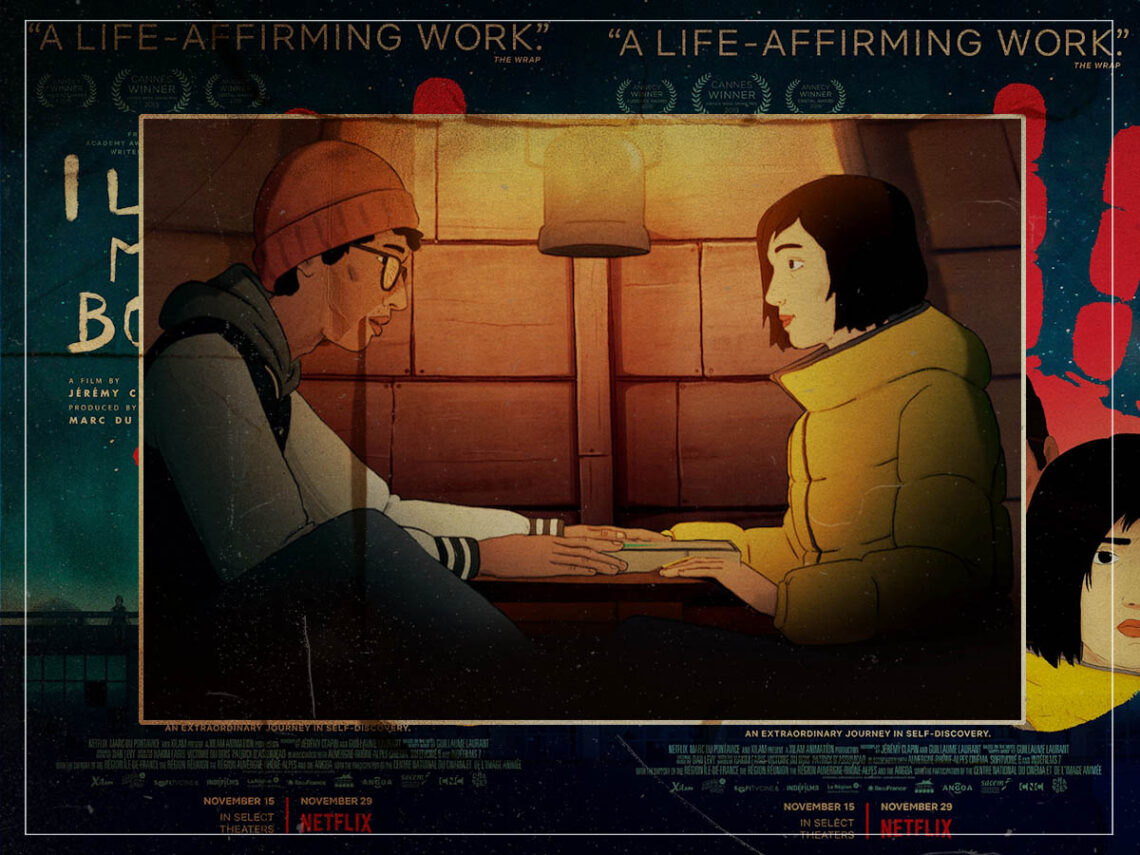
I Lost My Body is split into two alternating narratives. In the first, the hand escapes from a lab and navigates the treacherous streets of Paris, all the while remembering in flashes its life with the body it used to be a part of – playing piano, letting sand slip through its fingers, spinning a globe. In the second, a young man named Naoufel remembers his childhood, which was defined by the car crash that killed his parents. In the present day, he struggles to hold down his job as a pizza delivery man and reconnect with the wild ambitions he had as a child. When he meets a woman over an intercom during a delivery, he discovers that her uncle needs an apprentice in his woodworking business, and he takes up residence above the workshop.
Although Naoufel’s story features a powerful emotional journey, the most poignant moments in the film are centred on the hand. Its journey is without dialogue. With no face or voice to express recognisable emotions, the way anthropomorphised objects in a Pixar or Disney movie often have, it emotes through movement. In certain moments, the audience sees the world from the hand’s perspective, peaking through its fingers as it scuttles across the ground. At other moments, it’s seen from a third-person perspective. Through its movement, the hand shows a strong sense of individuality, awareness, and evolution throughout the film as it initiates the search for physical and emotional resolution.
When the film begins, the hand moves like a spider, its fingers acting as legs and its palm shrinking from noise and light. It battles rats under a subway platform, escapes a trash compactor, and falls into a rushing, ice-covered stream, its fingernails scraping desperately against the underside of the frozen surface. When it ventures into an apartment to search for the source of piano music that is wafting onto the street, it’s mistaken for a rodent.
As the film progresses, however, the hand loses its animalistic qualities. Instead of fighting for survival at every turn, it begins to discover parts of the world that stoke wonder and intimacy rather than fear.

In one scene, the hand is trapped in an apartment and ventures into a room with a sleeping baby. A point-of-view shot from the hand’s perspective shows that the room is quiet and still, except for a gently spinning mobile over the baby’s cot. The hand rests by the door for a few moments and then, framed from above, tentatively makes its way toward the cot.
It begins to climb, finger by finger. The baby turns, opens its eyes, and briefly watches before falling asleep again, unconcerned by the intruder. It drops its dummy on the floor, and the hand retreats. Instead of running away, however, it re-emerges with the dummy and slips through the bars of the cot. It places the dummy back into the baby’s mouth and rests on the infant’s chest for a moment. In close-up, you can’t see that it’s a severed hand anymore – it could just as easily be a parent coming inside to rest their hand briefly on their baby before going back to bed.
The hand moves one of its fingers towards the baby’s face, and the infant reaches out with its little hand and grasps it reflexively, tightening its grip around the finger as it continues to sleep.
Unlike the hand’s previous interactions with the outside world, there is nothing frightening about this moment. It’s an encounter full of tenderness that unfolds with the smallest of movements. It illustrates the yearning of the hand for human connection, but also conveys an overwhelming sense of peace and intimacy.
The scene demonstrates the intrinsic humanness of the hand. Like the memories that crop up throughout both the hand and Naoufel’s journeys, the hand is an integral part of a person’s life. It’s how we wordlessly communicate with those we love, and it’s how we discover the outside world. There is nothing macabre about the scene, which is a testament to mastery with which it was created.
In an interview following the film’s rapturous reception at the Cannes Film Festival, Clapin talked about how he changed the source material – a short story in which the hand is the narrator – to create a more emotive central character that could transcend language. “The film is really sensorial,” he explained. “It’s hard to talk about sensoriality in a book, and cinema helps us to talk about touch, about sound, about our relationship to the world.”
His use of the hand went beyond the specific characteristics of the specific part of the body, though. In an interview with The Hollywood Reporter, Clapin talked about how the hand and its desire to reconnect with its past were metaphors for something bigger. The “fantastic element” of a sentient hand prompted the director to think about his own past, and he hoped that it would prompt audiences to do the same.
“The film has a really universal theme with the past, memory, our relationship with our childhood and what we lost with childhood,” he said. “In the end, we all want to take back this missing part. At the same time, we have to try to be a better version of ourselves.”
In the film, the hand does finally find its way back to its body – Naoufel. But although it tries to settle back into its original place, it discovers that there isn’t a home there for it anymore.
I Lost My Body explores loss and a search for connection through the most unconventional of characters. By focusing with minute detail on the hand, however, it generates a powerful sense of empathy. Without the barriers of language or personification, the ambiguity allows the film to cut through any intellectual response and go straight to the emotion. It’s a balm for the soul when it feels like the human world is tearing itself apart, a reminder that connection can take place in the smallest of moments, no matter how immense the loss that preceded it.
