


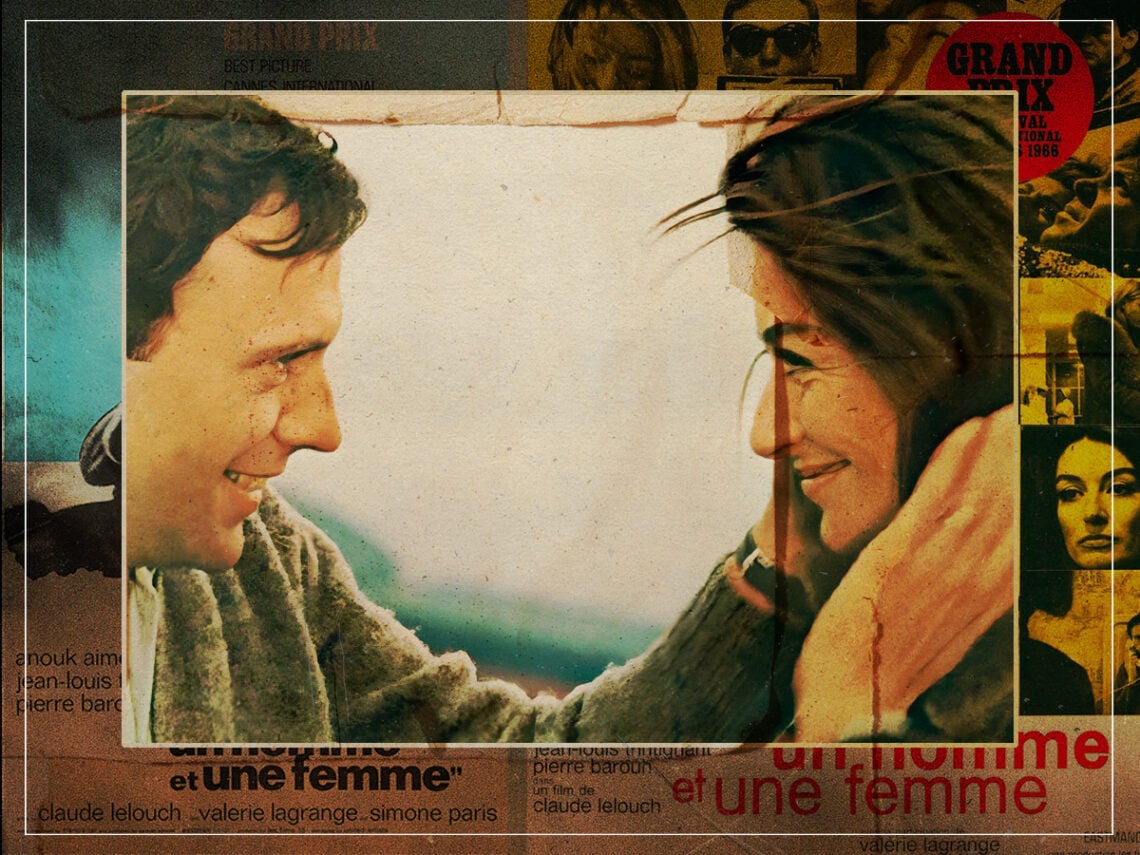
The past can haunt the present: grief, memory, and romance in ‘Un homme et une femme’

Love, for many, is the reason for existing. It makes the world go round, that feeling of total security and devotion to another person who understands you like no one else. The experience of being in love, trying to find it or falling out of it has defined countless works of art for centuries, from paintings to songs to films.
Cinematic tales of forbidden love, couples meeting in hopelessly romantic situations, and complicated love triangles have made us both swoon and weep for decades. However, many romance movies, particularly those churned out by Hollywood, often feel slightly overblown, with unrealistic circumstances (Serendipity), overdramatic displays of affection (10 Things I Hate About You) and tragic endings designed to make us cry (Titanic) defining much of the genre.
Yet, the experience of watching 1966’s Un homme et une femme delivers a completely different feeling. It’s a movie that feels genuinely romantic in every sense of the word. It’s intimate and simple, charting the blossoming relationship between two widowed characters whose children attend the same boarding school. Directed by Claude Lelouch, the film feels wholly personal and realistic, with Frances Lai’s score moving between playful moments and tenderly emotional cuts.
The movie utilises different film stocks, with black-and-white scenes leading to ones in colour. Although this was largely the result of budgetary reasons, this variation, including the use of both 35mm and Super 8, stops us from thinking about the movie with a sense of linearity. We’re made aware of these fragmentary memories from the past and how they interact with the present. The film follows Anouk Aimée’s Anne, a script supervisor, and Jean-Louis Trintignant’s racing car driver, Jean-Louis, as they begin a relationship despite both losing their spouses a few years prior. Anne is haunted by memories of her previous husband, who died in an accident on a movie set, which she happened to witness. Thus, Lelouch uses another fragmentary technique – flashbacks – to tell each character’s backstory, allowing these scenes to weave into the present day.
Time is not as linear as we think. The film suggests that the past can haunt the present, but these memories can coexist with new ones—they don’t have to be locked away in the backs of our minds. You can still grieve while experiencing the joys of a new love, which Anne soon comes to realise.
When the pair first have sex, Anne is distracted by thoughts of her past husband. By acknowledging her love for Jean-Louis, she comes to realise that she’s moving forward with her life, away from that initial stage of grief where it feels as though no one else can fill their place. It’s a complex realisation – one that Jean-Louis can’t quite understand for a start – but Lelouch treats this exploration of grief with great tenderness. Anne inevitably realises that Jean-Louis isn’t a mere replacement. He’s someone entirely new who can offer a different experience of love and help her rediscover happiness.
There are some incredibly beautiful scenes of the pair on the beach, with Anne appearing to unlock a sense of fulfilment as she holds him close and watches her child play with his. Lelouch encouraged Aimée and Trinignant to improvise during certain scenes, and the chemistry between them is blindingly apparent. Humour and romance intersect as the characters fall for each other, and you can’t help but hope they’ll ride off into the sunset together in Jean-Louis’ racing car.
The final scene of Un homme et une femme should go down in history as one of the most romantic scenes ever put to film. After a lovely time spent together and their love for each other declared, Anne goes back to Paris alone when she realises that her ex-husband still haunts her mind. Little does she know, however, that Jean-Louis has bolted down to the station in his car to surprise her when she steps onto the platform – knowing that they’re meant for each other.
It’s a moment of true understanding. Despite her admitting that their sexual experience was clouded by grief, Jean-Louis knows that with time, Anne will be able to overcome this. He’ll wait for whenever she’s ready, knowing that they’re too connected and well-suited for each other to simply throw the relationship away.
So, as the train pulls in, we follow Jean-Louis from behind as he weaves through people to find her, and when Anne finally appears, she looks genuinely shocked. Lelouch had actually hidden Trintignant from Aimée so that when she saw him, her surprise would be as real as her character’s. They embrace, and the handheld camera spins around them – something that had hardly been done before – sweeping us away in their romance.
Watch the trailer below.
