


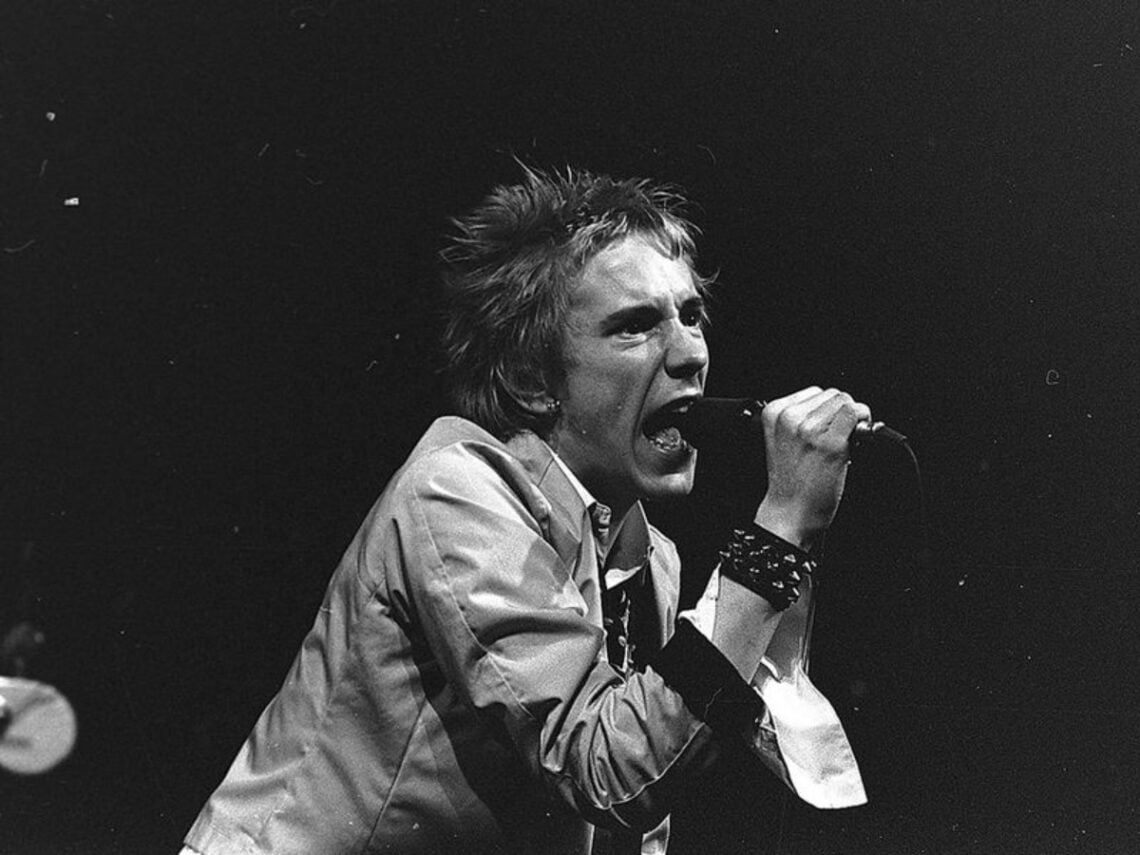
John Lydon’s cutting take on the Manchester Britpop scene: “It’s very incestuous”

If you subscribe to John Lydon‘s school of thought, the only two revolutionaries in history were himself and Mahatma Gandhi. Hell, when we caught up with him recently, he even referred to Bob Dylan’s ground-breaking early work as “just a waggon driven by horses kind of music”, so it is hardly a surprise that he took umbrage with the Manchester scene that burst into bloom in the late 1970s.
It is not without irony that the cultural explosion that occurred there was largely down to the Sex Pistols. When the rabblerousers arrived at the Lesser Free Trade Hall in 1976, the buzz of punk was just beginning to abound. The venue could only hold 150 people officially, but while about 10,000 claim to have been at the show, it is known for certain that members of Joy Division were amongst the crowd, as well as Factory Records founders Martin Hannett and Tony Wilson, Mark E. Smith of The Fall, Morrissey, John Cooper Clarke and, weirdly, Mick Hucknall.
The cultural significance of the show and the music that followed goes without saying, but it is not a legacy that Lydon is all that pleased about. In 1992, when the movement was breaking into the mainstream with the likes of Oasis – interestingly, Noel Gallagher would go on to say he’d give up everything he wrote with the band to have written Nevermind the Bollocks – Lydon rubbished any comparisons between that and what he opined to be the rather more sagacious punk revolution of the 1970s.
“It’s not a scene, it’s an ob-scene! It’s very incestuous and too smug by half for my tastes,” he told Creem when the Britpop of the north was likened to the punk movement. “They don’t think universally, they just think for themselves. They’ve formed a nice little clique and it’s too smug by half. It’s snobby,” the snarling frontman continued.
His main gripe was not with the music, more so that he thought it had no point beyond that. “It hasn’t got a clue about that, [the bigger picture],” he said. “It’s village mentality really – oh, you don’t want to talk to them, they’re from the next village!” And as for the Hacienda raves, he said: “I find them intensely boring. That’s the kind of thing for fashion victims.”
All the same, Noel Gallagher would likely argue that the point of Oasis was the fact it presented itself as music to have a good time with and proudly, not much more. As he explained regarding the inspiration behind ‘Live Forever’: “At the time it was written in the middle of grunge and all that, I remember Nirvana had a tune called ‘I Hate Myself and Want to Die’. Which I was like ‘Well I’m not fucking having that.’ As much as I fucking like him and all that shit, I’m not having that.”
His intent was to write a life-affirming counterpoint to “people like that coming over here, on smack, saying they hate themselves and want to die”. Meanwhile, he was at a bus stop in the sodding Manchester rain, revelling in the exultant culture that weekends in the city had to offer. So, if there was any point to the Manchester scene at the time, it was a celebration of music for music’s sake.
As the Oasis founder concluded: “Seemed to me like a guy who had everything and was miserable about it, and we had fuck all and I still thought that getting up in the morning was the greatest fucking thing ever because you didn’t know where you’d end up at night. We didn’t have a pot to piss in but it was fucking great.” Does music have to offer more than that? According to Lydon, it does, but, in truth, catch him on another day, and it seems like the sort of thing he may actually have agreed with.
