


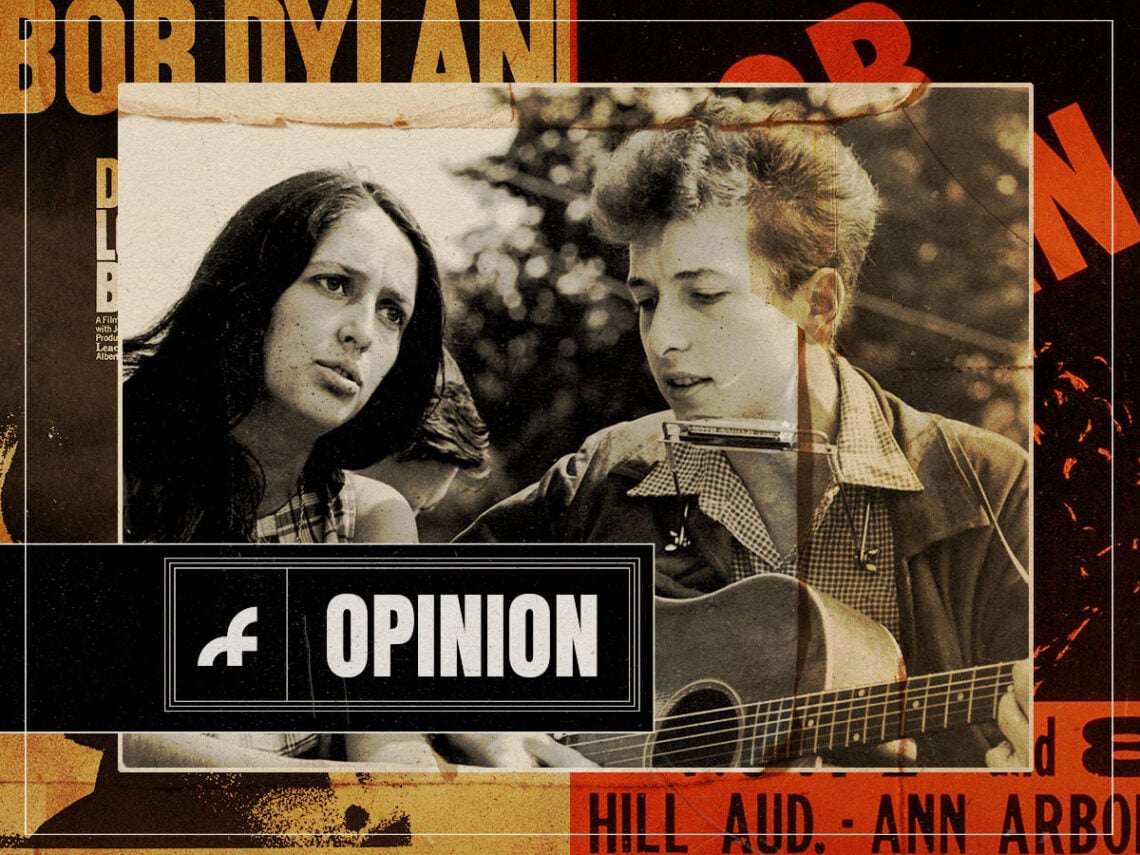
Hear Me Out: Joan Baez did ‘Don’t Think Twice, It’s All Right’ better than Bob Dylan

The first time I heard the words “Don’t think twice, it’s alright,” they came from the mouth of Joan Baez. This probably isn’t a very common experience. Devout Bob Dylan enthusiasts – of which there are still millions – will have Dylan’s shrugged yet knowing delivery on the original ‘Don’t Think Twice, It’s All Right’ ingrained into their psyche. Even more casual fans of Dylan’s songwriting will see ‘Don’t Think Twice’ as one of his signature tracks, but, to me, the piece has always belonged to Baez.
Released on the iconic The Freewheelin’ Bob Dylan, ‘Don’t Think Twice’ seemed to chart Dylan’s relationship with Suze Rotolo, an artist he dated in the early 1960s. The lyrics are melancholic, detailing a romance that has clearly run its course, but they also verge on closure and on acceptance, knowing that it ain’t no use to sit and wonder why. “I wish there was something you would do or say to try and make me change my mind and stay,” Dylan sings, “But we never did too much talking anyway, but don’t think twice, it’s all right.”
It’s a gorgeous farewell to a relationship, containing a myriad of emotions in three-and-a-half minutes. His words are at once knowing but reluctant, reserved but heartfelt, purposeful yet playful. As he complains about wasting his “precious time” on this person, his sentiment might seem bitter, but there’s an undercurrent of gratitude, of contentment, as if he knows the subject of his words so intimately that he’s sure they’ll just laugh his words off.
Dylan’s original recording of the song certainly enhances all of these feelings. At first, his wanderings down the dark side of the road are accompanied by a singular guitar, but its twangs are company enough. They serve to lighten his words, the bite within them. The introduction of Dylan’s beloved harmonica does the same, more wistful than hateful.
Dylan’s vocal delivery highlights the quality Paul Simon once suggested set him apart as a singer. “He’s telling you the truth and making fun at you the same time,” the Simon and Garfunkel songwriter once declared, as quoted by Peter Ames Carlin in Homeward Bound: The Life of Paul Simon. Nowhere is this more evident than in ‘Don’t Think Twice’.
There’s undoubtedly an authenticity to his tales of romantic turbulence, to his juxtaposed declarations of love and indifference, but there’s a sarcasm beneath it, too. As he urges us not to think twice and promises us that it’s all right, it feels as if there could be a double meaning to his words, whether it’s bitterness or something else entirely.

Baez’s voice lends a different quality to the breakup story, wavering with vulnerability and tenderness. Forgoing the harmonica in favour of more sincere strums, she wavers with each word, incorporating all the bittersweetness of the tale into her delivery. Her version of the track is far more placating than playful, and it’s much easier to believe her as she makes heartfelt reassurances.
The softer sentiment of Dylan’s words comes to life through her wavered words, and they become far more than the tale of a broken relationship. The track becomes a source of comfort, a dependable source of serenity in times of need. Each time I go to think twice about something, to ruminate on it for days on end, to catastrophise or agonise, Baez’s voice echoes in the back of my mind.
Many Dylan purists may shun the idea that anyone could do ‘Don’t Think Twice’ better than the songwriter himself did. His original recording is certainly a demonstration of his lyrical talents, of his ability to blur meaning with his perplexing tones, of his talent for turning the personal into something universal, but Baez’s version has earned a place much closer to my heart.
Perhaps it’s Baez’s (arguably) superior singing ability. Or maybe I’m just biased by experience. Maybe it’s the fact that I heard Baez’s take on the track long before I discovered Dylan’s, the fact that it tended to me through self-isolated study sessions and job rejections, the fact it still tends to me now, years later, but there’s something about her take on the track that elevates it beyond the original.
While Dylan’s track is a worthy companion for a meandering mind, Baez’s is the kind of song that can ground you when you need it. As her voice wavers to its highest heights, it somehow brings you back down to earth, comforts and consoles despite the devastation of its content. She may be borrowing words from Dylan’s notebook, but she makes them sound as if she penned them herself, as if they were lifted straight from the pages of her own, just for you.

Never Miss A Tale
The Far Out Bob Dylan Newsletter
All the latest stories about Bob Dylan from the independent voice of culture.
Straight to your inbox.