


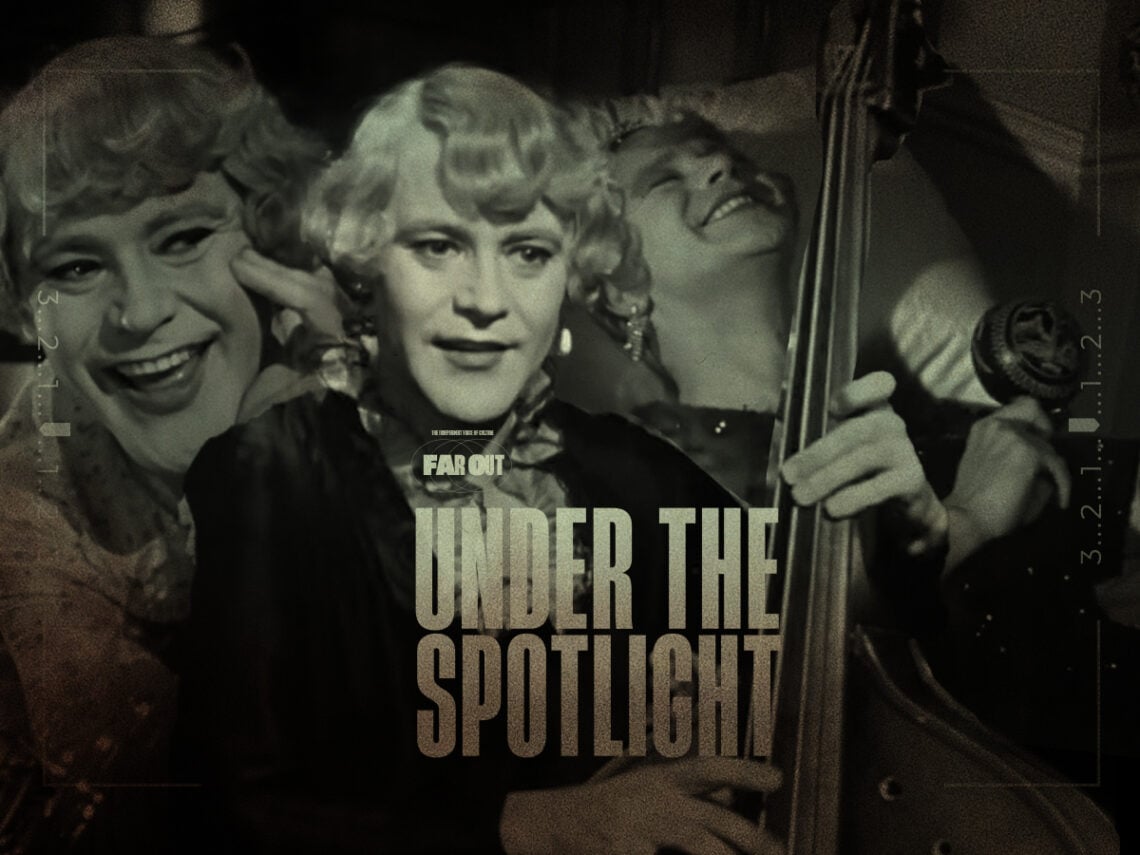
Under The Spotlight: Jack Lemmon’s radical performance in ‘Some Like it Hot’

Jack Lemmon won two Academy Awards during his career, the first coming in 1955 for Mister Roberts, and the second almost 20 years later for his performance in Save the Tiger, but it’s actually a crime that he didn’t get to take home a golden statuette for his performance as Jerry/Daphne in Some Like It Hot, because his comedic skills elevate the movie to its impeccable heights.
Of course, Marilyn Monroe is pretty unforgettable as Sugar Kane, singing songs like ‘I Wanna Be Loved By You’ in some showstopping outfits, but Lemmon is the beating heart of the movie, his embodiment of his female alter ego just perfection. When we first meet Lemmon, he is Jerry, a struggling musician who, alongside his pal Joe, played by Tony Curtis, witnesses several murders. The pair are trying to land a job, but the only one on offer requires female musicians, which leads to the perfect set-up: they dress up as women to avoid being tracked down as witnesses, and they bag the gig.
Initially, though, Jerry is against the whole idea. How are they going to successfully convince people that they’re women? That all changes once he steps on board the train and soon comes to believe in his feminine identity, fully embracing it. When asked his name, he gives ‘Daphne’, despite the fact that he and Joe had initially agreed on Geraldine. This is his first step towards embracing his new identity, which only continues when he finds himself agreeing with Monroe’s Sugar when she complains of her distaste for working with male musicians.
Daphne is such a vivacious character, and it’s as though Lemmon as Jerry is trying on a costume that he’d never have access to otherwise. Knowing his usual place as your average guy, he takes the opportunity to experience this whole new world, where he finds both excitement and the harsh realities of womanhood, like when he gets felt up in a lift. Because Jerry knows the peculiarity of his situation, one in which he is forced into a different identity out of no choice other than necessity, he embraces the absurdism and the chaos, delighting audiences with a bodacious vision of femininity.
One of the standout scenes comes when Sugar sneaks into Daphne’s bed for a drink at bedtime, but soon the entire coach is trying to squeeze in for a late-night party, wearing very little besides their nightclothes. Trying to mask his voice, he pretends he’s coming down with something, but this only marks the start of his stressful endeavour to keep up his façade. When Sugar gets in bed with Daphne, it’s Jerry who initially rears his head, clearly attracted to her but also trying not to give himself away. “I’m a girl, I’m a girl,” he repeats to himself, increasingly becoming alarmed by the chaos of the situation, his cries to Joe not strong enough.
His panic is hilarious, especially because the girls seem so oblivious to the fact that Daphne is a rather flimsy disguise. There’s a great physicality to his performance, like when he flips upside down to try and secure the whisky from Joe’s bag, opening it up with a slightly theatrical hand before holding the bottle as though he’s poised to hit a stirring Joe. Then, when he falls, his instinct is to pull his dress down, but we know it’s not really because he’s trying to be a dignified lady; it’s because he doesn’t want Sugar to discover what’s down there.
Then we get the whole subplot involving the romance between Daphne and the elderly millionaire Osgood, who proposes to him after they dance all night. Jerry gets genuinely excited at the prospect, and while the seeming absurdity of this situation is played for laughs, the whole thing is actually rather radical. When Jerry tries to come clean to Osgood about the truth of his identity, saying, “I’m a man!” Osgood simply replies, “Well, nobody’s perfect”.


The way Lemmon plays Daphne, in fact, seems to suggest that he has finally found a new sense of self, a comfortable form of expression. Considering that the Hays Code was in full swing during the release of the movie, it’s rather groundbreaking that the more explicitly queer-coded aspects of the movie were passed without trouble from censorship boards. What we see are two men embracing the spectrum of gender and sexuality, and while that’s not the main focus of the film, we witness a rather accepting vision of a world where people can explore their identity without being prosecuted for it.
Lemmon’s performance is so effortlessly flamboyant and easy to love, you can’t walk away from Some Like It Hot without being utterly charmed by him. The actor would give another one of his great performances under Billy Wilder’s direction again the following year with The Apartment. The pair evidently worked well together, and we can thank them both for bringing such a terrific, radical character like Daphne to the screen as early as the 1950s.
