


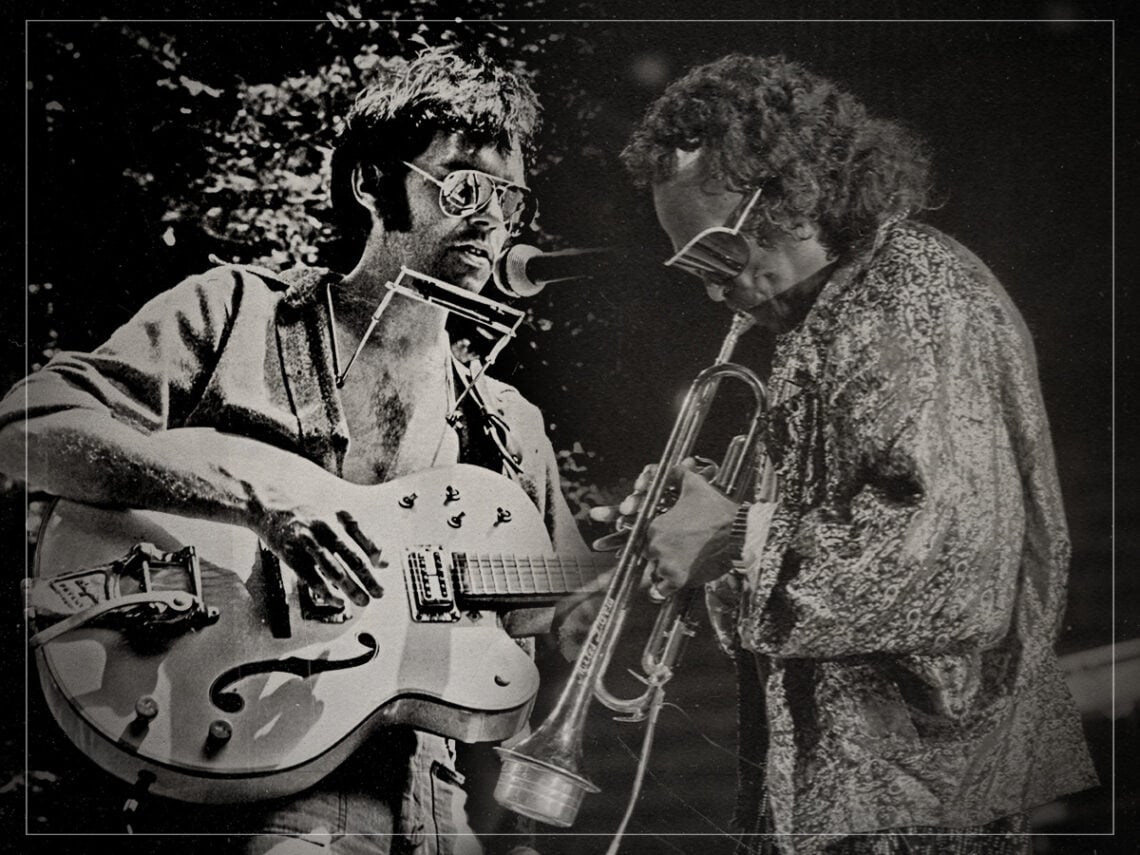
How Neil Young introduced rock and roll to Miles Davis in 1970: “Everybody dug it”

In 1970, Neil Young and Miles Davis were strangely on the same trajectory. Practically nothing else connects the two. They’re divided by genre, musical education, nationality, race, age and so on – but all that meant nothing.
Surely if someone were to plot a musical spectrum, Young and Davis would be on very different sides. Davis was a jazz kid from Illinois, but he moved to New York as early as he could. There, he was embedded in the scene with the likes of Thelonious Monk and Max Roach. He was playing smoky bars and getting his education in the standards.
Young, on the other hand, was a Canadian kid who worshipped Elvis Presley. He was raised on rock and roll, some country, and some blues. But overwhelmingly, it was all acoustic guitar slinging rockers, and so naturally, that’s where he ended up. He was playing folk clubs and cafes, twanging out Dylan songs, before he met Joni Mitchell and then decided to move to Los Angeles.
For years, those two separate camps stayed exactly like that. Young joined Crosby, Stills and Nash for a folk rock supergroup, while Davis was pumping out albums of jazz jams. However, the experimentation they were both doing was drawing them closer. Then, they suddenly crashed together.
At some point around the end of the 1960s, both made a dramatic change. Young’s band collapsed under the weight of all the fallout and drugs. Meanwhile, Davis shocked the jazz community by breaking form, playing around more and more with technology and, to their horror, electronic instruments and production effects.
The culmination of all of that was the 1970s record Bitches Brew, a masterpiece, but one with a confusing target audience. It wasn’t a record that the jazz world would necessarily love, nor was it anywhere near broad or mainstream. Instead, it was experimental, weird, obviously brilliant, but in need of finding its fans.
For Young, going solo again led to him experimenting more with a heavier, rockier sound – also shocking the fans that knew him as a folk man. He’d reunited with his backing band, Crazy Horse, and was no longer interested in making sweet songs in four-part harmonies.
So there they both were, in periods of reinvention and flux, when suddenly their worlds collided in real life. On March 6th and 7th, right when Columbia Records was trying to figure out how on earth to sell Davis’ new album that was endlessly more avant-garde than anything he’d come up with since, they randomly sent him Young’s way.
Promoter Bill Graham set up music’s strangest yet perhaps most iconic double bill as crowds at the Fillmore East in New York saw Davis opening the show for Young in 1970, hyping up the crowds with a set of his new experimental sound before Young introduced his own.
“Steve Miller didn’t have his shit going for him,” Davis recalled in an autobiography of his time opening for the shows. “So I’m pissed because I got to open for this non-playing motherfucker just because he had one or two sorry-ass records out. So I would come late, and he would have to go on first, and then when we got there, we smoked the motherfucking place, and everybody dug it.”
It was mutually beneficial. Young introduced Davis to the rock crowd, especially introducing him to the white rock crowd, who would prop up sales of his record. Meanwhile, Davis could spur Young on, encouraging him to keep pushing beyond tradition and into weirdness.
