


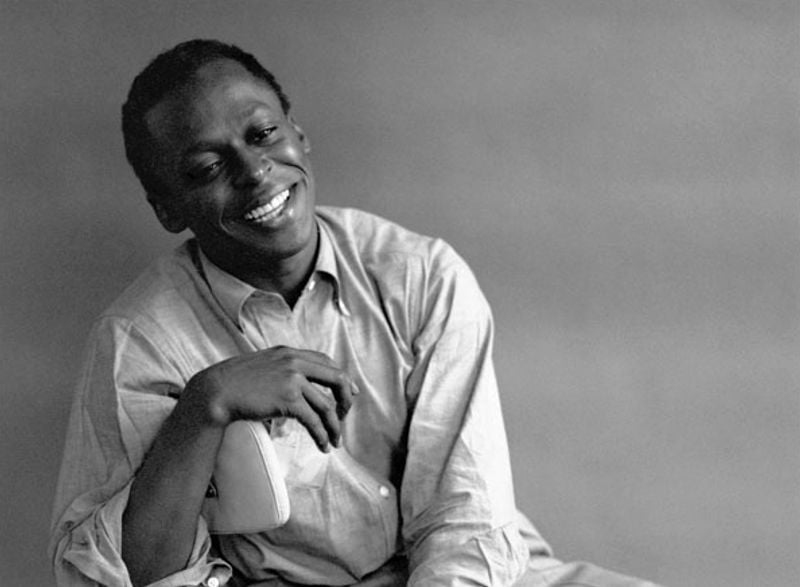
Miles Davis – ‘Bitches Brew’

Jazz music’s Raphael, Miles Davis embodied the cutting edge of America’s most revered genre. Having pioneered modal jazz with 1947’s The Birth of The Cool, Davis set about restructuring the very foundations of jazz with 1959’s Kind of Blue, a hard-boiled, immaculately executed masterclass in texture and structure. Through such transmutations, Davis cemented himself as jazz’s great innovator. It must have come as a surprise, then, when he realised his cultural cachet was beginning to wane. Cue Bitches Brew.
Davis had spent the previous two decades imbuing jazz with a sort of intellectual seriousness. Keen to cement the genre as a revered art form and sever its association with light entertainment, he embraced a Stravinskian penchant for impeccable Mohair suits, avant-garde compositional models and impenetrable gazes. It was under this guise that Davis seduced America. However, by 41, he was out of touch.
Sure, he was still releasing brilliant albums and performing with some of the most celebrated jazz musicians in the world, but it was becoming clear that he was the leader of an increasingly insular circle. What did progressive jazz mean to a generation of young people raised on Motown, soul and R&B? One thing Davis knew for sure was that if he wanted to survive, he needed to adapt.
Determined not to slide into irrelevance, Davis pulled off a stunning act of reinvention. Pop and rock had long since surpassed jazz as America’s preferred choice of popular music. Rather than ignoring this sea change, Davis disbanded his quintet and replaced it with a band featuring two drummers, two bassists and two, sometimes three, keyboardists. Davis understood that jazz’s greatest strength was its ability to soak up external influences and transform them. He also recognised that the genre had become obsessed with aesthetic purity. Rejecting the concept of jazz as a fixed genre, Davis began performing in noisy rock venues like the Fillmore East and incorporating elements of late ’60s pop and rock, giving birth to the infectious, experimental and immensely joyous Bitches Brew.
The album opens with ‘Pharoah’s Dance’, a musique concrète-inspired patchwork of edits and false-starts that sees drummers Lenny White and Jack DeJohnette underpin atonal flourishes of Rhodes and drooping baritone saxophone with brushed 16th notes, harking back to the days when jazz drummers were time-keepers first and improvisers second. About ten minutes into this 20-minute odyssey, conga player Don Alias ushers in a leftfield funk beat of bewitching potency.
With ‘Bitches Brew’, Davis employs a hefty dose of studio wizardry, drenching his trumpet in long-tailed echo, giving the whole recording a distinctly psychedelic feel. Davis might have been known as the progenitor of cool, but this title track sees him play with force and violence. With ‘Spanish Key’, Davis drops us back at the centre of the beat, with the trumpeter throwing neat motifs into a stark landscape of chugging funk guitar and discordant piano chords. A melodic and rhythmic highpoint, the track welcomes the virtuosic noodling of guitarist John McLaughlin, who delivers spool after spool of frenzied rock guitar before handing the baton to soprano saxophonist Wayne Shorter.
Davis casts another spell with ‘Miles Runs The Voodoo Down’, a breezy, playful number featuring some of the bandleader’s finest improvisations. Then comes ‘Sanctuary’, a call-back to the Davis of Ascenseur Pour L’échafaud, though one steeped in dazzling studio effects. The album ends with ‘Feio’, perhaps the most avant-garde track on the entire album, and one that will likely leave both jazz and rock fans scratching their heads, what with its fleeting melodies, strange textures and fragmented structures. Though there are snatches of harmony here, they are left unresolved, leaving the listener haunted by the disquiet of music that refuses to conform. And so Davis concludes Bitches Brew not with a full stop but with a question mark.
