


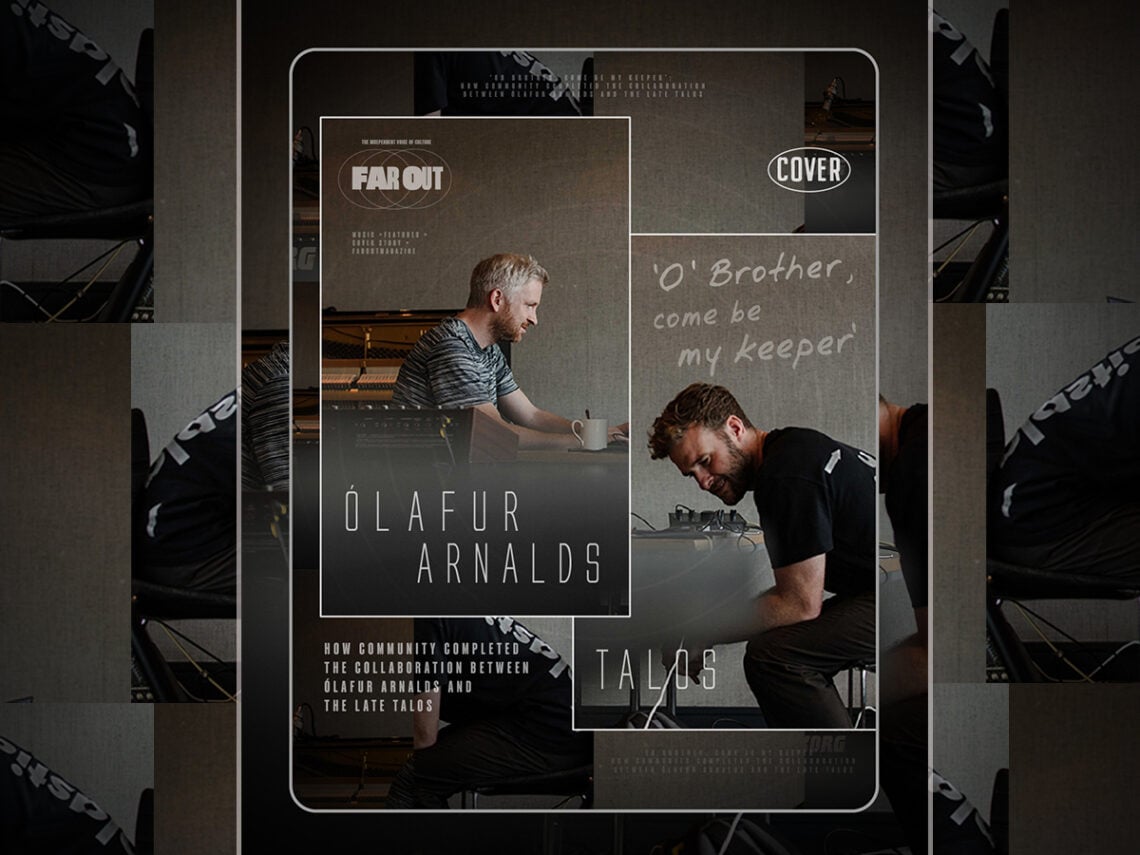
‘O’Brother, come be my keeper’: How community completed the collaboration between Ólafur Arnalds and the late Talos

I’m sitting behind Ólafur Arnalds at his studio, in Reykjavik, Iceland, watching him self-soothe; one hand holding up his head, the other fidgeting with his clothing. A gentle introduction is playing with a chorus of light violins and electronic details distorting it, and I watch the composer take a deep breath in, steadying himself, as his friend, Eoin French, or Talos, the late Irish artist, begins to sing. It is beautiful, it is heartbreaking, it is the most poignant moment of my career so far.
Eoin French was here at this studio; the pair were just beginning to collaborate and were just at the start of a new and great friendship when he got sick, seriously sick. Too ill to travel home, the decision was made that he would stay at Arnalds’ and, as a healing lifeline to dedicate themselves to during the ever-fearful experience of illness and the realisation that there would be no curing, they decided they would keep working. The result was A Dawning, an album made by Olafur Arnalds and Talos together.
“This is not an album about death”, Arnalds tells the room with strength, certainty and authority in his voice, merely moments after having to take a second when talking through the story and the fact that French didn’t see the album be finished. That’s another viscerally poignant moment I’ll remember for the rest of my life; this man, this deeply revered and respected musician, allowing himself to break and get emotional over the loss of his friend in a room full of strangers. In the brief time I get to share with him in Iceland, that will be what I come to characterise him as: incredibly, powerfully open. That is also the fuel, fire and foundation of this record.
In many ways, A Dawning feels like the pinnacle of what Arnalds’ work has always stood for. Collaboration is his lifeblood as his career as a composer revolves around working with others, whether it be other notable artists or the orchestras and musicians he brings together. Each project has come from the same core beliefs about what collaboration is about, not from career opportunities or business moves. Instead, he sees collaboration as a social opportunity to meet and spend time with like-minded people. Take something like Trance Friendz, for example, an album made with Nils Frahm, crafted over the course of one night simply because the two were hanging out and happened to be jamming, titling the tracks with nothing but the timestamp they started that particular improvisation at.
“Collaboration is a very intimate process. It’s a melding of two minds, and I’ve never really liked doing it so much by just sending someone something through the internet and getting something back,” Arnalds tells me, “we need to be in a room together. We need to play together and feed off each other’s energy, because that’s where the magic happens. You go outside of just the skill of, what can you do? And into what do you feel?” For Arnalds, his projects have always been guided not only by a shared energy in the room, but almost always, essentially, by simply getting to know someone.

His work with French was exactly that. The two men had been recommended to each other over and over, not so much as musicians but just as two people who should meet, with mutual friends always knowing they’d get on. In 2023, after a few run-ins where that fact was confirmed, the two musicians worked on their first song together, ‘Signs’, instantly realising that this would be more than a few odd tracks, it would be an album. “That’s why it was so special, because there was no forcing anything, no trying,” Arnalds recalled of those first sessions. That was the easy energy that fueled them and is captured beautifully in the ease of this album.
However, A Dawning inevitably became a different thing when French passed. Arnalds once again asserts, “This is not a tribute album. He made this album. Not me, you know, not me alone anyway.” But after French’s passing, Arnalds was tasked with finishing it – a process that would encapsulate so much; grief and friendship, yes. But also community and the very purpose of music itself. It was still a collaboration, but in a very different way.
“There was almost like a snapshot that got taken at the moment where he passed, where certain things couldn’t change anymore,” Arnalds said of the crafting of the record from that point on, “My role became building around those things, taking these sometimes imperfect or unfinished things we can’t change and creating a shell around them that presents them in the best way possible.” Mere weeks after the loss of his friend, he had to get back to work as sessions were booked that needed to be fulfilled. He tells an incredibly moving story about the first one following French’s passing, how he flew in their friends to support him and how, when he told the players what had happened, he had never seen “an orchestra lock in like that.” He recalled, “I could feel the respect they had for what we were doing,” and that feeling comes through on the record too; a project so packed with feeling and meaning that each note seems to give you goosebumps. Things tend to work like that, though.
Death and illness change things; they simplify them in a way. Anyone who has experienced the loss of a loved one has likely seen it; the way a community of family, friends and even strangers pulls together to help, the way the heart of humanity seems to glow with goodness and the desire to do right by the person passing, to grant them what they wish and work for their peace in any way necessary and then to honour their life and legacy after. A Dawning truly captures that on both sides, the before and the after.
Take ‘We Didn’t Know We Were Ready’ as the ultimate example. Under the beautiful choir of voices made up of Arnalds’ and French’s circle of friends, there are buried, scrappy takes. In French’s final days, Arnalds made a call out to the group asking them to record their parts ASAP. They all did, dropping anything and everything to get it done, even recording bits in cupboards during family holidays, all so Arnalds could craft the track on his laptop on a hospice chair to play to his friend and lift his spirits – is that not what love is? What does the community do for the other? What music is all about? Support, joy, strength?

After French’s death, the group gathered and performed it on TV in memory of their friend, all stood physically holding one another in an embrace, supporting each other through the grief and singing this song as a way to honour him. On both sides, during the illness and in the midst of the loss, the music was a crutch, but it was the community around it that was essential.
That was something Arnalds and French had discussed, especially as French realised he likely wouldn’t see the end of the album and asked his collaborator to complete it for him. “We talked about this idea that music at its roots is actually a service to community,” Arnalds said, “Music wasn’t an industry, it wasn’t a product. You would never say, ‘I finished this song.’ It wasn’t like that; it was just something that you played. You expressed through music, and it was a service to everybody else, whether it’s a religious ceremony, or a funeral, or a wedding, or just like a Saturday night with a choir, where people get together and it’s good for their mental health. This album felt like it became that very much.”
Once it was done being a service to French, to give him something to focus on and be excited by during his illness, it became a service to his loved ones. “It went from being this close collaboration that we were just doing for each other, because we enjoyed each other’s company and we enjoyed writing together to becoming something that was actually a service for all our friends, all our family, our whole community. And I wanted to kind of symbolise that by bringing actually everyone in on the album,” he said, explaining the decision to keep those cupboard recordings on the track but also to keep calling those friends in.
The record became a thing to revolve around, and during the process, Arnalds stayed in close contact with French’s family, checking in with them about certain decisions. He’d reach out to people who had worked on other Talos projects for advice. He’d have to talk to other people who had spoken with French in his last weeks, needing to understand certain lyrics or find scraps of information he didn’t have about the work. But what that granted was the opportunity, over and over, to connect, to talk about French and to check in on the community grieving him. “It’s just such a good cause for always keeping him alive somehow,” Arnalds said, “we’re always talking about him, always talking about how we feel about it.”
I shared with Arnalds during our conversation that I’d spent the days prior to it incredibly nervous. Talking about grief is hard. Every person has their own relationship to it. It’s something so many struggle to know how to bring up for fear of upsetting others, or struggle to know how to honour it in their lives, as we’re generally allowed a period of mourning, and that’s all. He said he knew the feeling. “There’s this strange time between the passing and a funeral, and then after the funeral, society tells us you’ve had enough time, you know, time to go back to work. The wheels of capitalism have to turn,” Arnalds explained, but said this process changed that. “This case is completely different, not just because of this record. His group of friends is a very unique group of people, a very special group of people that I’m incredibly fortunate to have met in this process. We had the passing, we had the funeral, and then we had the processing. We talk regularly, we have this project that people can congregate around.”

A Dawning is beautiful, but what it did for French, Arnalds, and the people in their lives is even more so. After his passing, the record became a thing to rally around, almost like a dinner table that they gathered at to share stories and memories, keeping that sense of togetherness going far beyond any wake.
For Arnalds, who was working on this album day after day, his friend was alive and with him in a very real way. It was a necessity. He had to keep engaging with what his friend would have thought or said, he had to keep considering his likes and dislikes and processes, trusting in their connection to make decisions on behalf of him, working through the music left to him and figuring out not how he wanted to honour Talos through it, but more specifically, how his friend would have done it.
He was tapping into perhaps the bravest and most interesting creative iteration of Talos. During their time together in his Reykjavik studio or during their time at French’s West Cork home, the musicians only ever got to know each other in a very intense way. Collaboration fosters that, there’s no hiding when sharing creativity. But when you pair that with French’s illness, it was a recipe for a whole new level of depth and a whole new type of creation.
“When an artist starts to realise they don’t have anything to lose there, there’s no bullshit anymore. There’s no filter, there’s no shyness, like, there’s no like, elitism, or like, ‘oh, it has to sound like this, this is cooler’, or something. You know that all of that is just going out the window, and all you’re left with is just the pure, vulnerable expression of music,” Arnalds said with the pair’s time together becoming the purest form of collaboration he’s ever seen as any sense of holding back or second-guessing went out the window. “Oh, it’s grand. It’s grand,” he said, imitating his friend’s thick Irish accent, “And that was it, you know. Before he was a super perfectionist, but after, the ego is just not part of it anymore.”
“Everything real has to be there,” Arnalds declared as the only rule for finishing the record. The rest was simply on impulse as he sat with the memory of his friend, still there as a collaborator. “I would sit here and work on the album, and I swear I could feel him there next to me,” Arnalds said, smiling wide at that thought, “I don’t know what it is, I don’t need to know what it is, but I would be working on these songs, and I would see him in the corner of my eye, sitting on my right side, and like bumping his head, or like doing a little stank face.” He repeats over and over in the time we spend together that his main feeling towards this project is simply pure gratitude. “I had all this extra time with him,” he said, granted the ability to keep getting to know this friend even after he was gone.

French clearly knew that would happen. While Arnalds stresses the importance of not trying to reflect on the lyrics of the album with the retroactive news of his death, reminding everyone that once again, this was an album made by two living friends, he notices things too, little messages left for him. “There is a lyric on the album that I didn’t really think about until a friend pointed it out to me recently. But he sings, ‘O’ Brother, come be my keeper.’ This is a lyric he wrote when he knew things might not go too well for him. So I don’t know what exactly he meant by that, but I’ve decided to take it quite literally as brothers in music, to be his keeper, be the kind of guardian of his musical legacy, by trying to present this in the way that I know he would like,” he said.
I sat and watched him listen through the whole album, watched him take another deep breath at the end, relax into his chair, his hands falling still. There’s a peace to it. The keeper, trusting he’s done his job. All of us listening, knowing he has.
How do you summarise a project like this with a concluding paragraph? In the same way that I was nervous about starting this conversation with Arnalds in the way that any conversation about grief is rife with anxiety about doing it right, the same grips me here. I want to do this piece right, to do it justice, and to honour not just the deeply impactful conversation I had with Arnalds but also the important and precious mission he’s been on in finishing this album and what it represents. I want to honour the talent of Talos. I want to honour the two men’s friendship. I want to honour all the interesting points this project touches on: community, the way perfectionism fails when priorities change, the power of collaboration, all of that. Mostly, I want to honour A Dawning and all the things it is; the work of a talented artist, but also the table his loved ones gather around.
In the same vein as Arnalds watching the orchestra lock in, their friends drop everything – everyone who has come in contact with this album seems to react the same. Anyone who knows its story knows how special it is and falls in line wanting to honour it the best they can. I join the ranks wanting to do that too.
