


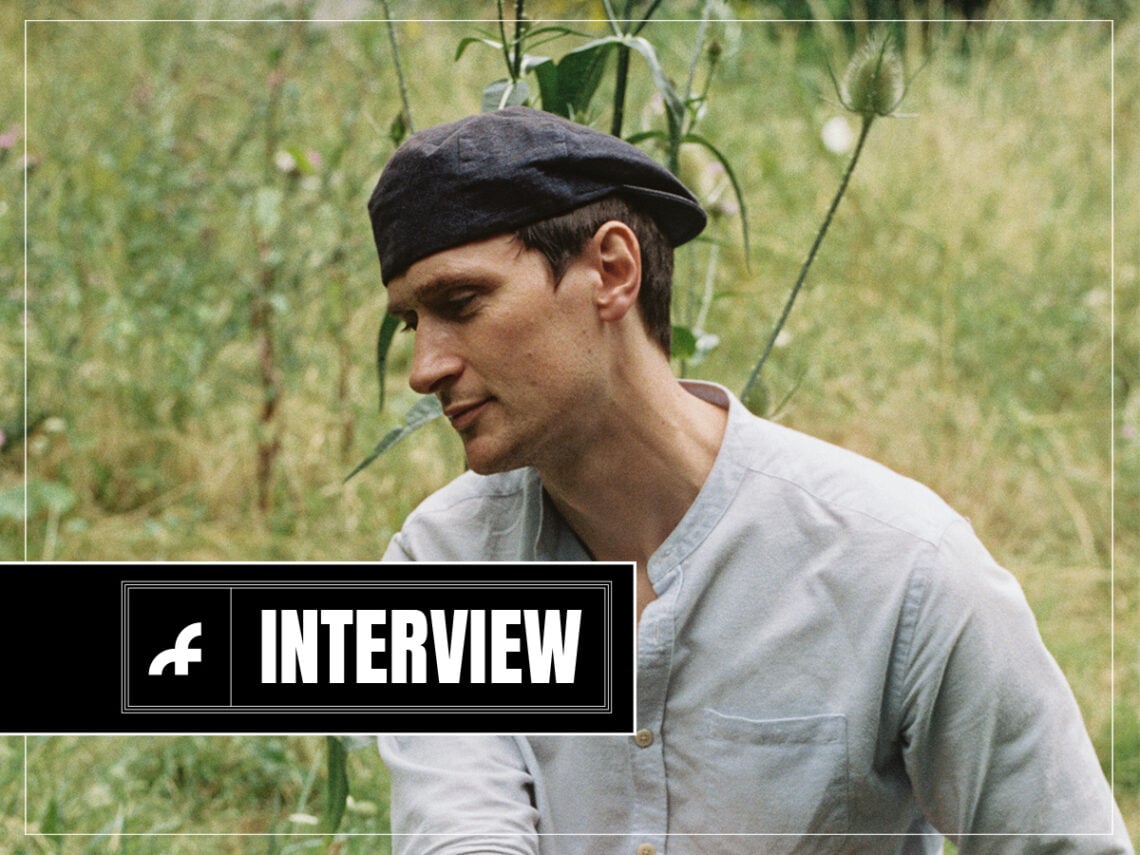
A meditation on patience, an exercise in trust: Why Erland Cooper planted his album and let Earth recompose it

In Spring of 2021, composer Erland Cooper made an album. After meticulously writing a score, gathering some of the world’s best musicians and capturing what would be Carve the Runes Then Be Content With Silence, he transferred it all onto one physical tape and hit delete. All the steams, all the takes, every production detail or mastering fix; gone. He even shredded the scores. It existed in one physical format only.
Most would guard that with their lives. Or, really, most would simply never allow their artistry to exist on the shaky ground of chance, where one wrong move could mean it was gone forever. But that chance is exactly what Cooper was playing with as he went to a remote Scottish island, dug a hole, and planted his album. There, it lay until the autumn of 2022, letting Earth do what it may.
“I don’t say buried. I actually say planted. Buried is quite final. Conclusive. This is about letting light in,” he tells me as we sit in a bird hide nestled in one of the secret gardens in the Barbican estate. It’s a rare peaceful retreat in the centre of a vast city, and it’s in places like this that Cooper feels most at home. When he tells me that and about his childhood, my almost singular question of “Why did you do all this?” starts to make a lot of sense.
On the simplest level, the answer could be that the Scottish composer is utterly a product of his upbringing. Hailing from Orkney, an island off the furthest coast of Scotland, his childhood was spent in one of the most astonishing landscapes there is, and as the son of a geography teacher and a zoologist, he was reminded of that daily. “We were encouraged to explore the natural world,” he says, “You know, we were surrounded by the elements and the sea, the air, the land of the Orkney Islands, it’s magical.”
With that in mind, the fact that the natural world has forever been a major inspiration for his work is no surprise. It’s also nothing new, as he points out, “I don’t think composers have shied away from writing about the natural world. It’s quite a common thing to do.” But when he dreamt up the plan to actually put the tape into the earth, he was taking it further than anyone else would date to. “I asked myself, How could I go a bit deeper into the landscape? How could I truly dig down and collaborate with the elements themselves? I’ve written about the natural world and landscape; how can I sort of collaborate with the soil itself?”

To return to my question of “why?” Cooper’s upbringing has an answer for that, too. “I was on an island in the North Sea, so the thought of even studying music was a pipe dream,” he says, reminiscing on a youth spent ‘rebelling’ by sneaking back into school; “As my mates were playing football, I was breaking into the school to learn how to use pianos, guitars, tape machines.” He’s proud to declare himself an “autodidact” in a musical world rooted in tradition and prescriptive lessons. As the self-taught kid from a small island, his breaking into the classical music world was somewhat of a coup. Now that he’s in, it’s his duty to rebel. With a left-field entry to the industry, he’ll remain a left-field force, stating, “I break rules that I’m not aware that I’m breaking, and I think it’s probably refreshing to some commissioners and audiences and infuriating to others. I don’t care.”
Refreshing or infuriating is precisely the kind of split reaction that Carve the Runes Then Be Content With Silence. The story of the album is one I find myself telling to people a lot. The reaction ranges from “That’s so cool” to an unimpressed “That’s so stupid”. But to me, it has stuck in my head as an object of total fascination. As a writer, the idea of taking a manuscript, deleting it and burying the only copy fills me with a kind of thrilling horror. I tell Cooper about how I could just imagine myself waking up in a panic in the middle of the first night and racing to go dig it back up and save it.
“There were moments I couldn’t sleep, yeah,” he laughs, “But funny enough, the night I deleted everything, I slept like a baby.” When the moment came for him to action his plan, it was a state of complete excitement and total, inspired clarity. “I think good ideas are just a combination of okay ones, and great ideas are a combination of good ones, and so you have lots of ideas floating around all over the place. And then all of a sudden, you get this moment where those ideas start to line up, and all of a sudden, it’s like this direct line that tells you exactly what to do, and you can’t stop until it’s done,” he says, for him, this album from it’s composition to the digging of the whole and even through the whole three years was that direct line. With that mindset, it became an easy thing to follow.
But that doesn’t mean it didn’t require incredible trust and strength. Cooper had absolutely no way of knowing what would happen to that tape. There was a high chance that when the time came to dig it up, every second of music would be lost. In fact, when a couple stumbled across it and dug it up in 2022, even though Cooper had originally intended to retrieve it after three years, the tape was completely flooded with water. That’s the whole point, though. This isn’t just a thing of letting nature work on the record, but this was a deeply personal project questioning the composer’s motivations, his relationship to art and his trust in himself as an artist.

“Destroy what you’ve made to truly go into yourself,” that was his thought process. “It asks the questions, and it makes us ask about what we truly value. You know, what do we care about? Which part of the process do you enjoy? Is it starting? Is it when you’re collaborating with others? Is it when you’re putting the edit together? Is it when it’s beautifully mastered and finished? Or is it when an audience says how much they’ve enjoyed your piece or disliked it?” It was only by refusing instant gratification and being removed from the typical and intense process of making an album and being within that album from the start until it’s handed to the public with no space for contemplation that those questions could be properly pondered. In short, “It was a meditation on value and patience. Could I write something, delete it, and then wait for three years, not knowing?”
But the project isn’t just about him. There is a reason why, after finishing the album out of the ground, Cooper decided that it would be dried out on public display. As the long process of trying to prepare the tape for the results to be revealed began, it toured the country, sitting in record stores for people to peer at. It was important to the composer that the album, which had been in solitary confinement for so long, be reconnected with the people because the people also inspired it.
Along with nature, the 2021 composition is a contemplation on creatives. “At the time when it was written, musicians, artists, writers, were being asked by government to retrain. So It’s a celebration of what it is to be in the arts, to be alive and kicking and resilient,” he said, “That’s how I see it. It’s about resilience.”
It’s also a celebration of the fascinating nature of audiences and an exercise in trusting them, too. He tells me that even if the tape had come out completely silent, he would have performed it, so when he gathered his first audience for the unveiling of the project, they very well might have sat in a room of total quiet. But as they filtered in, they were still eager regardless, and that energy is part of its story. “Would an audience sit with me, all unknowing what was going to happen when I press play?” the album asks as he says, “It was like a bold leap of faith from them. I have so much gratitude for them.”

There was a moment when the crowd held their breath: nervous, excited and curious. But what feels more special is the fact that there was a moment when Cooper did, too. For three years, the album had only existed in his head where occasionally melodies might be recalled, but inevitably, they faded, and he forgot it. Once the tape was dried out and cleaned the best they could, he went into a room and hit play with no idea what the earth might have done to his work and what, if any of it, might remain. When it started and the first note of surviving music, recomposed with the Earth’s help, struck up, his own work became beautifully new to him; “that was the fundamental feeling I had, that this is the rarest thing that maybe I’ll ever experience.”
It was an experience that mirrored the whole process and emotional life of the album: joy and grief and trust and humour. “There’s a moment in the middle where I’ve written into the score a two-minute remembrance silence. I’d completely forgotten that” he laughs as he recalls the moment. “So it’s halfway through the concerto, and then it’s completely silent for a couple of minutes. And I’m like, ’Okay, that’s it. Two movements are there, and that’s it.’ And then, all of a sudden, out of the silence, I heard the violins rising up. There’s more music. Oh my god. And I laughed. I laughed at myself, with myself, thinking, ‘You cheeky bugger!’”
But despite his joy over the final product of his album and all the beautiful ways that the ground played its hand in its final form, Cooper will wholeheartedly say that he would have been happy with silence. Because by now, the record feels beside the point. Instead, Carve the Runes Then Be Content With Silence is an incredible and inspiring exercise in trust, care and passion. More so than anything else, it’s a life lesson. As Cooper says, “It teaches you to let go, move on and start again; I think that’s part of it. It’s about grief, hope, joy. It’s one part remembrance, one part celebration. Really, it is about letting light in, giving something an opportunity to grow into something else.”
