


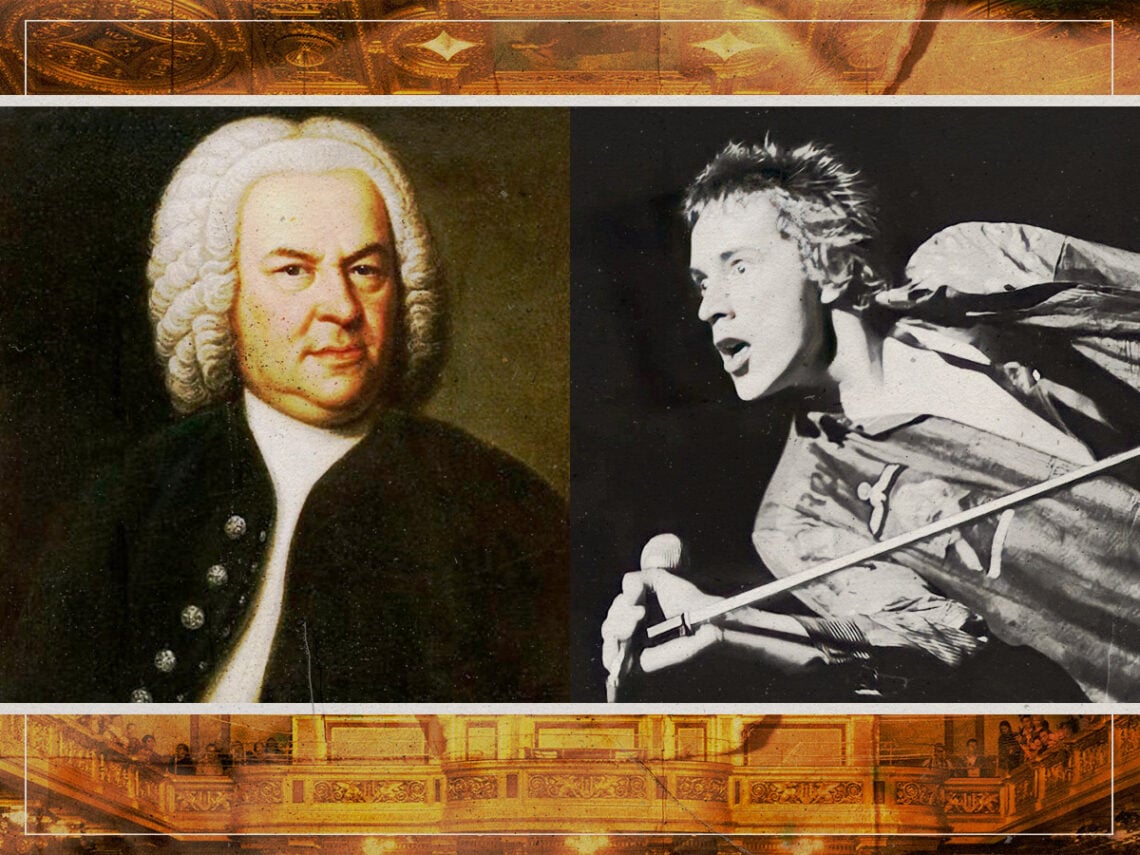
Punk as prologue: was Johann Sebastian Bach the John Lydon of classical music?

In a recent interview, noise artist and producer of Clipping Jonathan Snipes spoke about classical music and how the way we perceive it might be the same as how people perceive 20th-century music in hundreds of years. “You talk about 100 years as if it’s a long time; I think it’s actually still just a blip.”
He continued, “If someone doesn’t really listen to classical music and doesn’t have a sense of music history if you play them Bach, Mozart, Beethoven and Brahms, they might not be able to tell the difference, even though they’re like years and years apart.”
Snipes went on to talk about how people might eventually feel the same way about contemporary music. “I love the idea that our contemporary music, which is so specifically genred and sub-divided, that in 300 years, you play somebody Philip Glass, Lil Wayne and Merzbow, and they’re like, oh yeah, that’s 20th Century music…”
Several parallels can be drawn between classical music and contemporary music. Though we might not be at the point where both are viewed in the same light as Snipes predicts, there are certain attitudes towards classical music which carry over into the modern day. Many of these are obvious, such as how the melody is put together and time signatures used to build a piece up and slow it down; others are harder to look for, and that may well be because they aren’t there at all, and simply our desire to find respectable grounding wins out. But if you look at both of the mindsets of the musicians, there is an argument that Johann Sebastien Bach was the John Lydon of classical music.
John Lydon is known for his musical stints in the Sex Pistols and Public Image Ltd. However, he is also famous because of how outspoken he is and because he can bring out his opinions in a way that is often entertaining. While his politics and lifestyle choices are far from comfortable, it’s always fun to read what he has to say about other musicians. He has never been afraid to hold his tongue, and many artists who are loved have been on the receiving end of his musical lashings.
The majority of criticism that John Lydon has ever made about musicians boils down to one thing: he doesn’t believe what he is listening to. When he spoke about Kiss, he said, “There’s a lot [of artists] that are selling you an image that’s false, deliberately fake and deliberately commercial.” In talking about Sting, he said, “He’s gone and taken himself far too seriously, hasn’t he? ‘I am an intellectual, honest, please believe me. Look how unshaved I can be.’” And he criticised Joe Strummer of The Clash by saying, “It’s nothing personal, I liked Joe. But you can’t be a champagne socialist; you’ve got to be more honest with us than that.”
In his Essay on the True Art of Playing Keyboard Instruments (1753, 1762), Bach talks about playing music in a similar way, saying, “A musician cannot move others unless he too is moved… In languishing, sad passages, the performer must languish and grow sad… Similarly, in lively, joyous passages, the executant must again put himself into the appropriate mood.” In other words, if you are going to play music, you need to buy into what you’re playing. If you can’t connect with the music yourself, then how can you expect your audience to?
There are certainly parallels between Lydon and Bach here, as even though the music they played was very different, they both believed that the most effective way for a musician to get the most out of their sound was to play honestly.
There are other parallels in the sense of their attitude towards making music, too. Bach was one of the pioneering composers who moved away from craftsmanship in his writing and leaned further into emotion, opening the doors to the romantic movement. John Lydon did a similar thing with the Sex Pistols, as nobody was praising the band’s technical ability and instead the passion with which they played.
Punk is relatively romantic in that sense, and the parallels between the two pioneers behind both movements further emphasise that link. Of course, a lot of differences could also be highlighted between the two, but there is no doubt that the honesty they prioritise at the heart of the music they both make and listen to somehow connects them. Exactly how much? It’s hard to tell, so we need to take a classic approach and let history decide.
