


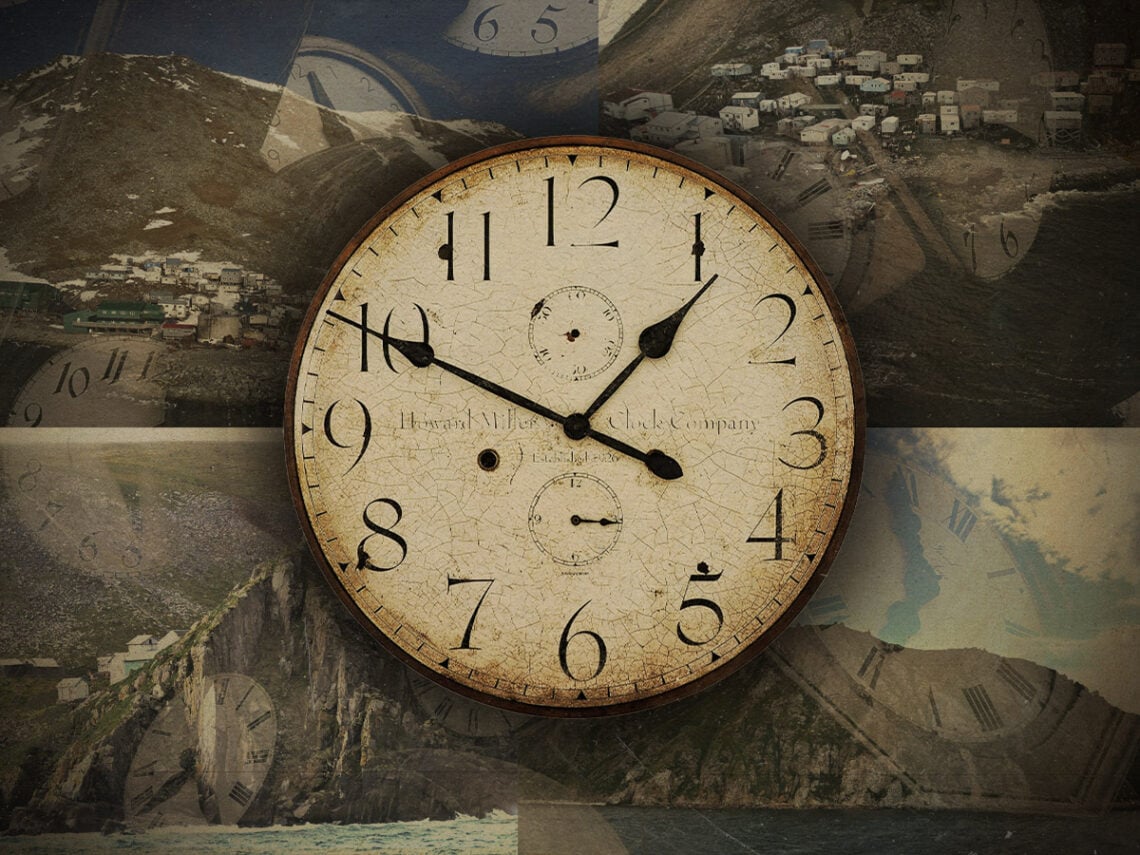
The Diomede Islands: How can two islands three kilometres apart have a 21-hour time difference?

One of the worst parts of when you travel has to be changing time zones, a period of uncertainly where your body says one thing and your watch says something totally different.
Fly from the UK to the Southern Hemisphere, and you’re going to feel jet lagged for what feels like an age, although you can mitigate the impact if you plan in advance and adapt your sleep pattern.
Some countries, like China, have it right, having shifted from five time zones to one in 1949, with Mao Zedong wanting to promote national unity by having everyone use the same clock. Other huge countries have more, with Russia leading the way, using 11 time zones, even though over 60% of the population lives within the Moscow time zone. Moreover, the Russian territory is involved in one of the world’s greatest time zone anomalies, in terms of the Diomede Islands, which have two rocky outposts separated by about 3.8km and a staggering 21 hours.
Otherwise known as the Gvozdev Islands, they are situated in the Bering Strait, the body of water that separates Alaska from Siberia, and are named after Saint Diomedes, due to being discovered by Danish-Russian explorer Vitus Bering on August 16th, 1728, the day the Russian Orthodox Church celebrates the saint. Surprisingly, despite less than four kilometres of water separating the two islands, there’s a huge difference between them, both in terms of time and culture.
The larger of the two, Big Diomede, is Russian territory, while Little Diomede belongs to the United States of America, and by a quirk of cartography, the International Date Line splits the two, running down between them, which means that Big Diomede is 21 hours ahead of its smaller cousin, dropping to 20 in the summer months, thereby leading them to be nicknamed ‘Tomorrow Island’ and ‘Yesterday Island’.
When the Alaska Purchase treaty was finalised in 1867, the islands were split between Russia and the US, and after World War II, the Russians built a military base on Big Diomede, AKA Tomorrow Island, forcing the small indigenous community there to be forcibly relocated to mainland Russia. During the Cold War, they took on extra significance, with the water between them known as the ‘Ice Curtain’ and seen as an important division between the two warring countries and ideologies.
A small indigenous community remain on Little Diomede, with the Inupiat people, living a remote and isolated existence, surviving on a diet of walrus, seals and fish, and due to the inhospitable terrain, they are only accessible by helicopter during the winter and by small boats in the summer.
Hostility between Russia and the USA might have thawed in the following decades, but the two islands have different lives, with Little Diomede’s residents capable of spotting Big Diomede on the horizon and quite literarily looking into the future, but in reality, the sun is rising and setting at the same time, with the differences between the two islands being a manmade one, rather than a geographical one.
They stand as a reminder that existences are shaped by human hands, and that time, calendars and even borders are human constructs that impress their will onto our lives.
