


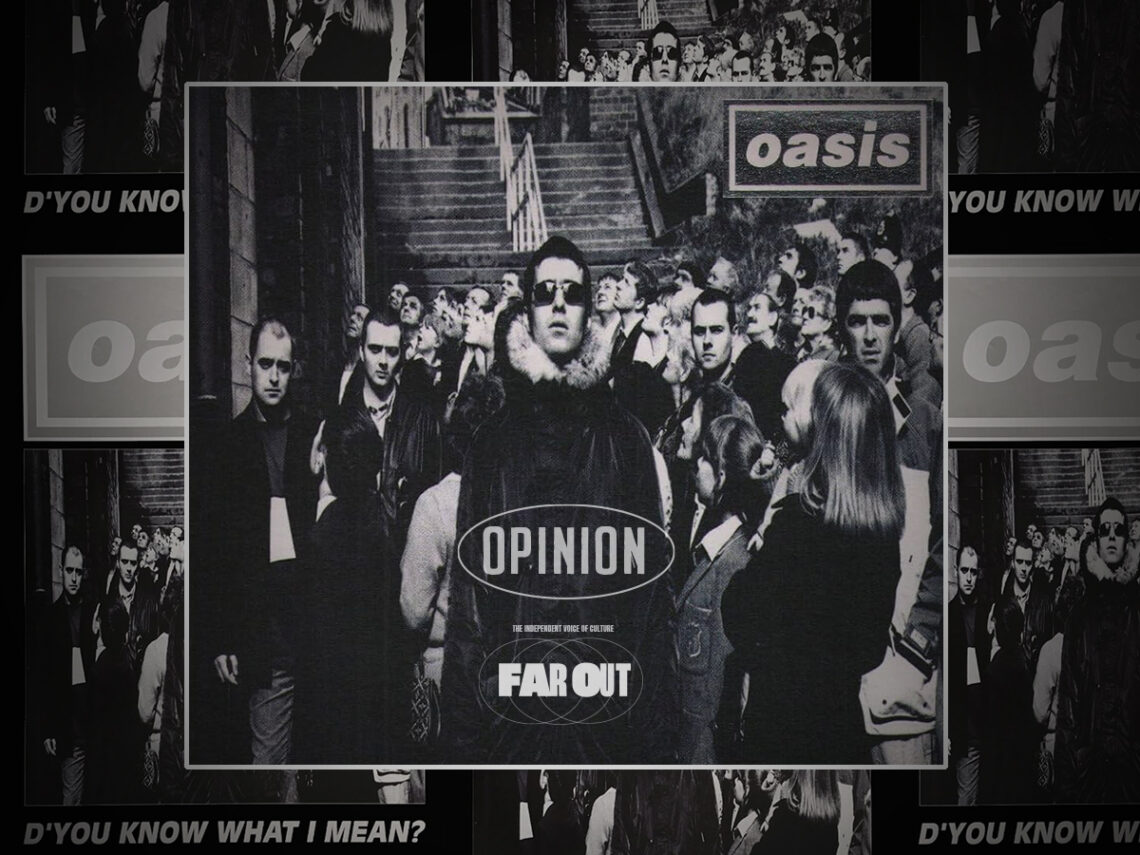
Hear Me Out: Oasis ‘D’You Know What I Mean?’ is music’s greatest comeback single

It’s July 7th, 1997. Across the UK, those lucky enough to have Sky TV have it tuned to MTV. This was in the days when music television actually featured music videos, complete with VJs to provide the requisite banter between songs.
While Britpop had peaked in the summer of 1996, there was no doubt that the biggest band around was still Oasis—they continued to be a phenomenon.
They had last released music some 16 months ago in February of the previous year with ‘Don’t Look Back in Anger’ from the multi-million selling ‘(What’s the Story) Morning Glory?’; what felt like a lifetime had passed for the millions of fans who hung on every note Noel Gallagher produced.
It’s impossible to state the feverish clamour for new music from Oasis at that moment in time. Noel had recently been seen on Chris Evans’ TFI Friday show, a one-off episode in the ginger presenter’s house, and was begged to play just a sample of anything new on an acoustic guitar, but refused “because nobody’s got a plectrum”.
The giant Knebworth gigs in the summer of 1996 were the closest anyone got to witnessing new material—it was there that the band debuted ‘My Big Mouth’ and ‘It’s Gettin’ Better (Man!!)’ from what would eventually be announced as ‘Be Here Now’, but it was several months until bootlegged versions of those tunes began to appear, usually on unofficial compilation CDs in Camden Market.
In the days before the internet and file sharing, there were precious few leaks, and so there was no hint of what Oasis were planning to put out on the third album until that day in July, when we learned they would be unveiling their new single, ‘D’You Know What I Mean’, with its accompanying music video.
As 18-year-olds in Britain, there really wasn’t much else in life at that time other than football, beer and girls. The football season had finished, and women were still exotic, scary mysteries, and so there we sat, in front of an enormous 21-inch screen, waiting for the most anticipated single release in UK music history.
MTV’s presenter that day was Eddy Temple Morris, a well-spoken, long-haired chap who did a fine job of encapsulating the excitement we all felt as he counted down the minutes to the premiere, constantly reminding us of what we were about to witness. And then, to the sounds of a radio tuning static, backwards, singing and bleeping Morse code, the song finally began.
We saw the band assembled with instruments on a kind of post-apocalyptic industrial wasteland, looking somehow different. As though they’d weathered the mighty storm of ’94–’96, becoming the world’s biggest band from a council estate, and thus, were more focused and determined. Liam looked incredible in his Elvis sunglasses and an army parka, with overhead shots of, not one but six or seven military helicopters, and random young men and women in combat trousers threw smoke grenades as Alan White’s thunderous drums kicked in and Noel strummed a flying V while chewing gum. We stared in wonder.
The song is eight minutes of feedback, heavy guitar, repurposed ‘Wonderwall’ chords, the most anthemic pre-chorus imaginable, strings, a screaming guitar solo and a true call to arms for the assembled millions waiting for this. In fact, the lyrics were right on the money as Liam and Noel together implored, “All my people right here, right now, d’you know what I mean?”
As vague as it was, it was perfect. We knew exactly what they meant. Noel has previously played down the lyrics, saying he was hoping to say something profound but settled on something ambiguous. But the truth is, if you look closely, you’ll see all the pressure, arrogance and history of the band summed up in the verses.
Noel had a nation waiting on him at that time, hounded through airports, pens and LPs thrust at him, with tabloids salivating. Through the song, he responded, delivering a summation of everything he had become. And the sheer confidence at play is astonishing. He actually speaks of God sitting on his shoulder, despairing at people, asking the Mancunian for advice on why the human race won’t make more effort to “fly through the storm” and “believe in life”.
“Listen up man, they don’t even know you’re born”, replies Gallagher, nonchalantly.
Elsewhere, Oasis’ influences are referenced directly, with iconic songs by the giants who helped get them to this point, such as The Beatles, Dylan, Small Faces, The Hollies, even Motown. Blood on the Tracks, ‘The Fool on the Hill’, ‘Don’t Look Back’, ‘My Mind’s Eye’, ‘Bring It On Home’: a young Gallagher was channelling all those months of sitting in a two-bed, listening to records and trying to pick out the chords.
Even the opening line is a statement of intent, with Noel reflecting on visiting his mother as a changed man, a famous rock star returning to the Burnage estate where he was never handed anything: “Step off the train all alone at dawn, back into the hole where I was born, sun in the sky never raised an eye to me”.
When the music video came to an end, my best friend and I turned to each other, open-mouthed, and Temple-Morris knew exactly the words that were needed. “Again”, he screamed at a nearby producer, “Play it again. Right. Now”. So they did.
Last week, some 28 summers later, we stood with 80,000 other disciples at Wembley Stadium and belted that chorus into the night, a repudiation of the time passed, of social media and smartphones, and Trump and Covid-19 and the cost of living. A football stadium became a cathedral, enormous songs echoing around the arena from a band we never thought would reunite.
All my people, right here, right now, d’you know what I mean?
