


Glastonbury 2025: Neil Young takes the festival back to its roots

It has been 55 years since the first Glastonbury Festival, and during that time, the live music industry has become virtually unrecognisable. Those early events were composed of small groups of peace and love hippies, living freely and feeling the music. There were no food trucks, VIP passes, or on-site glamping showers; the focus was placed entirely on the art form. In all likelihood, festivals and live music will never return to those simpler times, but Neil Young’s headline slot on Saturday night at Glastonbury 2025 certainly affirmed that the spirit of peace, love, and music still lives on in the 21st century.
Unity has been a prevailing theme throughout the history of Glastonbury, and this year’s edition is certainly no different. However, Saturday saw a growing divide within audiences, between those spending their evenings with some high-energy pop mastery courtesy of Charli XCX and those looking forward to the timeless songwriting talent of Neil Young. Two utterly incomparable artists playing at the same time on different stages certainly split the masses, culminating in a relatively small (by the standards of Pyramid headliners) crowd for Young.
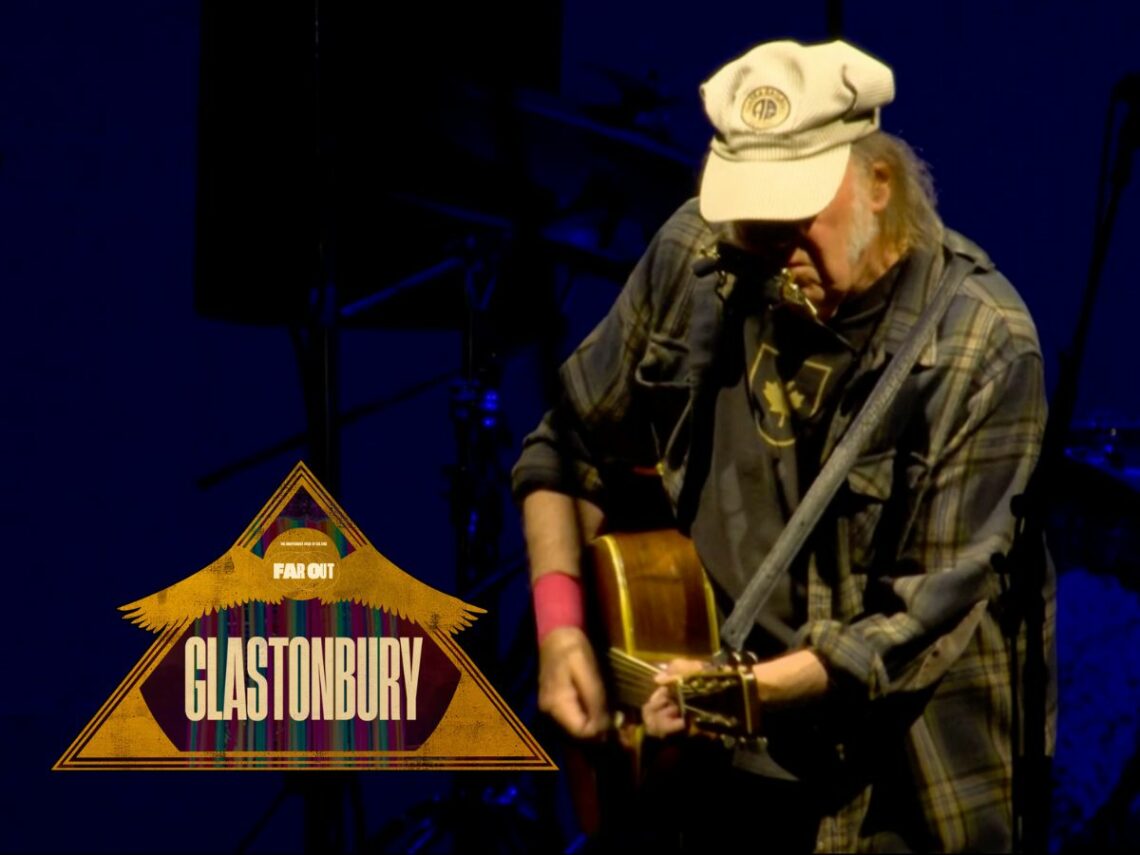
This reduced attendance changed the dynamic of the show entirely. Calling any Pyramid headliner an intimate experience would be a ridiculous stretch, but Young’s extensive set certainly felt much more personal and connected than anything else that has taken place on the stage over the course of this weekend. The iconic songwriter emerged onto the stage at 22:00, without any fanfare, standing in a spotlight with a battered acoustic guitar and sinking into a gorgeous performance of ‘Sugar Mountain’.
After a day of intense heat, sunburn, and walking for miles on end around this colossal festival site, being able to sway gently in the breeze to these enduring classics was a truly moving experience, and one which continued throughout Young’s performance. After that opener, the former Buffalo Springfield musician brought out his band, The Chrome Hearts, but he stayed stoically behind his lowered cap, silent.
It was only after three songs that he greeted the audience, taking a dig at the BBC in the process. This set has been plagued with difficulties, miscommunication, and uncertainty since before it was officially announced. Young pulled out of the festival due to its partnership with the BBC, declaring that the festival is under “corporate control”, before relenting only days later. More recently, Young forbid the Beeb from broadcasting his set, before again relenting and allowing the broadcaster access to his Pyramid show.

So, when greeting the audience after ‘When You Dance, I Can Really Love,’ Young made sure to let his feelings be known. “How you doing at the back?” he asked of the ever-expanding crowd at the Pyramid. Upon receiving a rapturous reply from the top of the hill, he gave the crowd a knowing smile, “Oh good. How about you people with your TVs in the bedroom?”
That was the extent of Neil Young’s crowd work, but then his work largely speaks for itself. His set felt incredibly stripped back: no fancy light show, video backdrop, or ridiculous props. Like those early festivals back in the 1960s and 1970s, the focus was placed entirely on the music, which could not have been better. After all, who else is equipped to take Glastonbury back to its humble roots? Neil Young and his politically-charged lyricism were at the heart of that first hippie age – he even played one of the standout sets of Woodstock back in 1969, although he was similarly unhappy about being filmed.
As Young’s set took audiences on a journey through his incredible songwriting repertoire, the atmosphere in the Pyramid crowd only grew more unified and joyous. By the time ‘Harvest Moon’ came around, complete strangers were embracing each other, and everybody swayed unknowingly in unison, as if it was a natural human reaction to the song. That particular track was followed by an emotional performance of the Crosby, Stills, Nash and Young track ‘Looking Forward’, which Young played on Hank Williams’ guitar, heightening the sense of legacy and musical celebration at the heart of the performance.
After an hour and a half of vulnerable acoustic numbers and expansive folk-rock masterpieces, including an unexpected but not unwelcome volume of shredding guitar solos, Young and the Chrome Hearts took a bow and left the stage, but it was not over just yet. As one of the many flags at the Pyramid demanded, the songwriter could not leave without sharing his magnum opus track ‘Rockin’ in the Free World’.
Amid a backdrop of social and political turmoil, with the UK stocking up on nucelar arms, the US marching ruthlessly towards being a fascist state, and multiple genocides taking place in Palestine, Sudan, and a host of other nations around the world, Young’s defiant message of hope felt more poignant than ever. With the CND symbol planted firmly above him on the Pyramid stage, Young belted out the song during the triumphant encore, and it was echoed back to him by the tens of thousands of attendees in the crowd.
‘Throw Your Hatred Down’ was the final song of the set and, during a weekend that has witnessed a wealth of political speeches, the unifying resistance of Young’s songwriting felt more impactful and important than anything else at Glastonbury. Over the course of his set, he successfully stripped Glastonbury back to its roots, but he also offered an inspiring message of hope for the future. In that sense, Young was a truly perfect headliner for this year’s festival.
