


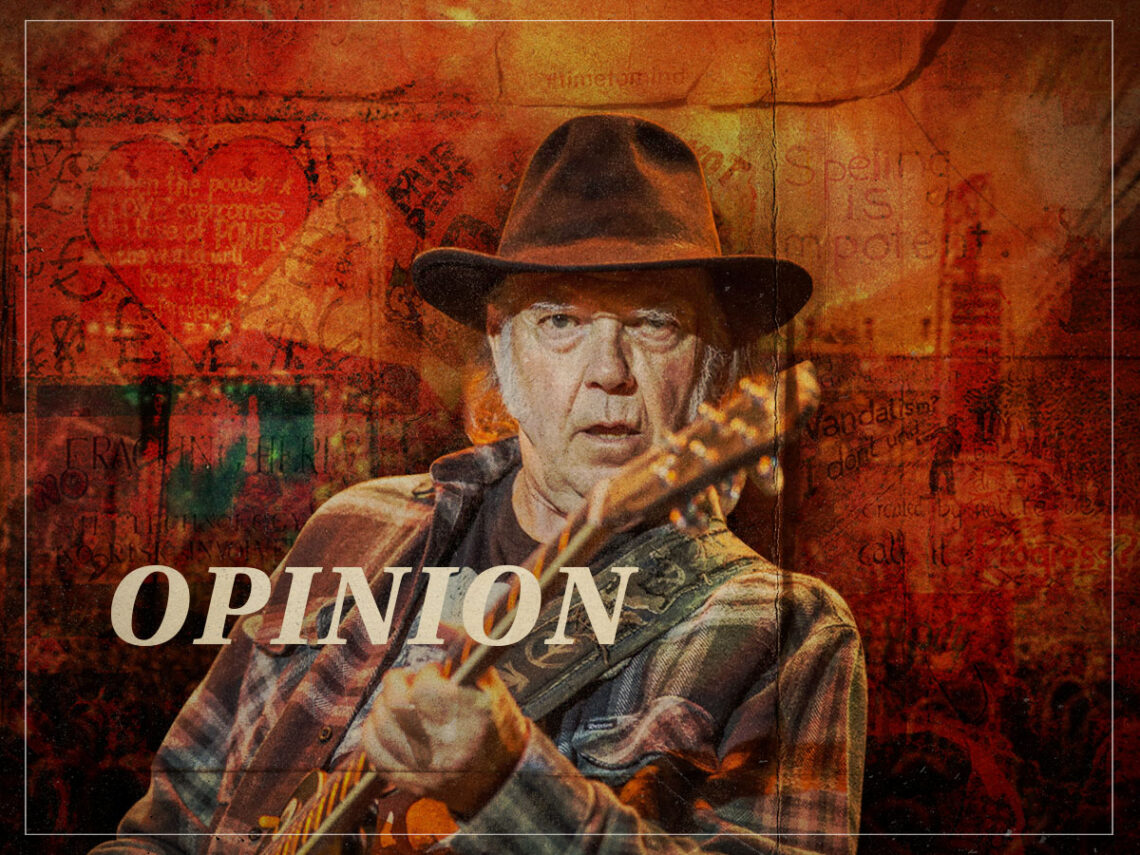
‘Corporations have feelings’: Is Neil Young right about Glastonbury?

Music festivals have always represented the pinnacle of counterculture, going back to the hippie heyday of the 1960s. Since 1970, when Worthy Farm opened itself up to droves of music fans and artists for the first time, Glastonbury Festival has been a place almost entirely removed from the wider world, with attendees free to exist on their own terms and rebelling against capitalist society—or, at least, that is the idyllic image that the festival presents.
In recent years, countless music festivals have been criticised for the prevalence of corporate sponsors and investors throughout their events, and Glastonbury is certainly no exception. The latest to pile on this criticism is the iconic songwriter and elder statesman of folk-rock, Neil Young.
Pulling out of his scheduled appearance on the Pyramid Stage in 2025, the singer – whose music has regularly attacked the corporate world – highlighted the fact that Glastonbury operates in partnership with the BBC. “We were told the BBC was now a partner in Glastonbury and wanted us to do a lot of things we were not interested in,” he shared on his website.
“It seems Glastonbury is now under corporate control and is not the way I remember it being,” Young boldly declared before concluding: “We will not be playing Glastonbury on this tour because it is a corporate turn-off, and not for me like it used to be.” This criticism has certainly been echoed by a variety of other artists and longtime attendees of the festival, many of whom have claimed that its countercultural beginnings have been diluted beyond recognition.
Young’s criticism of the festival seems invariably linked to the BBC, which has had a partnership with Glastonbury since 1997 – the year Young was scheduled to make his first appearance at the event. When he eventually performed in 2009, parts of his set were broadcast by the corporation, and the former Buffalo Springfield musician did not seem to have any issue with it. As such, it is easy to poke holes in his current criticism of the festival and its so-called corporate sponsorships.

In truth, you would be hard-pressed to find any modern music festival without corporate sponsorship these days. Last year, festivals like The Great Escape, Download, and Latitude were criticised and even boycotted by artists as a result of being sponsored by Barclays Bank, who became a target of the Boycott, Divestment, and Sanctions (BDS) movement due to the bank’s ties to Israeli arms deals.
Many of these grievances seem justified, however, it is also clear that corporate sponsorship is an unavoidable aspect of the modern festival experience in the capitalist age where live music is grossly under threat, and without their involvement, many festivals simply would not have the budget to continue.
Glastonbury, on the other hand, is different from any other music festival. Throughout its history, the event has always made an effort to support ethical businesses and worthy causes, from its endless support of the Campaign for Nuclear Disarmament (CND) to its continued partnership with Greenpeace. It largely still presents this virtuous image to the public. If you dig a little deeper, however, there might be some truth in Neil Young’s comments.
For the past two years, one of Glastonbury’s sponsors has been luxury car manufacturer Land Rover. While petrol-guzzling luxury four-by-fours seem at odds with the peace and love image of the festival anyway, it must also be remembered that Jaguar Land Rover was linked to illegal deforestation in Paraguay back in 2022, which seems entirely at odds with the environmental message at the heart of Glastonbury.
You could certainly link this sponsorship back to comments made by Young, which highlight the apparent hypocrisy at the heart of Glastonbury Festival and of the wider landscape of corporate music festivals and large-scale venues.
Upon initial inspection, it is easy to dismiss Young’s recent comments about Glastonbury as a grumpy bloke throwing his toys out of the pushchair, especially given that his BBC claims were devoid of any specific demands. However, the songwriter’s take on the festival does open up a wider conversation about the increasing normalisation of corporate influences in music festivals.
On the one hand, the money brought in by these sponsors and partnerships allows the festivals to keep going year after year, paying artists fairly for their appearances and workers for their labour. After all, every year sees the departure of more music festivals as they struggle to stay afloat in a time of increasing costs and lower attendance. On the other hand, it is difficult to truly believe the spiritual, green message purported by Glastonbury, while the festival site is littered with logos and businesses with shady histories.
This is where Young’s issue with the BBC proves particularly telling: the broadcaster is not the typical firm you think of when it comes to shady corporate sponsorship, yet it is responsible for the image presented. Thus, if Young’s problem is with the duplicity of its free-love affrontery and rigid capitalist realities, then lambasting them as the face of its secretly waning soul is much more apt than perhaps it first appeared.
It remains to be seen whether the festival industry will ever truly sever ties with its corporate interests. However, Glastonbury and its reputation seem too deeply ingrained in corporate investment and culture to ever return to its grassroots countercultural beginnings. The festival always tries to be more ethical and sustainable than the rest, but it simply cannot exist in its current form without outside investment. For the time being, therefore, it seems Neil Young will be staying away from Worthy Farm, and it remains to be seen how many other artists will follow suit.
