


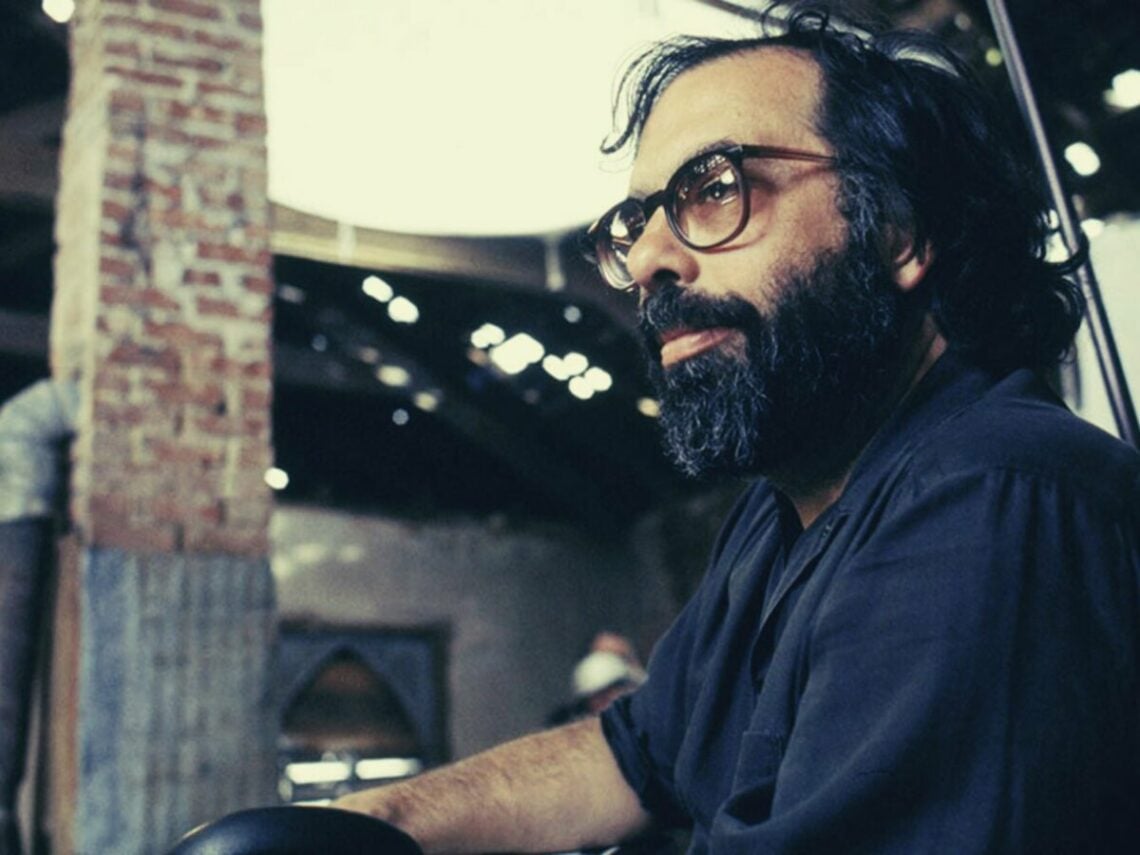
Francis Ford Coppola reveals the two biggest regrets of his career

As one of the prominent figures of the ‘New Hollywood’ filmmaking movement of the 1960s and ’70s, Francis Ford Coppola joined the likes of Martin Scorsese, George Lucas and Steven Spielberg in a quest to revitalise the American film industry. After winning the ‘Best Original Screenplay’ Academy Award for his writing contributions to Franklin J. Schaffner’s Patton, Coppola launched into a decade of brilliance unparalleled in Hollywood history.
Coppola’s 1970s filmography boasted a run of all-time classics, including the first two instalments of the seminal Godfather trilogy, 1974’s The Conversation and 1979’s Vietnam War essential, Apocalypse Now. Over this prolific period in his career, Coppola worked with notable actors like Marlon Brando, Al Pacino, Robert De Niro, Harrison Ford, Gene Hackman and Robert Duvall and helped to revolutionise filmmaking.
Suffice it to say, Coppola has very little to worry about regarding his legacy; however, like most of us, he’s not without regret. Following his jaw-dropping run in the 1970s, Coppola sought to stretch his legs into new pastures, namely, his spectacular 1982 failure One from the Heart.
The director, who had cut his teeth with gritty thrillers and war dramas, tried his hand at romantic comedy and sadly followed through with a wet fart. Although the eventual movie was a critical and commercial disaster, Coppola revealed in a 2003 interview with Today that his “beloved associates” on the project had a hand in its failure.
Coppola had conceived the idea with a theatrical production in mind. “I should have said, ‘Fellas, I love you, but if you don’t want to do it as a live production, I have to tell you that I’m gonna get people who do.’” The project was one of Coppola’s deepest regrets, as it gutted him financially and corroded his status.
Throughout the 1980s, a filmmaker of five Academy Awards had become a director for hire, taking on moribund projects such as Gardens of Stone, which only served to further the damage to his status with minimal financial consolation.
Following “those more serious masculine pictures” of the 1970s, “I was anxious to look into another area of my background, which was as someone who directed musicals in college,” Coppola reflected in conversation with Today. “Sometimes you can fail as easily by having your ambition too great as to have it be too small. I think I’ve done that many times in my life. I go for the whole shining dream and then very often fall short of it because you sort of have to.”
“So often I make my decisions not on the basis of total logic but sort of a kind of intuition,” he continued in self-analysis. “Now, as I’m older, I realise one thing that makes me different is that I sort of go to the finished vision, finished — then back up and figure out how to do it. … Like building castles in the air but then putting the foundation afterward.
“Because if you do it the other way, each time you come up to an obstacle, you change the finished vision. ‘Oh, well, we can’t get that much concrete.’ ‘OK, then we won’t make it out of concrete then.’ ‘The county won’t give you the permits.’ ‘OK, what will they give us the permits for? All right.’ If you’re constantly changing your dream in order to suit the hundreds of practical problems, then the dream won’t be there when you’re finished.”
Coppola certainly doesn’t expect people to revere One from the Heart on the level of some of his other movies, but said he’d like people to see it and say, “Ah, that’s a pretty film.” He chalked the ruthless critical appraisals to, “’what’s-he-doing-that-for? syndrome’, where you’re judged based on what you’re known for.”
“The filmmaker wants to experiment, but the market forces and the audiences and maybe the critical faction wants you to stay in your place,” he added. “I have to stay in my place; I’d like to go to the South Seas and write a novel, and be Gauguin … [but] I got to be here and be in the rat race, and you have to as well.”
Elsewhere in his conversation with Today, Coppola revealed his next biggest regret: “My generation, me and my colleagues, didn’t leave the film industry in a better place for the young people coming now. […] It was terrible then, but it’s worse now.”
Coppola attributes much of this failure to the financial greed of Hollywood, which often values quick cash over artistic merit. He recalled working with notable Hollywood magnates such as Jack Warner, Daryl Zanuck and Sam Goldwyn, “who were certainly concerned about business, but they were showmen.”
“They were more like Harvey Weinstein, in truth,” he continued. “Harvey Weinstein is, you know, a controversial figure. But you gotta say that besides the fact that he’s bright, and he’s vulgar — but they were vulgar — he loves movies. He loves movies. But I don’t know that Rupert Murdoch loves movies or that Viacom [owner of Paramount] loves movies. Any of them! They don’t. They’re building empires.”
In a poignant conclusion, Coppola took issue with the devaluing obsession with sequels and remakes in modern cinema. “Look, I’ve been blessed by the film business. I’m not saying this with any rancour,” he asserted. “My idea of the perfect studio was: You make one film that has a real shot to make a lot of money, and then you make another one that has no shot to make a lot of money, but one protects the other. That’s why you have them both. You have the vitality of new areas of experimentation, and you have the security — you have a horror film made each year or something. But they don’t do that. Now they just want to make money.”
