


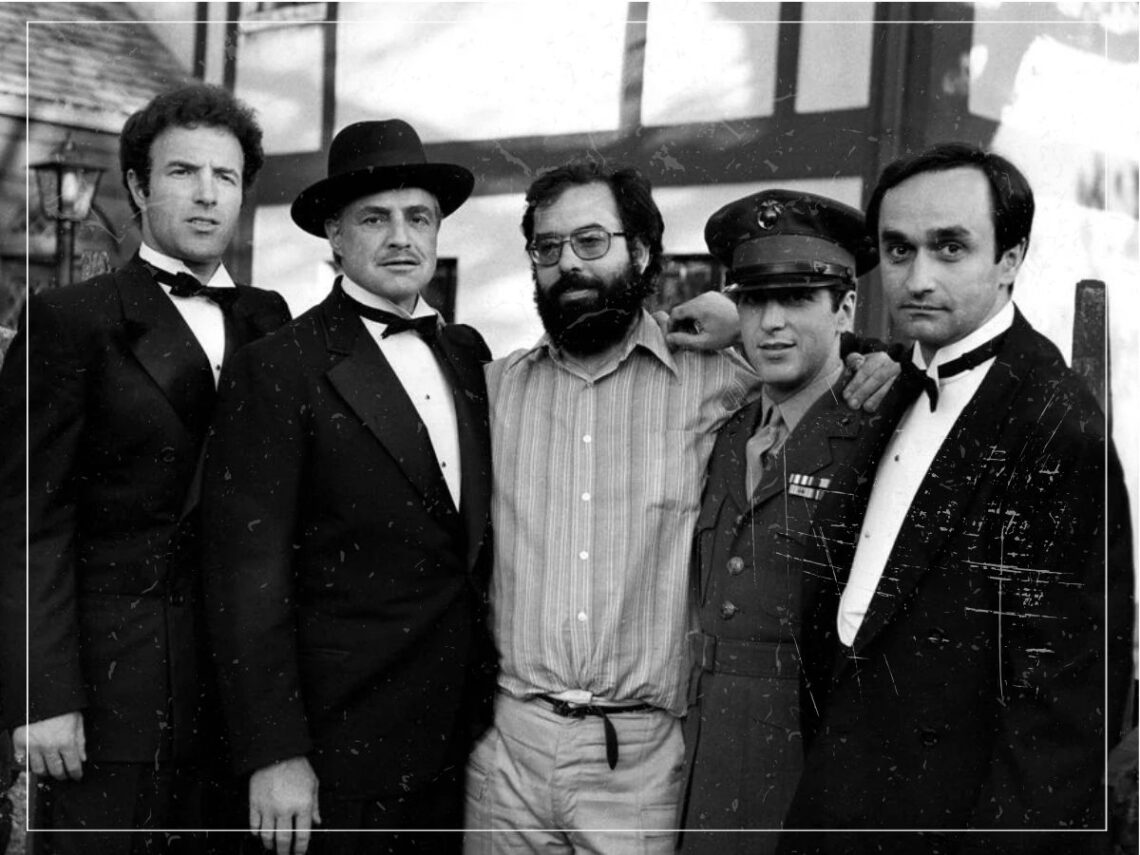
The “struggles” that made Francis Ford Coppola hate the “horrible experience” of ‘The Godfather’

When Francis Ford Coppola took on The Godfather, he was just 29 and had yet to trailblaze the so-called ‘New Hollywood’ era alongside the likes of Martin Scorsese, George Lucas and Steven Spielberg — a group later nicknamed the ‘movie brats’.
The group would go on to define cinema as we know it today, and centrally placed in the litany of movies that erupted from these great minds is The Godfather, a picture which has been so routinely suggested as the greatest of all time, that it feels impossible to deny with any real credibility.
Coppola’s ability to throw his now-perceived weight around as he approached The Godfather diminished. His status within the cinematic world had just begun to bud following a string of low-budget movies, a rise which had so far peaked with 1970’s Patton, a film by Franklin J Schaffner, which Coppola co-wrote.
“I had made my success writing war movies: Patton and stuff like that,” Coppola recalled of his gradual rise to prominence in the early 1970s in a conversation with Cigar Aficionado. “But they hadn’t come out yet, so in reality, I had no success.” Coppola’s dedication to his craft meant his next venture would be as meticulously planned and delivered as possible, and, like so many of the greatest movies ever made, The Godfather began with books. “I remember going to the library,” the director recalled, “and I pulled out three books on that subject. I read them all.”
Coppola is a famously meticulous movie maker, and getting the story from the pages of a book onto the big screen needed a cultured hand. Coppola was in need of education in the subject, too: “All I knew about the mafia is that there had been a movie called Black Hand, starring Gene Kelly, that I had seen when I was a kid,” he added. “My father took me to see it. And I knew there was something about the Mafia, but I knew nothing about what it was or how it worked.”

When taking on The Godfather project, Coppola made extensive notes in a copy of Mario Puzo’s 1969 novel of the same name. “When I accepted the job, I cut all the pages out of the book where I made my notes, and I glued them into this thing myself,” Coppola recalled. “I made this myself,” the director shared while producing a scrapbook of sorts that acted as his holy book of direction for the project. “And then I went through very carefully, and I analysed each scene.”
“This book was done months before the filming,” he added. “There was no movie at this point. But I had the job. And then I used this book to write the script for Paramount, [production head] Robert Evans and those guys, and I turned in the script. I had decided that the book had a jewel in it, which was the story of the father and the three sons.”
As we now know, The Godfather became one of the true greats of western cinema and is widely regarded as the greatest film of all time. However, Coppola’s success was an unlikely cut against the grain; the grain being obstinate Paramount executives. “The movie was a black sheep at Paramount,” Coppola told Cigar Aficionado. “They didn’t like it. They didn’t like my idea. They didn’t like me.”
“At the beginning, they felt that by getting a young Italian guy, (a) they could make the movie cheap, (b) they could boss him around, and (c) it would give it some Italian flavour,” he added. However, the project was marred by issues. The movie was in no short supply of hold-ups, with Paramount seemingly disagreeing with every decision Coppola made, from casting to setting to his own position in the chair. The movie was thought to be destined for failure if the budget wasn’t restrained.
“I went to them [Paramount] and said, ‘I don’t want to make it as a contemporary movie. I think it’s very important that this movie is also about America. And I think it’s very important, like the book, that it should be set in the ’40s,’” Coppola remembered. “‘Absolutely not,’ they say. ‘Absolutely not. If we set it in the ’40s, we’re gonna have to have costumes, we’re gonna have to have sets. Cars. We gotta get old cars. We gotta make the budget, so absolutely not.’ I said, ‘Well, to me, the story won’t work with hippies in it. It’s a classic story,’ I kept saying.”

The executives also disagreed with Coppola’s plans to make the movie in New York. “You’re gonna make it in LA, or you’re gonna make it in Kansas City, or you’re gonna make it in San Francisco,” Coppola remembered being told. “It’s not gonna be in New York. New York is the most expensive place in the world to shoot a movie. You cannot make it in New York.”
After such disagreements, Paramount executives began to entertain the idea of booting Coppola from the job. “I realise that they’re starting to go out to more important directors to see if maybe they can get rid of me, who’s making trouble,” Coppola said. “The budget is not going to be under $2million if he makes it in New York. I heard rumours that they had offered it [the director’s role] to Costa-Gavras and then Elia Kazan. They both turned it down.”
Another setback came when Coppola began the casting process. He had his heart set on Robert Duvall for the role of Tom Hagen and Al Pacino for Michael Corleone, but the executives had different ideas. “Listen, Francis, we’re taking over,” Coppola recalled of the conversation. “You have to really cast this movie. Don’t give us this Al Pacino and all these people like Bobby Duvall; we don’t want them.”
Thankfully, Coppola managed to get Marlon Brando on board for the role of mob boss Vito Corleone, which, among other factors, gave him more leverage when negotiating with the executives. While the movie was ultimately made to most of Coppola’s specifications, he was scarred by the experience and loathed the film for a long time.
“The struggles went on right through the editing,” Coppola continued. “They pulled the music out and said how they hated the music, or how they told me to take a half an hour out, or they were gonna fire me, and that when I took the half hour out, they said, ‘You ruined the picture.’ Or they said, ‘We ordered a movie and you brought us a trailer,’ so they put the half hour back in, and then they said, ‘Look how brilliant we are; we put that in.’
“To me, it was just a horrible experience. I hated it. I still hate the memory of it. I didn’t even know the picture was any good until a friend of mine that I called to give me some advice looked at it and said, ‘This is terrific.’ That was Bob Towne, the writer. But at the time, I had nothing positive happening.”
Following his poor experience with Paramount executives, Coppola turned his back on the production giant, remaining close with his cast and crew, heading towards the second movie in the trilogy. Of cast members like Pacino and Duvall, Coppola told the publication, “We remained close, and we worked together. They went on to become movie stars. But they had never been the doubters. They were just these kids I brought in, and they were hoping I wasn’t gonna get fired. The group was tight and remained tight. Of course, when I made the second film, which I didn’t wanna make, the rules were different. Paramount had nothing to do with it. They didn’t even see the script or anything.”
A picture which Coppola would later described as a “romance” has since become one of the most adored movies in existence, and placed Coppola as one of the most widely appreciated directors of his age. Though this movie may well have been a struggle and pushed Coppola to the edge of reason, it was the film that wlloed him to continue his journey to become one of the most celebrated filmmakers with a new hefty amount of respect.
