


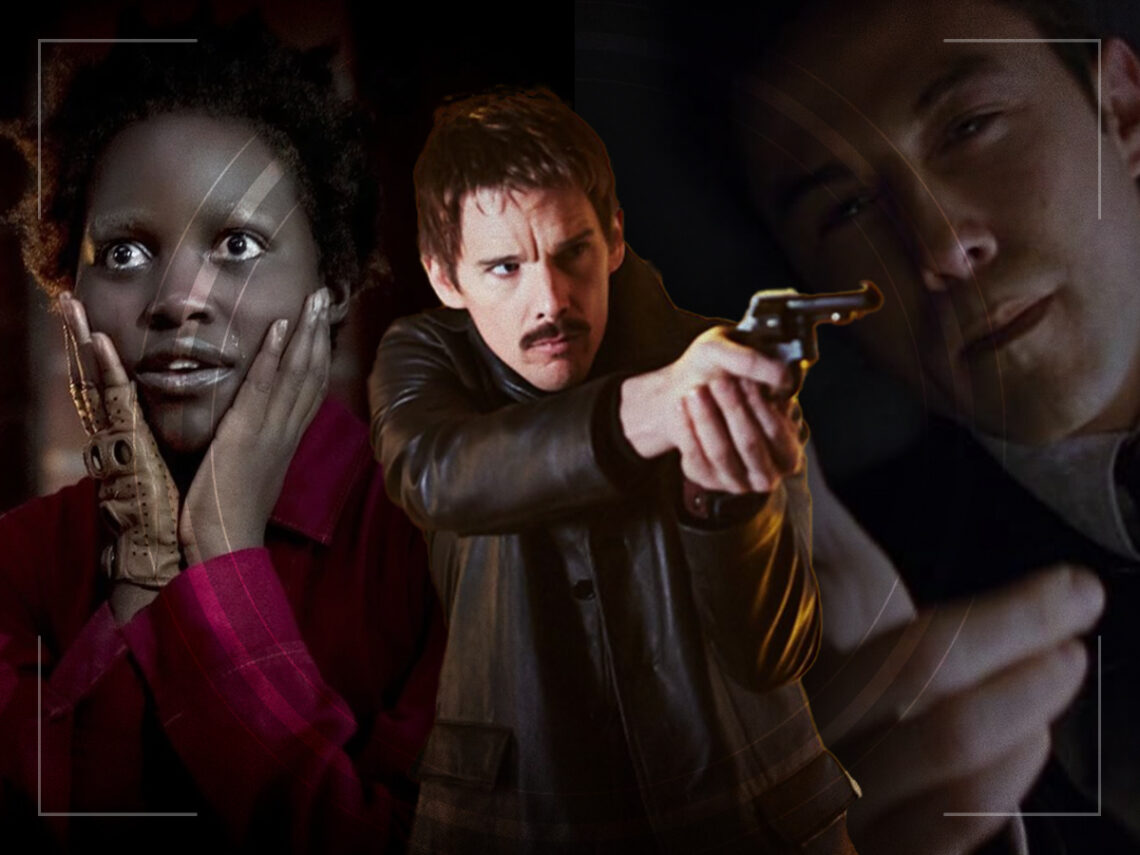
Five movies that make less sense every time you watch them

Everyone loves watching a movie that treats its audience with respect and expects them to pay attention. The best examples of these films unfold their plots in ways that challenge the viewer, without giving them all the answers, and conclude by asking the audience to parse their mysteries to gain a complete understanding.
Over the years, countless incredible films have operated in this way, and their logic stands up to scrutiny when they are picked apart afterwards. Many movies like this include a twist ending, which makes you look back upon preceding events in a new light, but when you watch the film again, you see the clues laid out like breadcrumbs for you to follow.
Naturally, though, not every movie is built like this, and over the years, there have been plenty of ambitious, acclaimed, and successful films that, at their core, don’t make much sense at all. In fact, the more you watch them, the more their nonsensical nature begins to stick out like a sore thumb.
From a recent allegorical horror movie to a superhero blockbuster, by way of a couple of time travel headscratchers and a virtual reality curio, here are five movies that make less sense every time you watch them.
Five endlessly confusing movies:
‘Us’ (Jordan Peele, 2019)

Jordan Peele is clearly an extremely talented filmmaker, and his time as one-half of the sketch duo Key & Peele will forever live in my heart. However, in my opinion, Get Out, which worked so brilliantly on the surface as a horror movie but also had a true thematic resonance, has left him in a position where he must try to repeat that trick every time he makes a film. For me, his follow-up movies Us and Nope didn’t work anywhere near as well, with Us in particular falling apart upon second viewing.
On first watch, the ending of Us is horrifying and confusing, but by the time the credits rolled, I thought I had a handle on what actually happened. Upon second viewing, aided by a couple of explainers, I was in full comprehension of the facts, yet somehow that only made the entire plot of the movie seem so far-fetched that it stopped making sense.
The idea of the ‘Tethered’ being humanity’s doppelgangers who live underground, but who have now ascended to take back the world that was kept from them, is just too silly to buy into. Maybe if the movie had seemed over-the-top and fanciful from the start, it might have worked, but in Peele’s film, it simply invited too many questions that couldn’t be logically answered. It only worked on an abstract, intellectual level, with the Tethered being an obvious allegory for the poor and downtrodden working class in society, but an intellectual allegory does not necessarily make for a good horror movie ending.
‘The Dark Knight Rises’ (Christopher Nolan, 2012)

The Dark Knight Rises is an incredibly frustrating movie. On the one hand, it has some truly awesome stuff in it, from the bravura opening plane sequence to Tom Hardy’s brilliantly eccentric Bane performance. On the other hand, though, it’s easily the worst offender in Christopher Nolan’s Dark Knight Trilogy for throwing logic to the wind, and while some of these things are easy to forgive on first watch, they become more and more nonsensical with each subsequent viewing.
For starters, this major Hollywood blockbuster actually features Gotham City’s entire police force being sent underground to battle Bane’s army, leading to every one of them being trapped there for five months while the villain runs amok above ground. The notion that any sane police department would send every single officer to tackle one case is farcical and only makes sense in the context of movie logic. In essence, Nolan needed Bane to have free rein, so he sent all the cops underground.
At various other points in The Dark Knight Rises, Bruce Wayne’s broken back is healed by being punched into place; he somehow gets back from a pit in the Middle East to Gotham City, which has been cut off from the rest of America, with no explanation; characters reveal secret identities that have no bearing on the movie despite making comic book nerds happy; and Batman fakes his death to go live in Italy with a woman who sold him out to the guy who viciously snapped his spine. Nonsense!
‘Looper’ (Rian Johnson, 2012)

Rian Johnson’s Looper is the first instance of time travel appearing on this list, but it won’t be the last. As lots of writers and filmmakers will know, time travel is a notoriously tricksy thing to portray, because no matter what tactic you take, you’ll inevitably be left with people pointing out all the logic holes and inconsistencies in your method. Such as when an internet journalist like me tells you your movie makes less sense every time it’s watched.
The conceit of Looper is undeniably compelling. Joseph Gordon-Levitt plays a hitman in the present day who kills people sent back from the future, because in that time, it has become impossible to get away with murder. However, matters are complicated when his own future self, played by Bruce Willis, is sent back to be killed. What would happen if he killed this version of himself? Would he cease to exist?
In a way, Looper is the poster child for a movie concept that makes you say, “Oh, that’s cool!” followed by “Wait a minute…” as you think about it for any length of time. The more you watch the movie, the more it starts to seem like it doesn’t make a lick of sense, and you begin asking pesky questions like, “Why can they get away with kidnapping in the future but not murder?” and “Couldn’t the future people just have ‘past JGL’ killed instead of sending his future self back in time?” Or, most pressingly of all, “Why did they cover JGL in prosthetics that in no way make him look more like Bruce Willis?”
‘Don’t Worry Darling’ (Olivia Wilde, 2022)

I liked Don’t Worry Darling quite a bit. As a psychological thriller that begins with a Stepford Wives-ish concept but evolves into something much more modern, it hit most of the right notes, and the cast, especially Florence Pugh and Chris Pine, are great. The film’s big reveal that the idyllic ’50s picket fence setting is all a computer simulation created by Pine for husbands to live idealised lives with wives whose only function is to serve their needs is also pretty clever, and invites a lot of discussion about gender and the subjugation of women.
However, logistically, the reveal doesn’t stand up to much scrutiny, and therefore, the movie can be easily picked apart if you really want to on repeat viewings. It seems clear that Wilde intended to leave some mysteries dangling at the end of the film, and that’s fine, as it invites discussion and theorising about the movie. But, when that theorising descends into frustratingly unanswerable questions, and not “What did this mean?”, your movie may be in trouble.
For starters, why would Pine’s villain implant all the wives’ memories with the exact same fake backstory? If he’s capable of devising a virtual reality so thorough that he can enslave human beings within it, isn’t that a huge oversight on his part? Does he not think the wives will ever talk about their pasts? In another scene, Pugh witnesses a plane crash, which leads her to Pine’s secret headquarters. No one else sees the crash, and it’s never mentioned again, so…what’s that about?
‘Predestination’ (Michael and Peter Spierig, 2014)

Predestination is a very cool sci-fi thriller starring Ethan Hawke and a pre-Succession Sarah Snook. Hawke plays a ‘Temporal Agent’ who travels through time to stop criminals before they commit crimes. However, one criminal (Snook) always evades him. As the movie progresses, the audience finds out that Hawke and Snook are the same person, but both are stuck in an endless temporal paradox, including a gender reassignment surgery, that renders their origins unknowable.
Now, I had trouble understanding that sentence as I typed it, so that should give you some insight into how much of a head trip Predestination is. It’s the kind of movie that pushes its conceit so hard and so far that you have to give it credit for ambition, even if you’d need a doctorate to understand it, and even when it’s explained to you, it’s unclear if all the logic checks out.
Having said that, Predestination is a great example of what happens when a movie makes less sense every time you watch it, but that doesn’t rob it of its power. The film is still fascinating each time; the acting from Hawke and Snook is still incredible each time; and it’s the kind of intricate sci-fi tapestry that makes you want to crack all its mysteries, even if you know you never will. Amazingly, Hawke once revealed that the movie has such a dedicated fanbase that a police officer once pulled him over simply to ask about the film’s mindboggling ending.
