


‘Don’t Worry Darling’ Review: Style beats substance in this retro thriller

With a generous helping of drama and intrigue surrounding the Don’t Worry Darling press circuit—”Miss Flo”, director Olivia Wilde and Harry Styles‘ romance and the laser-focussed precision with which the internet analysed footage seemingly depicting Styles spitting on Chris Pine’s lap, to name a few— you’d be right to head to the cinema just to see what all the fuss is about.
Lucky for us, the tableau of perfected suburbia offers a sun-soaked pastel backdrop, dreamy enough to act as a brief reprieve. Victory is Palm Springs-esque retro utopia, where employees of the mysterious namesake company live with their families, gratefully shepherded by Frank (played by Chris Pine), the town’s charismatic leader. Two such residents are Alice Chambers (Florence Pugh) and her husband Jack (Styles), who, along with the rest of town, lead a seemingly perfect life. The husbands leave for work as one in the morning, waved off by a chorus of perfectly coiffed wives who go about their day home-making, shopping and gossiping.
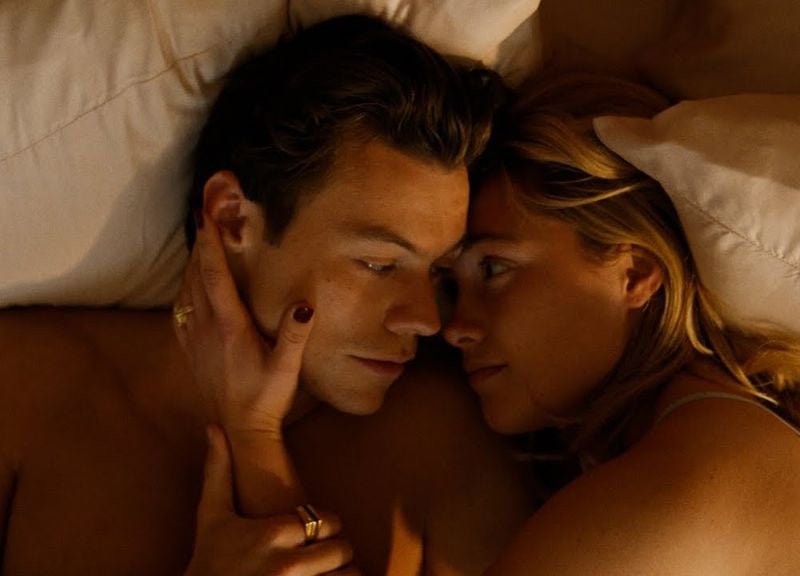
The picture of a 1950s housewife, Alice greets Jack with a drink after he arrives home from a long day doing whatever it is they do at the Victory project. As long foretold in the trailer and in the press, Jack greets her another way. All is bliss… until it isn’t. The crack’s in Alice’s perfect life begin to show, and she starts to question the forces that keep the town so damn pleasant.
The era-relevant vinyl bops are interspersed with distorted jarring soundscapes as Alice’s reality begins to unravel. Victory’s palm tree-lined streets start to read a little more “cult” than cul-de-sac. Later, at a swanky company party, the men of the Victory Project beat their chests, praising the chaos-free world they’re building. Later, Styles dances at the behest of Frank (Pine), literally shuffle-ball-changing as his leader commands, something arguably mirrored in their respective acting talents. As Alice spirals further, pay attention to the unified tensing of the audience’s shoulders as her behaviour is called “hysterical”.
Florence Pugh is sensational, breathing fresh life and agency into tropes that Stepford Wives and The Truman Show have both tackled before her, carrying the twists and turns of the thrilling plot with grace, even when they feel a touch heavy-handed. Styles has a decent first turn as a male lead, despite being the object of much online hilarity, while Chris Pine plays his enigmatic figurehead with dynamic assuredness. Wilde, in her turn as BFF, Bunny, peppers some enjoyable winks and zippy lines in to mock the stereotypes that are stylishly served throughout.
There is no doubt that Don’t Worry Darling is a slick and beautifully shot film. However, the brief glimpses of a more interesting further narrative are too quickly shut down. The polished exterior, though suitably dazzling and wonderfully beguiling, if only for a short while, is not enough to shake the feeling that the most interesting part of Alice’s story was left untold.
