


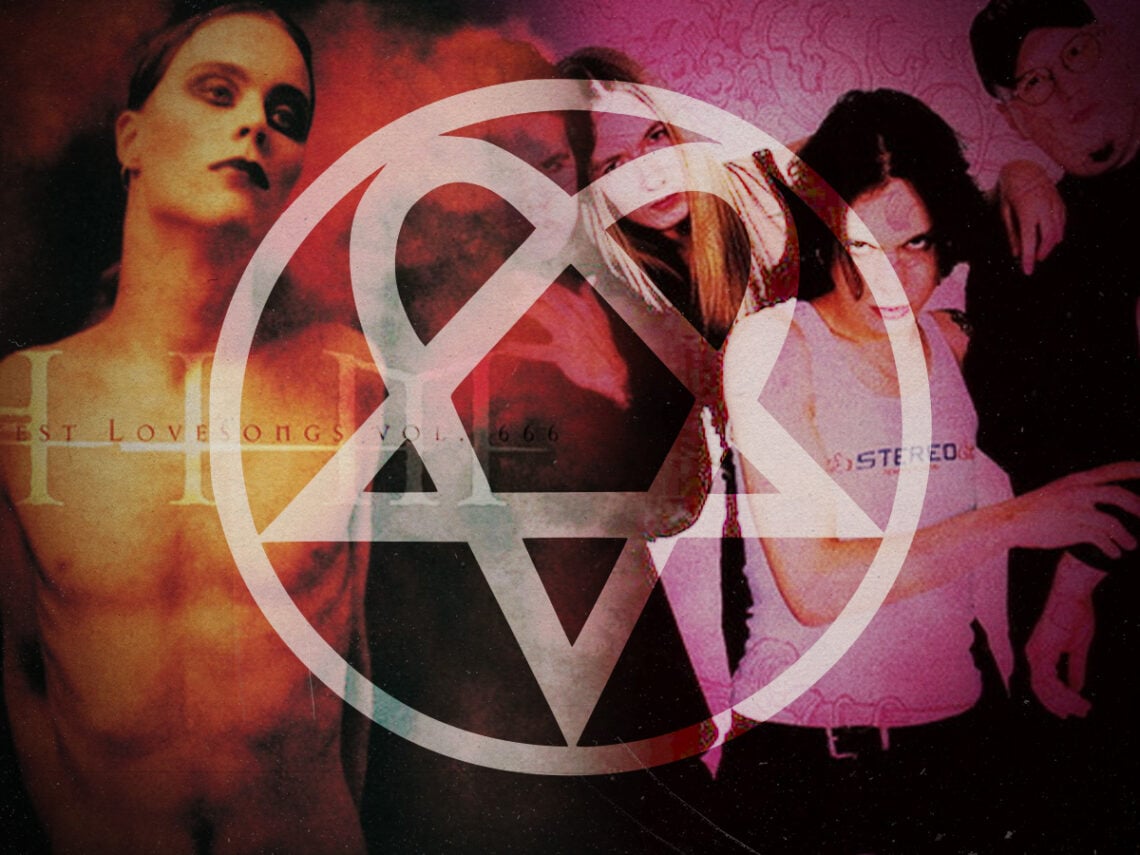
Where did the “Heartagram” symbol actually come from?

Some of rock culture’s most enduring iconography personifies and leads a life of its own, outside of the defining discographies it once adorned.
Andy Warhol’s banana image for The Velvet Underground & Nico comes to mind, as does the Rolling Stones’ signature tongue logo. Some icons, like the Nirvana smiley face, for instance, have become quite literal caricatures, removed from artists almost entirely and becoming an icon of culture, at large. One of rock’s most recognisable symbols, one that grew beyond the culture into the realms of skateboarding, film and television, and more, came from HIM, a Finnish goth metal band that, at the time, was relatively nascent.
Before HIM’s frontman, Ville Valo, became one of metal’s most timeless voices and songwriters, a vampiric figure with an unmistakable baritone voice, he was pondering the ways in which his band could stand apart, in his infatuations with gothic imagery and lovestruck lyricism. The day that Valo turned 20 years old, November 22nd, 1996, he sat in his flat in Helsinki, Finland, waiting for his friends to arrive and commence a beer-filled night. To pass the time, he began sketching nonsensical drawings on paper, as he told Louder Sound in 2016, “Figure out something cool”.
For HIM’s first release, the 1996 EP 666 Ways to Love: Prologue (only to be released in Finland), the band adorned it with a heart that had “666” inside, as a logo. “It just felt a bit boring,” Valo admitted. “It didn’t feel nice or cool.” For a band that traversed the edges of Satanic imagery while passionately singing about all matters of the heart – love, devotion and its demise – HIM needed a unifying symbol that would capture a balance of their energies: unshakeable vulnerability, almost painfully romantic, rooted in a morbid vision of gothic and metal traditions.
“So I’d been drawing and drawing and drawing, but at that time, that combination of something kind with something Satanic-looking wasn’t everywhere,” Valo explained. “You didn’t get those Satanic-looking teddy bears, if you know what I mean.”

Continuing to haphazardly sketch, a symbol eventually came about from a hexagram-type configuration: a combination of a heart and a pentagram, emphasising the complexity that Valo wanted to define, “the soft and the hard, the male and the female, the ying and the yang – which, for me, is important,” he described.
The “heart” side, as Valo defined it, acted as a sort of homage to Elvis Presley’s ‘(Let Me Be Your Teddy Bear)’, while the antithesis of the pentagram reflected the spectrum of hard rock, indebted to HIM’s influences, from the original love metal croonings of Type O Negative, the foundations sown by Black Sabbath and the raucous energy of Mötley Crüe.

Eventually, Valo’s friends showed up for the evening, and he presented his design as the “heartagram” (a name that thankfully stuck, as opposed to his friend’s suggestion of calling it the “loveagram”). Valo’s original sketch was then stowed away somewhere in his home, unseen in the decades since, but the design stuck in the singer’s mind as he imagined the ways that HIM could elevate it.
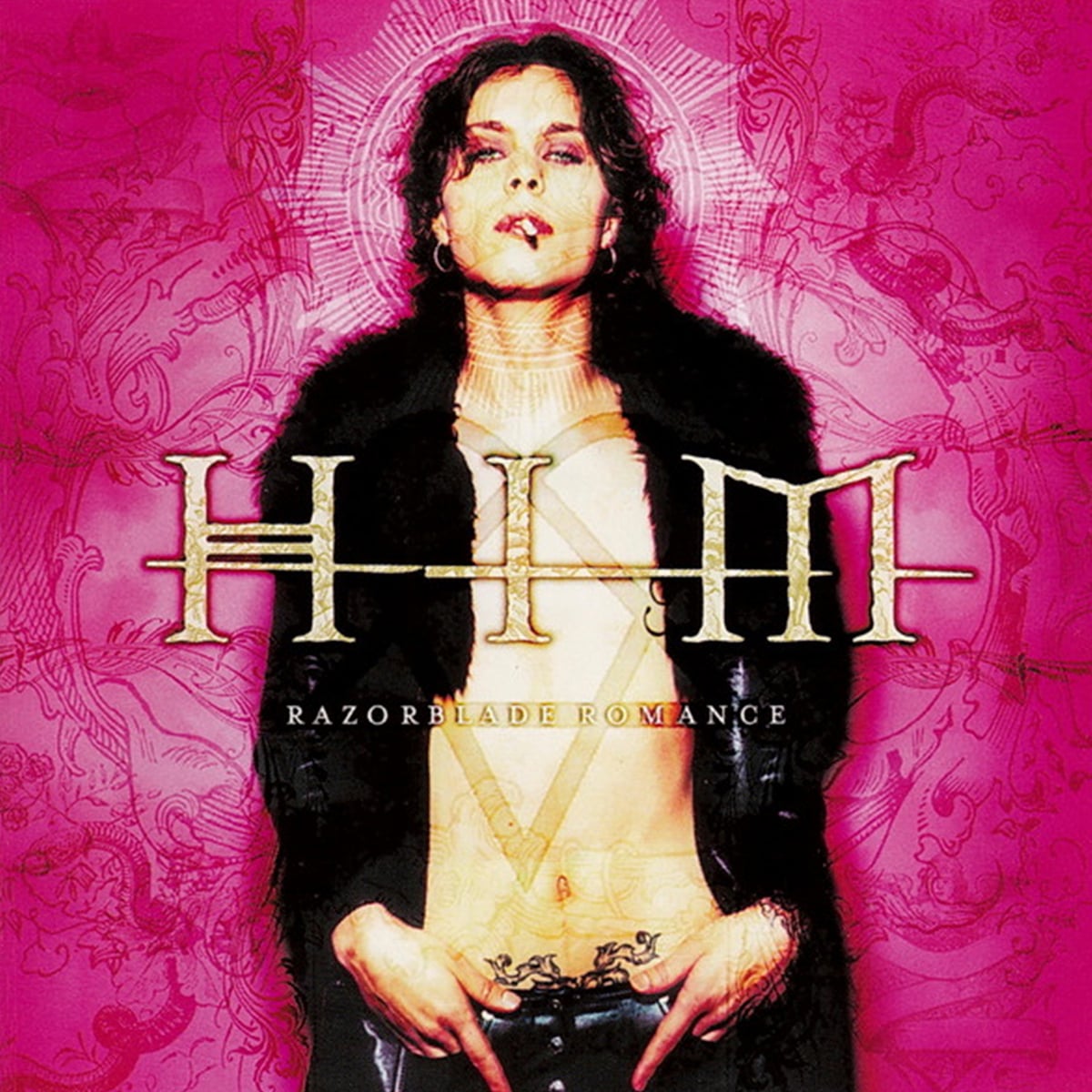
Valo got a friend to enhance the heartagram on a computer, and the symbol was soon engraved in the band’s imagery, appearing in some way, shape or form on five of their eight album covers, beginning with 2000’s Razorblade Romance. 2003’s Love Metal is solely adorned with a gold heartagram, the first of their covers to centre on the symbol, becoming a descriptor of their image and sound.
“We have such terribly short memory spans that we couldn’t possibly think of having individual symbols like Led Zeppelin did,” Valo told Metal Hammer in 2004. “The heartagram stands for HIM as a band, as an entity and for love metal in general.”
It was Razorblade Romance that first caught the ear of American skateboarder-turned-Jackass stuntman, Bam Margera. While on a plane to Finland to attend a skateboarding contest, Margera read articles about HIM, the band at the time was relatively unknown in the States. In his hotel room, the music video channel’s number one video was HIM’s ‘Right Here In My Arms’, and he became so obsessed that he immediately went to the record store to get his own copy of Razorblade Romance. Margera put HIM’s music as soundtracks to his CKY videos, collections of stunts and pranks mixed with skateboarding, and eventually became good friends with Valo and directed some of HIM’s music videos.
With Margera’s lauding of HIM as his favourite band, they began to slowly break through in the States and beyond, and the heartagram came along with them. Margera began adopting the symbol on his skateboards and merchandise, and it became synonymous with skateboarding culture at large.
In tattoo culture, the heartagram became a staple of early 2000’s alternative iconography: Margera has had multiple heartagram designs inked over the years, while fellow Jackass madman Steve-O tattooed his own, X-rated version of the heartagram on his chest, and tattoo artist Kat Von D placed the symbol on both of her ring fingers. As seen on her reality show, LA Ink, the heartagram featured as decoration in her High Voltage Tattoo studio, too. The symbol was also shown in various television series, including Criminal Minds and Charmed.
Valo, himself, would adopt tattoos of the heartagram in the coming years: first, an elaborate design with the heartagram centred on his lower stomach, followed by his chest and neck. Recently, rapper Playboi Carti has frequently featured the heartagram in the aesthetics for his 2020 album, Whole Lotta Red and his label, Opium. He also had the heartagram tattooed on his arm.
“It’s started to have a life of its own,” Valo enthused about the symbol. “There are a lot of people who have them who don’t actually know what it was, don’t relate it to the band, and in that sense, I consider that to be my greatest achievement. “So it’ll be nice to have it on my tombstone. And it’ll be nice to see where it’s going to go next.”
HIM would sadly disband in 2017, with Valo going on to start his solo project, VV, in 2020 (stylised with an updated heartagram, with two extra lines to form a ‘VV’ in the centre), but the heartagram lives on – whether people know its origins in the Finnish goth metal band’s image, or not.
