


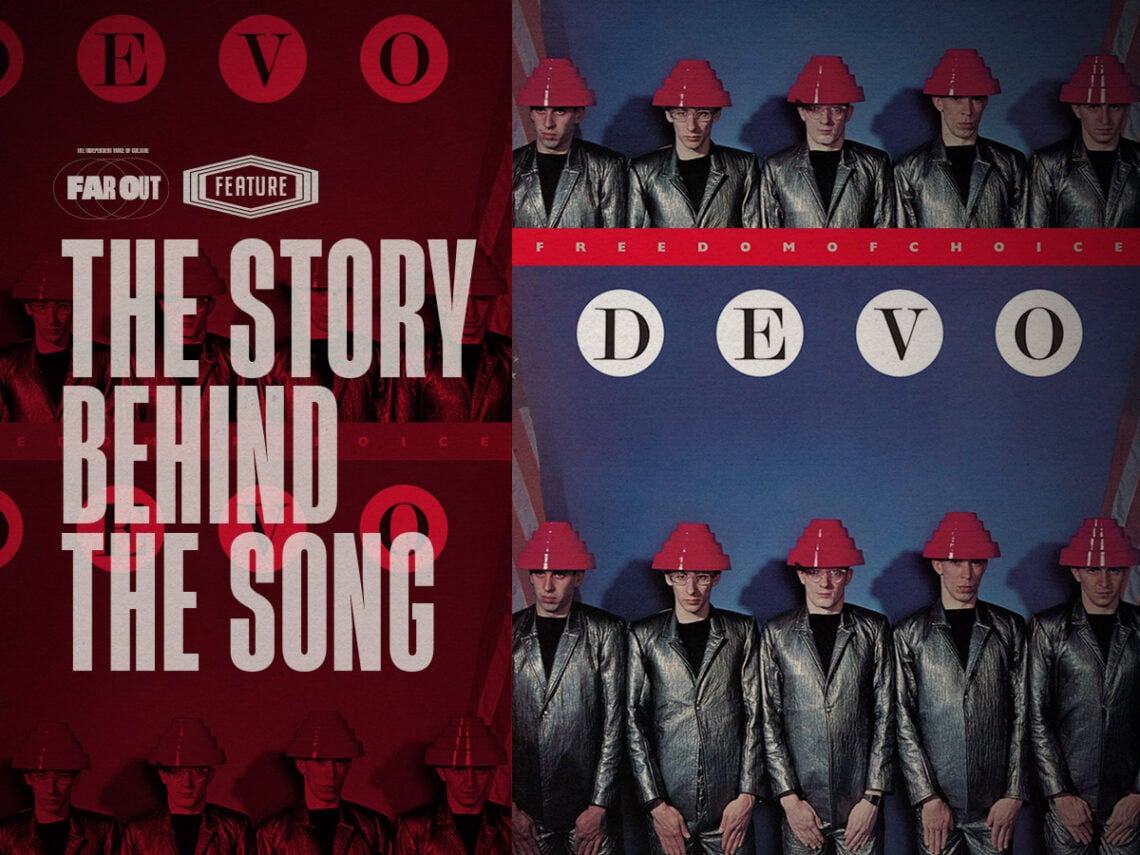
The Story Behind The Song: Devo’s big idea for ‘Freedom of Choice’

Some say the viral phenomenon of our new math-rock alien heroes Angine de Poitrine could never have happened 50 years ago, but anyone watching Saturday Night Live on the night of October 14th, 1978, might beg to differ. That’s when much of the wider population of the United States got their first proper look at Devo.
Dressed in yellow biohazard jumpsuits and welding goggles, the Akron, Ohio outfit dove into their frantic, industrial cover of The Rolling Stones’ ‘Satisfaction’, and within minutes, the national audience split into two camps, not unlike those currently arguing over Angine de Poitrine. Devo were either the long-awaited saviours of rock or a weirdo novelty outfit with a silly gimmick. Strangely, even as the band established itself as bonafide hitmakers over the next few years, the American public continued to operate under one of those two assumptions.
“We were trivialised and pigeon-holed,” Devo co-founder Gerald Casale said in 2024, looking back on his band’s peak commercial success in the early 1980s. It’s a complaint Casale and fellow songwriter Mark Mothersbaugh have been making for decades, but every time they talk about it, it sure seems like being misunderstood was also a cheeky point of pride.
After all, when you’re politically minded men dressed as factory workers or sporting flower pots on your heads, there’s an obvious intent of subversion going on; an attempt to communicate with your in-the-know audience while willingly confusing the hell out of everyone else.
“We had a meta approach,” Casale told the Associated Press. “It was a multimedia, big idea approach. Music was an element, a layer, a dimension, but it was connected to this big worldview.”

While casual observers of Devo saw their act as weirdness for weirdness’s sake, a sort of pretentious theatricality, appreciators quickly bought into the lore of the project. “We were seeing a world that was the antithesis of the idealised, promised future ginned up in the ‘50s and ‘60s,” Casale said. “What we saw was regression.” Or, in other words, the de-evolution of society.
Suffice it to say, nothing that’s happened in the nearly 50 years since Devo’s debut album has done much to disprove their theory, and as a result, the band’s early albums have held up a lot better than any of their members likely would have anticipated, both in terms of the lyrical subject matter and the pioneering synth-inflected brand of post-punk.

While the first two Devo records, Q: Are We Not Men? and Duty Now for the Future, were cult hits, their third release, 1980’s Freedom of Choice, would represent their commercial breakthrough, powered by the massive success of the single ‘Whip It’ and its video’s proliferation on the brand new network MTV.
‘Whip It’, quite famously, was misconstrued by countless fans as a song about masturbation or sadomasochism or any other number of naughty hobbies, when it was actually intended as a satirical commentary on America’s obsession with self-empowering sloganism. As usual, hardly anyone understood the reference, and Casale and Mothersbaugh were left to shake their heads in dismay publicly while presumably chuckling to themselves in private.
In the wake of the ‘Whip It’ sensation came another misunderstood single, the title track to ‘Freedom of Choice’, which had the propulsive beat and upbeat tone of a sort of feel-good sports anthem, complete with a roller derby music video. On a first listen, ‘Freedom of Choice’ was a call-to-arms from the energy dome wearers, rallying their followers to get to the polls in 1980 and prevent Ronald Reagan, an agent of de-evolution, from becoming the next leader of the free world.
“A victim of collision on the open sea / Nobody ever said that life was free / Sink, swim, go down with the ship / But use your freedom of choice.” Interviews the band gave after the album’s release in the spring of 1980, however, painted a less urgent and decidedly more cynical view of the current political situation.
“The fact that [Jimmy] Carter, [Ronald] Reagan, and [John] Anderson are the best candidates for president that this country can come up with is frightening and pathetic,” Mothersbaugh told the Spokesman-Review a few months before the 1980 Presidential election. “Our government is a joke. All the different sections negate each other.”
Mothersbaugh didn’t just hold the politicians and capitalist business interests responsible for the de-evolution of America, though. The song ‘Freedom of Choice’, on a closer listen, reveals that the finger is also firmly pointed at the everyday citizen, fat and happy on his own patch of land, willing to sacrifice his own freedom for a lazy sense of comfort.

As the outro of the song explains, “Freedom of choice / Is what you got / Freedom from choice / Is what you want.” Mothersbaugh was quite frank in explaining the motivation behind the track. “People in this country have warped perceptions of freedom,” he said at the time.
Over 40 years later, Gerald Casale was only more convinced of that viewpoint, having now lived through the Trumpification of US politics. “We were dealing with that horrible phenomena [of de-evolution] that we recognised then,” Casale said in 2024. “People want to vote away their choice. They have this flawed human nature where they want to suck up to authority. They want to be told what to do. They will vote away their freedom. That’s exactly what happened here.”
To better explain their point within the song, Casale and Mothersbaugh decided to deploy a moral tangent direct from the ancient fables of the Greek storyteller Aesop, specifically the tale of ‘The Dog and His Reflection’, in which a happy pooch is carrying a bone in its mouth, but stops when it sees its reflection in a pond, mistaking it for another dog with a bone.
Greedily, the dog decides to steal his rival’s bone and barks angrily at him. In the process, he drops his own bone into the water, only then realising his own stupidity, and somehow, in Devo’s hands, this morphed into the following lines: “In ancient Rome, there was a poem / About a dog who found two bones / He picked at one, he licked the other / He went in circles, he dropped dead.”
As Casale later told Songfacts, the human equivalent of Aesop’s dog came down to the “meaningless choices” we make, “like between Pepsi and Coke, or pink fur shoes or blue suede shoes. Just mindless consumerism.”
It has to come with no small amount of irony, then, that ‘Freedom of Choice’ later found its way into a TV commercial for beer; Miller Lite to be specific. In 2013, over 30 years after they wrote it, Casale and Mothersbaugh agreed to license a re-recorded version of the track for an advert about a guy who uses his freedom of choice to avoid boring light beers like Bud Light and pick up a Miller instead. Before you accuse Devo of selling out to de-evolution, however, they will tell you it’s all still part of the old subversion game.
“Today, when people use Devo’s music in commercials, they either completely miss the point or excise the irony on purpose,” Casale told Songfacts, with Mothersbaugh adding, “I liked that [Miller Lite] one as much as the Swiffer one [that used ‘Whip It’]. Gives me goose bumps of repulsion.”
‘Freedom of Choice’ was far less successful as a single than ‘Whip It’, but it has remained one of Devo’s signature songs, most recently serving as their closing number for their 2026 set at Coachella, played while a video of a tattered American flag was projected on a screen behind them.
“Freedom of choice,” Casale told the crowd as the band left the stage. “Use it or lose it. It’s going fast.”
