


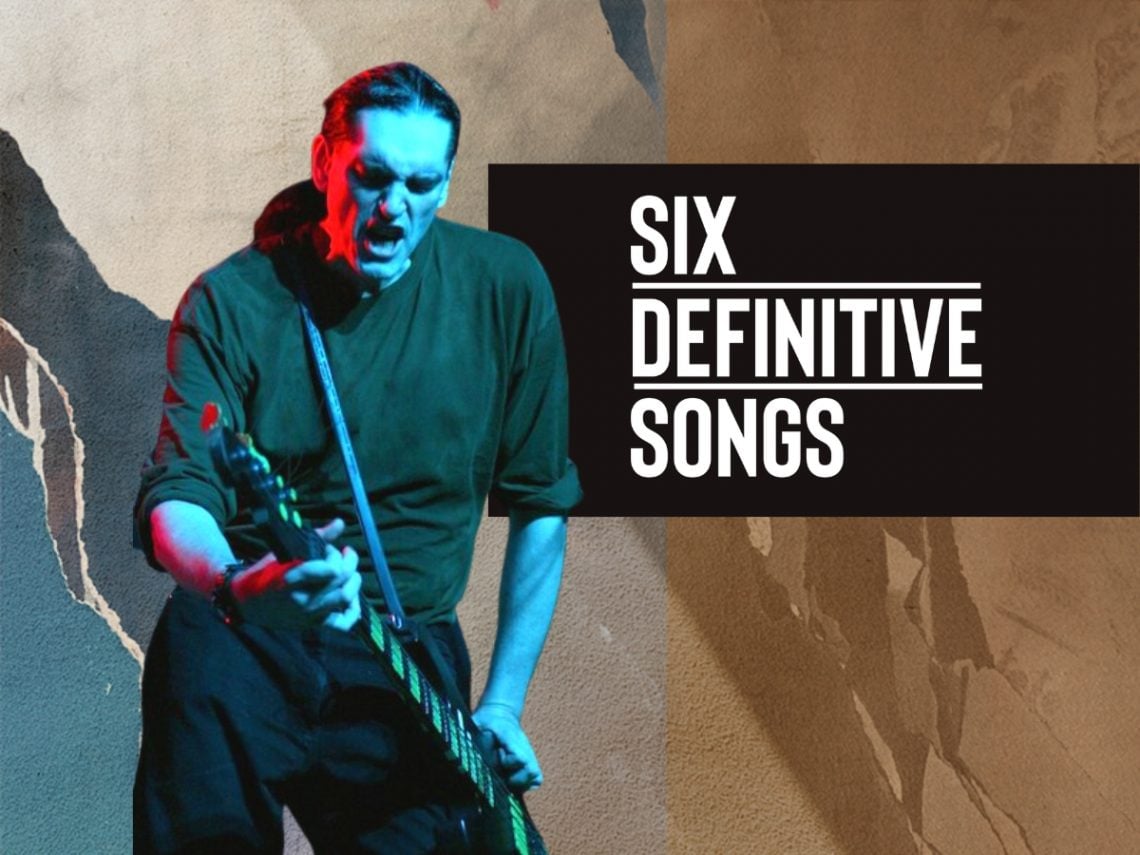
Six Definitive Songs: The ultimate beginner’s guide to Type O Negative

Brooklyn band Type O Negative were a law unto themselves. Formed in 1989 out of the ashes of towering frontman Peter Steele’s former outfit, the controversial thrash group Carnivore, the quartet soon put the past behind them and created a glittering legacy. Gradually developing an individualistic sound, it was ostensibly goth metal but was also characterised by elements of psychedelia, electronic and doom, with a generous splash of pop mixed in for good measure.
Comprised of vocalist and bassist Steele, guitarist Kenny Hickey, keyboardist Josh Silver and drummer Sal Abruscato (replaced by Johnny Kelly in 1993), the band’s style was as expansive as any of their shoegaze or dance contemporaries. Perennially impossible to pin down due to their multifaceted nature and propensity to surprise, it was due to this refreshing quality that Type O Negative established such a dedicated fanbase.
During an interview with Chaos Control in 1992, before the platinum-selling Bloody Kisses was released, Steele revealed the varied music taste that underpinned the dexterity of Type O Negative. “I like psychedelic music, I like goth, I like some early metal, and I like indie,” he explained. “I was not trying to copy anybody, but I certainly used to listen to this stuff, and I think it’s rubbed off on me.”
The group elevated this chameleonic musical style with a sardonic outlook. It resulted in various moments that helped them stand out. In many ways, this character has kept their fanbase dedicated to this day, despite them disbanding in 2010 with Steele’s tragic death. These moments include the gross-out cover image of 1992’s The Origin of the Feces and ‘Bad Ground’, the opener of October Rust, which duped fans into thinking their speakers had broken.
Find the six definitive songs of the ‘Drab Four’ below.
Type O Negative six definitive songs:
‘Christian Woman’ (Bloody Kisses, 1992)
One of the best songs in the quartet’s oeuvre, ‘Christian Woman’ is a track that attests to the extent of their stylistic dexterity. One of two songs credited with launching Steele and the gang to greatness, this extended cut is split into three distinct parts that range from goth-metal to a piano-oriented ballad. They are A) ‘Body of Christ (Corpus Christi)’, B) ‘To Love God’, and C) ‘J.C. Looks Like Me’.
The track is inspired by a real woman with whom Steele was once romantically involved. He once told Revolver: “She was a Roman Catholic, much as I am, but she would get off on breaking the rules a little bit. She would ask me to dress up as a priest and, well, I guess you can just imagine what would happen after that. So, I guess you could say I have a bit of a priest infection.”
‘Black No.1 (Little Miss Scare-All)’ (Bloody Kisses, 1992)
Perhaps Type O’s best-known song, ‘Black No.1’ is an anthemic delight. The sister track to ‘Christian Woman’, the band had some of their most storied moments when playing this live, with Steele’s infectious bassline and chorus delivery impossible to ignore on record and in person.
A demonstration of the band’s classic irony, the lyrics discuss a relationship with a goth woman in a semi-autobiographical account from Steele. In addition to this, the group threw in a number of comical references to ‘gothic’ features of popular culture, such as Halloween, Lily Munster and Nosferatu. Notably, there are also tongue-in-cheek music references to ‘The Addams Family Theme’ and ‘The Munsters’ Theme’.
During an interview with Revolver, Steele discussed the gross origins of the track: “I was waiting in line for three hours to dump 40 cubic yards of human waste at the Hamilton Avenue Marine Transfer Station, and I wrote the song in my head. I’m not kidding you.”
‘Love You to Death’ (October Rust, 1996)
A more traditionally gothic cut in the sense that the band blends the genre’s romanticism with dark themes, even the paradoxical title of it, ‘Love You to Death’, reflects the kind of push-and-pull that characterised the New York outfit. Comprised of a haunting piano line, a heady sonic palette, and some of Steele’s best lyricism, many aspects make this piece one of Type O’s best.
The opening duo of lines: “In her place one hundred candles burning /
As salty sweat drips from her breast”, is a quintessential lyrical moment of Peter Steele. It’s poetic but also coloured with a slightly comedic, overtly sexual essence, something the frontman did so well.
‘Wolf Moon’ (October Rust, 1996)
A refined piece of goth metal, for some Type O purists, ‘Wolf Moon’ is their ultimate cut. The track never fails to impress, featuring Josh Silver’s eerie keyboard, Steele’s booming vocals, and one pulsating mass of air from the guitars. Added to this, the thick chug that Steele and Hickey provide in the chorus is one of the definitive moments the pair recorded together. Punishing yet able to strike directly at the heart; this is what Type O were all about.
With the mention of the wolf moon, unholy water and silver bullets, this was Steele and the band throwing themselves head-first into the world of all things gothic. Steele commands the titular moon to cast a spell on him, and that’s exactly what he did to listeners when this piece first burst through the speakers.
‘Haunted’ (October Rust, 1996)
No discussion of Type O Negative or their masterpiece, October Rust, would be complete without the last musical track on the record, the atmospheric, ‘Haunted’. Commencing with the mysterious synth note and then Silver’s moody piano, it’s akin to being blind-sided in outer space when the rest of the band kicks in. Something close to doomgaze, the band took their penchant for the ethereal to another level here.
Wholly expansive, Steele’s reverb-drenched vocals are incredible. Lyrically speaking, if Tennyson’s Lady of Shallot had a sonic manifestation, it would be ‘Haunted’. Ten minutes of romantic darkness, this is my personal choice for their best song.
‘I Don’t Wanna Be Me’ (Life is Killing Me, 2003)
The only single from Life is Killing Me, the sixth and final studio album Type O Negative released, ‘I Don’t Wanna Be Me’ is well-deserving of a place on the list. A catchy piece of punk complete with an earworm of a riff, coloured by a viscous chorus effect, it’s likely to be stuck in the head for days.
Hickey would later reveal to Kerrang! that the song’s unusually straightforward style was written in response to his frustration at Steele’s proclivity for complex arrangements.
Of the more severe lyrics than usual, Hickey also explained in the same interview that they reflected Steele’s feelings: “At the time, Peter […] wasn’t really doing too well, health-wise. He was getting sick of addictions and sick of life, hence the title, I Don’t Wanna Be Me. He didn’t wanna be Pete anymore.”
