


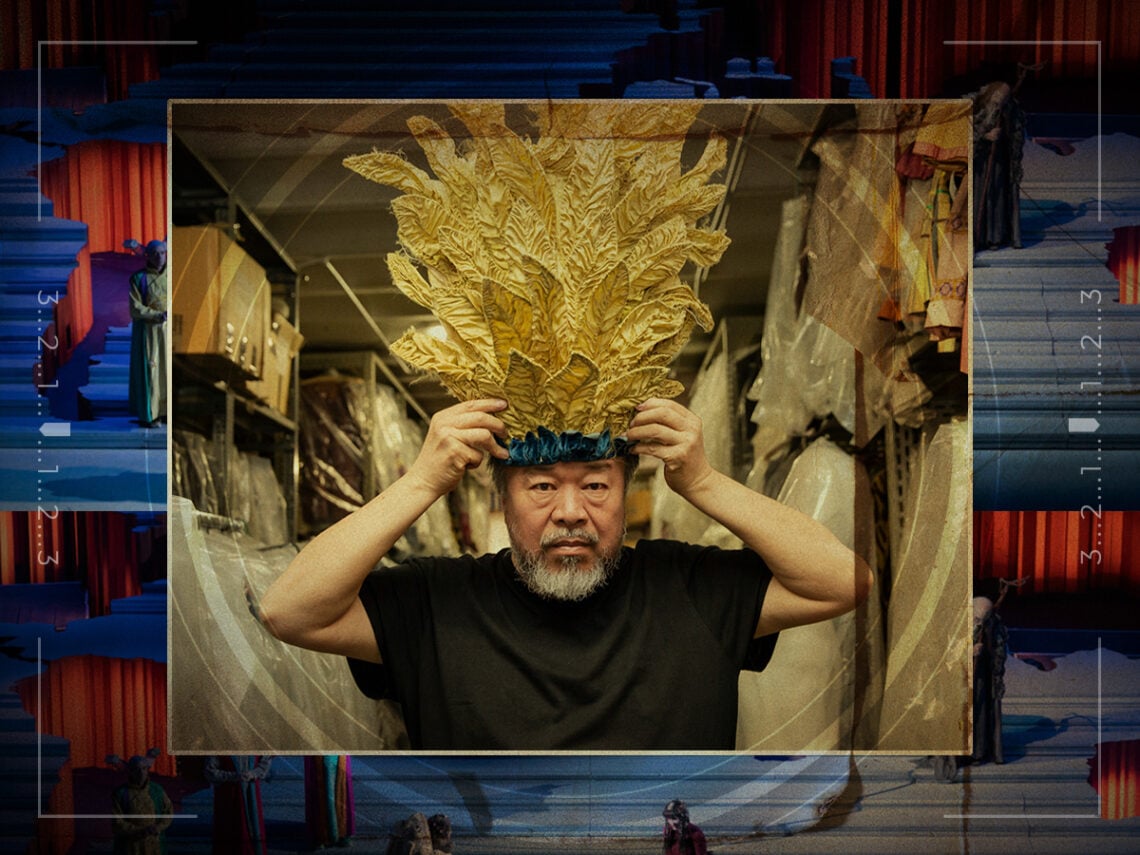
‘Ai Weiwei’s Turandot’ documentary screens at Hot Docs Festival

Writer, director and cinematographer Maxim Derevianko’s first full-length film is a challenging documentary that follows the staging of Puccini’s beloved opera Turandot by rebel artist Ai Weiwei, whose reputation alone suggests a unique and fascinating approach to the classic material. Following its world premiere in Copenhagen, Ai Weiwei’s Turandot will be screened at select film festivals, including Toronto’s popular Hot Docs Festival.
Chinese avant-garde artist and activist Ai Weiwei has expressed his political opinions and world views through a range of artistic forms, including sculpture, video, photography, architecture, and a number of difficult-to-categorise exhibits. Most of Ai’s artwork contains clear pro-democracy or anti-authoritarian messages, either direct or metaphorical, which have earned an enthusiastic following and the ire of authorities, resulting in multiple arrests and detentions by the Chinese government over the course of his career.
As the son of an exiled dissident and poet, Ai came by his nonconformist views early. His artwork has never been separate from his passionate perspective on human rights, free speech, and various social and political causes he has espoused over the years. His efforts have earned him a range of honours and awards from such diverse groups as Amnesty International, Time, and the Royal Swedish Academy of Arts, along with multiple honorary doctorates and professorships from universities worldwide.
More recently, Ai directed his talents into an unfamiliar arena: opera. In 2022, he made his first foray onto the stage with a live performance of Turandot at the Rome Opera House. The artist has often found ways to combine traditional art forms with modern messages; this opera was no exception. Accounts of Ai’s approach suggest he was prepared to reinterpret the century-old opera to apply its themes to the modern world.
This includes dealing with (but not censoring) the original opera’s ethnic stereotyping (which had caused it to be banned in China), and applying the storyline to contemporary issues, including the rise of authoritarianism and the nature of power. At the same time, opera fans were satisfied with the musical performance, despite some fairly extreme changes in the production’s set and costume design. Ai threw himself into the production enthusiastically, despite his self-admitted disinterest in opera and music, in general, joking, “I like to do what I’m not good at”. Ai seemingly took directing an Italian opera as a new and intriguing challenge.
The process of bringing Turandot to the stage was unexpectedly difficult, partly because of the Covid-19 lockdown in Italy, which caused a lengthy postponement, resulting in the final version taking almost two years longer than expected. The documentary covers these difficulties, along with Ai’s reunion with longtime friend Chiang Ching—a former dancer and dance instructor turned successful choreographer— and his collaboration with Ukrainian conductor Oksana Lyniv—whose interest in political issues matched Ai’s intensity. Derevianko’s approach to the material lines up with Ai’s sensibilities, displayed in the inclusion of unrelated but illustrative footage and seemingly random events in the streets that illustrate the use and abuse of power, whether over human beings or, in some cases, animals.
The film itself is not a simple account of the Turandot production, although opera enthusiasts were appreciative of the respectful capturing of key moments from the stage performance. Director Derevianko follows Ai’s management of the opera but also portrays the artist’s personal approach to art in his direction of the play. “I intertwined this ancient narrative with contemporary political realities,” Ai explained in an earlier interview, continuing, “For an opera to endure, it must be reinterpreted to remain relevant to humanity’s present condition.”
Derevianko seems to adopt Ai’s practice of using traditional art forms to address current issues. Ai’s background, including his repeated run-ins with the government is part of the story; the process of preparing the opera takes in the production team’s struggles with Covid-19 and their Ukrainian conductor’s grief as her home country was invaded while in rehearsals. The film promises to be equal parts a chronicle of a unique creative process and a portrait of the determined firebrand behind it.

Never Miss A Scene
The Far Out Film Newsletter
All the latest film news from the independent voice of culture.
Straight to your inbox.