


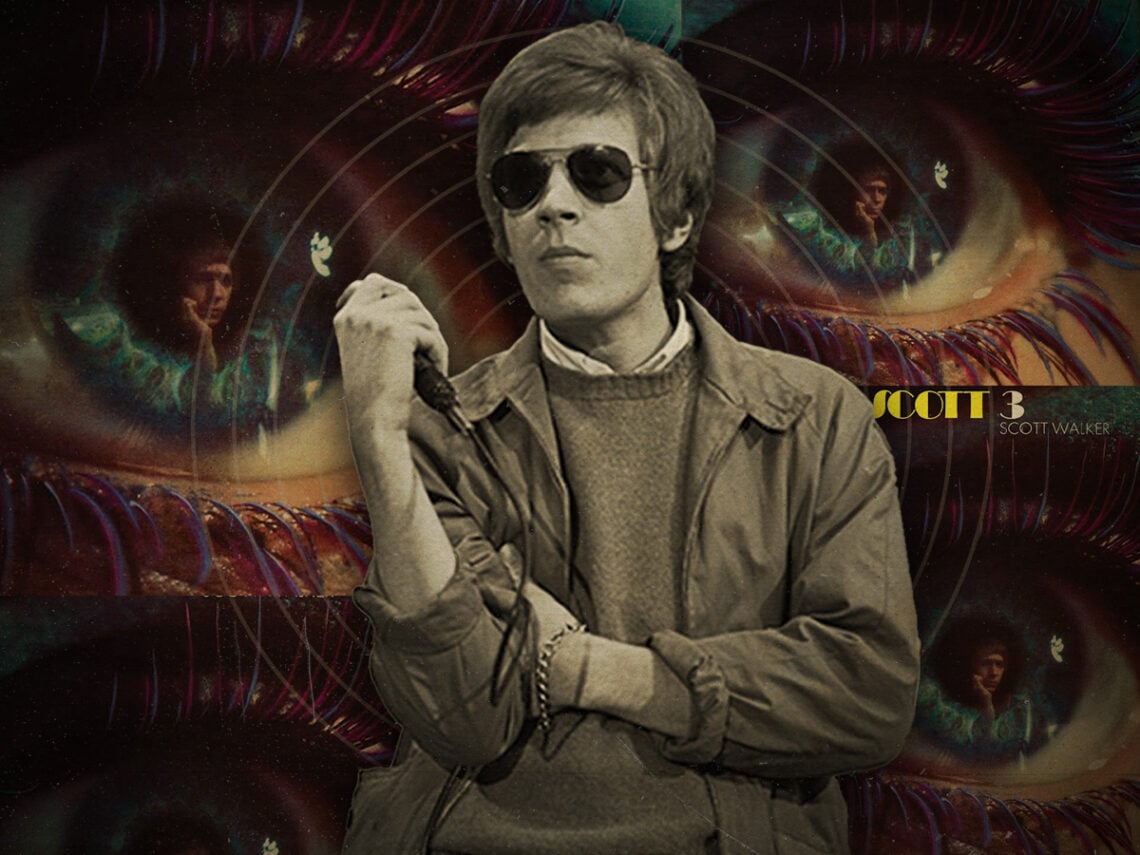
‘Scott 3’: Did Scott Walker’s 1969 masterpiece kill his career in the mainstream?

Scott Walker followed up the triumphant sales successes he’d achieved with The Walker Brothers, who’d taken ‘Make It Easy on Yourself’ and ‘The Sun Ain’t Gonna Shine Anymore’ to the top of the UK Singles charts in 1965 and ‘66, with another solid showing with his debut solo album, Scott.
The album climbed all the way to number three upon its 1967 release, and it must have felt like the British-American singer’s hot streak would never end. Walker wouldn’t need to wait long to top the charts again, as his follow-up album, Scott 2, went two places higher into number one when it came out a year later.
Much like his earlier work, Scott and Scott 2 both drew on a bank of material from songwriting greats like Jacques Brel, Mort Shuman, Cynthia Weil and Barry Mann, Burt Bacharach and Hal David, Tim Hardin and Henry Mancini, but crucially imbued all of their songs with his own indomitable style and imposing baritone voice. With imperious orchestration and arrangements, the songs on Walker’s first two albums were filmic in their scope and quality, cinematic in their expansive scale and in the drama of the songs. Just listen to the sweeping enormity of ‘Best of Both Worlds’.
But Walker seemed to want the best of both worlds himself, too. By the time he came to make Scott 3, he had branched out, and he began writing his own songs to suit his singular style and voice; that voice which had been served so well and, in turn, had served the songs of those other writers. But the songwriting credits weren’t the only major change between albums two and three.
The scale and scope of the songs here were similarly enormous as they had been before, but some of the more conventional orchestration had become more bombastic and avant-garde; some of the dreaminess of his songs seemed slowly to be turning into nightmare landscapes (‘Rosemary’), or else, into grandiloquent and manic frenzies, as on ‘We Came Through’.
Though Scott 3 was more experimental than its predecessor, the success of the earlier album left Walker with enough cultural cachet to get to number three in the charts again. But by the time that Scott 4 rolled around later on in 1969, and following Walker’s short-lived and ill-received BBC variety show Scott, his popular credit was at a then all-time low. Scott 4 became not only his first release that didn’t make it into the top three, but unbelievably, it didn’t even chart at all when it came out.
Scott 3 marked the beginning of the end for Walker’s successes and popularity as a singer, although he would continue to write, record and tour through the rest of his life. On it’s release, fans were alternately turned off by the lack of familiar material, the more expansive and experimental sound of these grandiose new songs or perhaps just moving on to new trends (and, likely in search of more upbeat material), but in more recent times, Scott 3 has finally found its audience.
Though it was the last time that Walker would ever taste the top ten again as a solo singer, it marked the last hurrah for someone who had, up until that point, seemed so untouchable. Such a legacy surrounding an album might be enough to kill an artists reputation, but when later generations revisited Scott 3, we heard that there is a lot to appreciate, a lot to love, and a lot to be inspired by on the album. In fact, it might just be his magnum opus.
Sure, it doesn’t sound like it has any chart-friendly singles or any broad commercial appeal, but listen well and you’ll hear the sound of a whole universe spread out across this 37-minute and 22 seconds of music. What more can you ask for from a record than that?
