


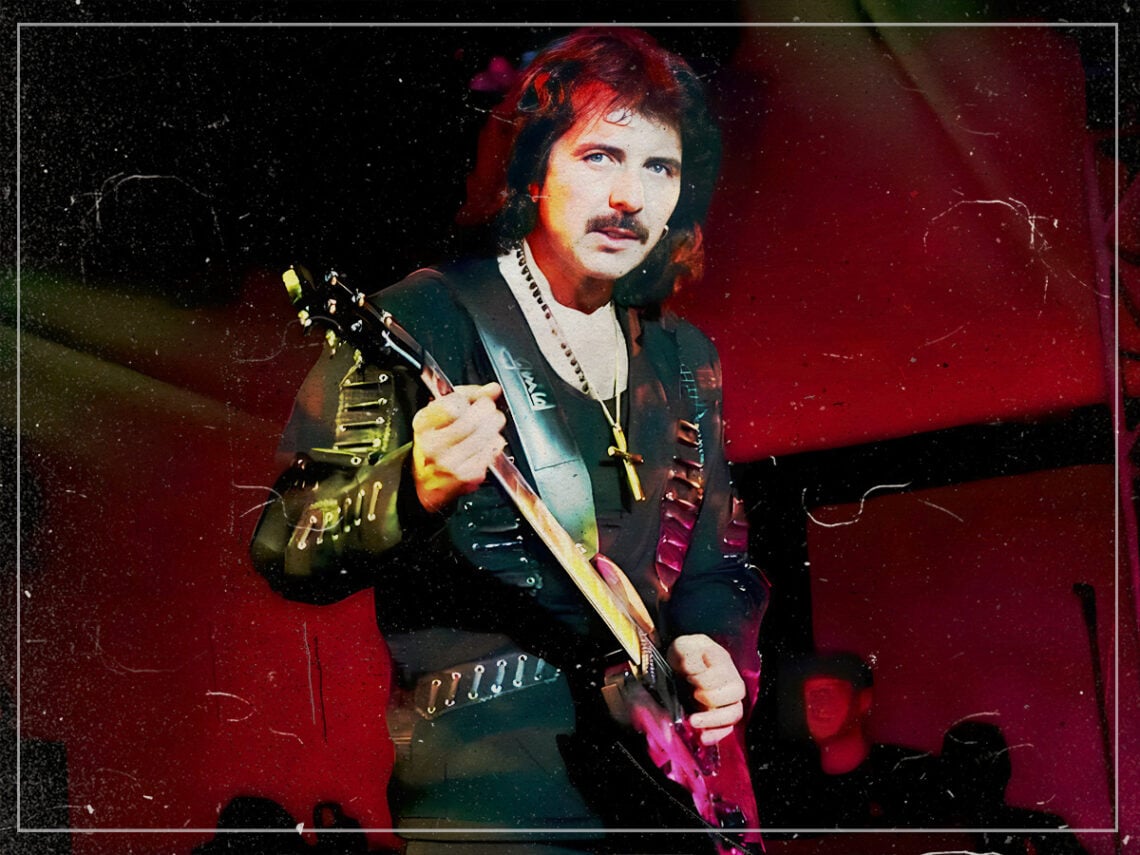
The classic rock guitarist Tony Iommi couldn’t get close to: “It just wasn’t my style”

As the in-house guitar hero of metal pioneers Black Sabbath, almost every player with a heavy proclivity owes something to Tony Iommi. One of the fretboard masters who rose in the wake of Jimi Hendrix’s searing sonics capturing the imagination, he bridged the gap between rock’s past and future with his de-tuned approach, impactful riffs and generally menacing style.
Thanks to the Birmingham native, the guitar was re-energised for the bleak 1970s, when the hippie dream had failed and contorted into something much darker than many could have imagined only a few years prior. While others, such as Jimmy Page and Ritchie Blackmore, also asserted their dominance and soundtracked the new epoch, no one did it as fittingly as Iommi.
While it undoubtedly would have been Jimi Hendrix at the tip of the spear of the 1970s if things had gone as people would have, his tale ended tragically in the inaugural year of the decade, meaning that his disciples carried his torch after he had fallen.
Of course, Page and Blackmore are more than deserving of their place in the history books. Still, it was the profoundly unique nature of Iommi’s approach that saw Black Sabbath rise so quickly, ironically, after a period of being misunderstood when the fading flower power was still the zeitgeist.
What separated Iommi from many of his contemporaries was that his innovations were born out of necessity as much as creativity. After losing the tips of two fingers in an industrial accident, he adapted his playing style and tuned his guitar down to ease the tension on the strings, inadvertently laying the foundations for the sound of heavy metal.

No one had ever de-tuned their guitar so low and perfectly paired it with distortion. This was the start of the blues taking on a much different form and breaking off from its rudimentary era. Accordingly, everyone from Metallica to Guns N’ Roses and Alice in Chains would rise in the wake of Sabbath’s first chapter.
Eddie Van Halen was one of the most influential players to cite Iommi as a hero. Bringing string-tapping and dive bombs to the masses, as well as eye-watering technique, Van Halen was open about his eternal love for Iommi’s approach, despite it being a much different operating formula to his own, and the two even struck up a great friendship as the years passed. In an interview, Van Halen said Iommi’s riffs are “just the power. It just engulfs you. You just feel it, you know? It makes you vibrate.”
Although their styles could hardly have been more different, both guitarists shared an instinct for rewriting the instrument’s rulebook. Where Iommi built his reputation on monumental riffs and atmosphere, Van Halen dazzled with speed and technical invention, proving there was more than one path to reshaping the future of rock guitar.
When remembering his late friend in Spin in 2021, Iommi returned the praise to Van Halen and explained why he was incapable of doing what the Californian musician could on a guitar.
Asked if he had ever tried the hammer-ons and other techniques that Van Halen made his own, the Birmingham native replied: “No. In a word! [Laughs]. I mean, he was so good. And he got absolutely amazing at that stuff. Oh, man, I couldn’t do it. I had tried. But again, when somebody’s done it, to me, I don’t want to be going around doing it; ‘Oh, Eddie Van Halen already does it.’ But I couldn’t actually do it. To be honest, it just wasn’t my style of playing. What he did was just brilliant.”
The mutual admiration between Iommi and Van Halen underlines a truth often overlooked in discussions about guitar heroes. Rather than competing to be the fastest or most technically gifted, the greatest players recognise originality above all else. Iommi never wanted to imitate Van Halen, just as Van Halen never tried to become another Tony Iommi, and it was precisely that commitment to forging their own identities that made them two of rock’s most influential guitarists.
Iommi’s devoted appreciation of Van Halen makes complete sense, as multiple generations of aspiring guitarists around the world have derived inspiration from the same source. Watch Eddie Van Halen live below.
