


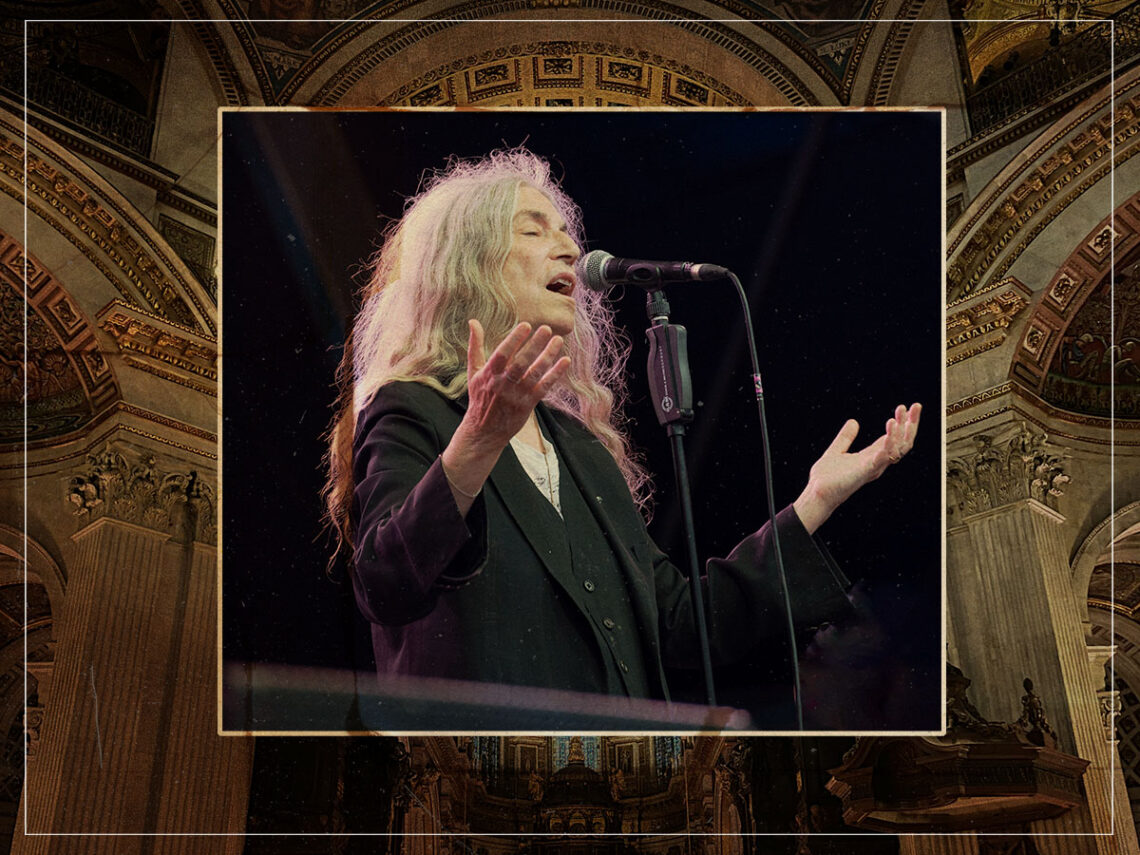
Deities and disciples: Patti Smith at St. Paul’s Cathedral

Before Patti Smith came on stage at St. Paul’s Cathedral, after everyone had milled about utterly awed by the surroundings, the priest came out and told us all to put our phones away; no videos, no photos until the end. This is my recollection, realistically more for me than for you.
When I was about 14 or so, there was a book in HMV on sale for £4, and I liked the cover. All black with one single polaroid image, titled Just Kids. I bought it, and I read it. It sounds embarrassing, but every writer ends up having to say it: I’ve always been a writer. There has never been a moment in my life where I thought about doing anything else, but when I prepped to start GCSEs and actually began zoning in on a path, that singular desire was starting to feel like a curse as the confidence of childhood disappeared into a teenage doubt that maybe I’d amount to nothing and all of it would be a waste.
Reading Just Kids for the first time was revelatory. I’d never read anyone write like that, where poetry was weaved into the narrative with such ease and such lightness. It has the artistic weight of a classic, but Smith’s approach is so effortless that it feels like a conversation. When you’re within those pages, it feels like being sat down by a wise sage and told a story.
But it reminds readers time and time again that the creation of the book wasn’t effortless. Patti Smith is a worker and always has been. Her role as an artist is an active one; it’s a job and a daily undertaking that she’s devoted to. Suddenly, the path ahead of me didn’t feel so rocky. It didn’t feel like something luck would either transport me through or shove me down, it felt like a road that I would take step by step with my own effort and time and care and work; which is a fantastic lesson to learn.
With each re-read of the book, new lessons emerged, and the further into my love for Smith I got, the more tokens of advice I seemed to gather. Flipping through my beaten up paperback, I see them all there, starred or underlined by my hand through the years. I wrote about that once:
“Near enough every page has pencil on now. I underline like an act of prayer, adding with every re-read the way religion morphs with a person over time. If the aim of it all is to become more godly, become God, I’m always trying to become you. Making it all holy; making nurturing radical, making carefulness cool, making softness skilful; I think I’ve been running every part of me by your standard since.”
In short, Patti Smith has always been a spiritual presence for me, and for so many others, too. She’s more than a musician; she’s more than a writer. Her unique mix of wisdom, inspiration and power makes her feel God-like or divine. On stage, her presence is akin to a kind of divine leader where everyone is hooked into her every word. So, despite her punk origin, her presence in this cathedral makes total sense.
But when she emerges, she instantly refuses that platforming. Instead, she positions herself as a follower, a disciple just like us, as she lines up and honours her many deities with songs: Martin Luther King, Sylvia Plath, St Paul himself and Bob Dylan as she performs ‘A Hard Rain’s Gonna Fall’ and messes it up, just like she did at the noble prize ceremony as we all laugh and cheer and plenty of us cry; wowed at what we’re witnessing and the beauty in the humble humanness of it all.
Another deity comes in the form of Fred ‘Sonic’ Smith, her late husband, and the father to her children, one of whom sits next to her. The entirety of Smith’s set was beautiful, but no moment more so than when the musician and her son Jackson play the guitar together, synchronised for the introduction of ‘Beneath The Southern Cross’. As the song expands as the rest of the band join in, their personal grief and remembrance grow into a collective one as the band, and then everyone in the room, says a silent prayer for someone they’ve lost or are losing and let that prayer be carried on the sound waves of a four piece rock band in the air of one of the world’s most beautiful rooms.
The more I write, the more it strikes me that nothing I write will be enough. Even if I’d taken reels of videos and photos, that wouldn’t have been enough either. What went down in St. Paul’s was a moment of beauty and awe that nothing can truly capture. It was something to just sit and embrace and let wash over you. Smith once said, “An artist is somebody who enters into competition with God,” but in the cathedral, lining up her own divine influences as we lined her up as our own, the spiritual world seemed to be in perfect harmony.
