


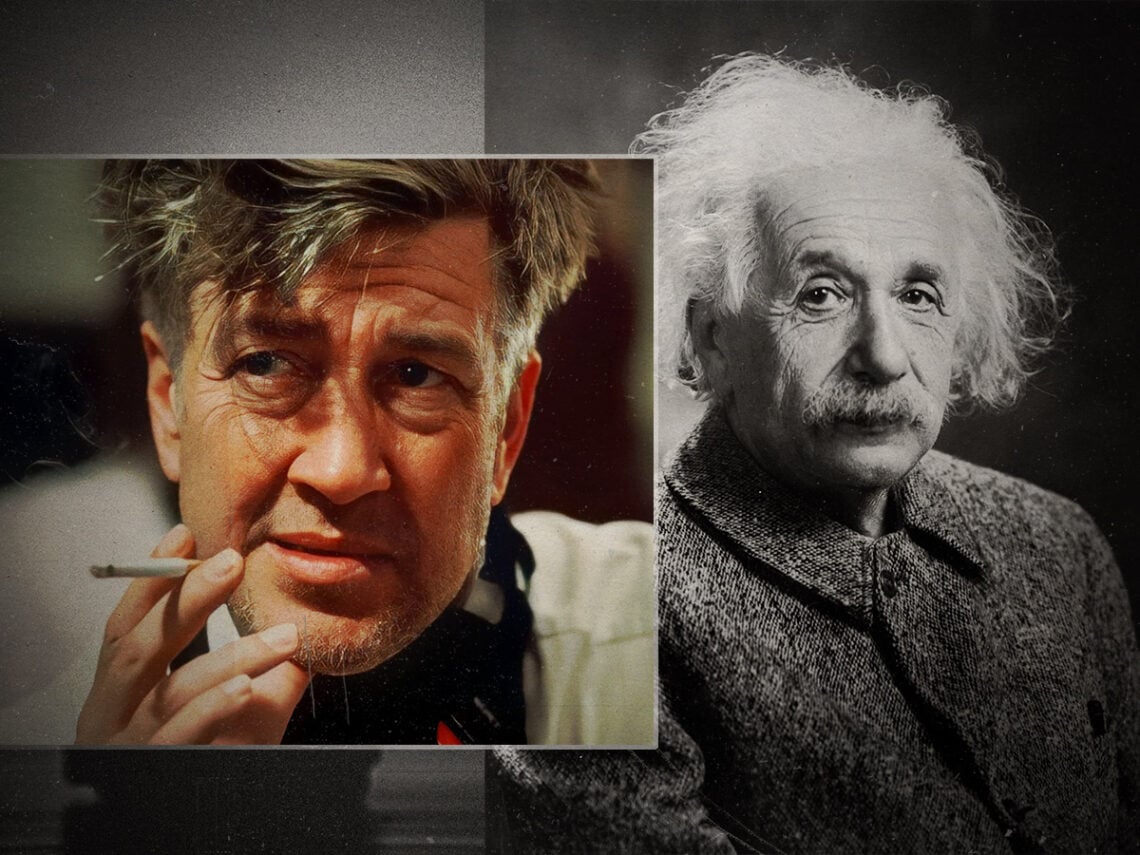
When David Lynch was convinced he had overshadowed Albert Einstein: “He had such audacity”

If there’s anything you could always count on David Lynch to do, it’s achieve the impossible, whether it be crafting an entirely new genre or defying the laws of gravity itself. As a thinker, Lynch worked completely outside the box, encouraging others to deeply and critically consider the world by getting in touch with their subconscious and feeling their way through each experience. It is also a quality that defines his films, as you journey through the unknown and make peace with uncertainty.
From the unanswerable questions in Mulholland Drive that arise from the presence of the tiny old people dashing around the skirting boards or the white horse that boldly stands in the middle of Laura Palmer’s living room, Lynch was the kind of filmmaker who was comfortable occupying a whole other realm of reality. He brought others to the realisation that there are millions of unknowns and all we can do is try to stay curious about these possibilities.
However, this wasn’t just limited to his filmmaking, with the director also extending his creativity to a number of other media, both as a talented painter and through the art of transcendental meditation. Lynch dedicated himself to teaching others about the power of mindfulness and how it can connect you with your true self and most authentic ideas, using this technique himself to ‘catch the big fish’ and find stories that he’d later visualise onscreen.
This form of thinking first merged with his filmmaking style while studying at the Pennsylvania Academy of the Fine Arts, with the director creating an experimental animated short for his final year project titled Six Men Getting Sick. The narrative follows a one-minute animation loop projected onto a handmade screen built from six casts of his own head, with each figure regurgitating, and the sound of a siren also looping in the background. The internal organs of the figures become visible as a sick-like substance fills their bodies and moves towards their heads before they throw up.
While he had no experience with this medium at the time, it didn’t stop him from trying something different, with his former wife Peggy Reavey saying, “He had such audacity”, describing how he had believed he could build a perpetual motion machine and even went to the Franklin Institute to let them know he had cracked it.
“He’d just go straight to the top and tell people, ‘I think I know how to build a perpetual motion machine. ‘I’m an art student’. Einstein couldn’t do it, of course, but people do what he says, so they let him in! He was utterly earnest. And this guy, very nicely, explained why his plan wouldn’t work, and we trooped out to have a cup of coffee.”
A perpetual motion machine still remains to be realised, but if there’s anyone who could have made it possible, it was David Lynch. It might need him to defy the laws of the universe known to us, but Lynch seemed to be in touch with some higher force that allowed him to create things nobody had ever seen the likes of before.
