


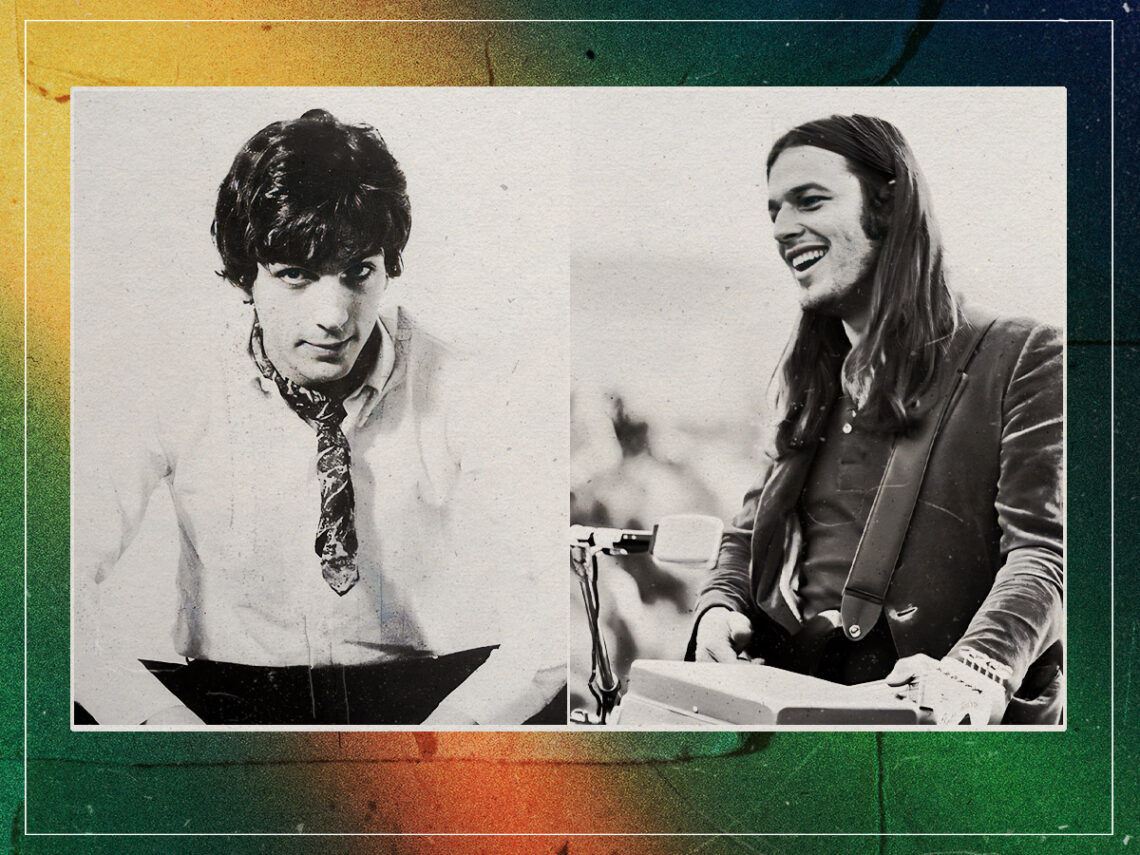
“It was hell”: the reason David Gilmour hated producing Syd Barrett

While the mere mention of their name might instantly bring to mind stereotypical snapshots of a stadium-filling rock band, the story of Pink Floyd is not as simple as this status suggests. For David Gilmour, Roger Waters, and the rest of the group, the climb to the summit was filled with snags.
Of course, the fractious relationship between Waters and Gilmour is a topic that often rests on the tip of tongues. Still, this fraught subplot is just one of several intense junctures the band has experienced. Yes, the schism between the dictatorial Waters and the rest of the group would change the direction of their lives, but this reality would not have materialised without the first and, therefore, most significant transition Pink Floyd experienced.
The group was formed in 1965 by frontman and guitarist Syd Barett, bassist Waters, keyboardist Richard Wright and drummer Nick Mason. Although Barrett was two years younger than the rest of the band, he and Waters were childhood friends from Cambridge and shared a musical outlook. This artful disposition would see them ditch the rhythm and blues of their early years and become an innovative component of London’s underground scene.
Fusing the vibrancy of inexperience with Barrett’s role as Pink Floyd’s primary songwriter, the group shed the skin of the genre standards of their formative chapter and, under the striking lighting of the UFO Club, honed their out-there style, which remains among the era’s most original. Energetic, probing and often unsettling, despite becoming tangled with the psychedelic movement, their music was always incongruous.
With songs such as ‘Astronomy Dominé’ and ‘Interstellar Overdrive’, Pink Floyd’s 1967 debut, The Piper at the Gates of Dawn, became Barrett’s magnum opus. However, his time with the band was short, and by April of 1968, he was out due to a debilitating convergence of mental health issues and drug-taking. He wouldn’t even make it through the production of their second album, A Saucerful of Secrets. It was finished by the rest of the band, which also included another old friend from Cambridge, Gilmour, who was recruited as guitarist in December 1967 to assuage the increasing burden of his mental illness on operations.
After Barrett departed, Pink Floyd embarked on an immense creative metamorphosis, culminating in their string of consequential concept albums in the following decade. Yet, this is only a simplified description of this period. During this era, Barrett didn’t just evaporate; he embarked on a short-lived solo career, releasing the two albums, The Madcap Laughs and Barrett in 1970, which Gilmour helped produce. Waters also worked on the former, with Wright assisting on the latter.
Given his mental state, this was a fraught period for all involved, and Gilmour reflects on it with a hefty dose of realism. During a 1983 interview, the guitarist said “it was hell” producing the two Barrett solo efforts and explained that it was a challenging, unrewarding experience, as their old friend had checked out.
Gilmour said: “It was hell. But you know, we always felt that there was a talent there, it was just a matter of trying to get it out onto record so that people would hear it, and of course Syd didn’t make that any easier for us. There were various techniques we had to invent for trying to get the stuff recorded. It was very very difficult; not really very rewarding. And I’ve no idea how Syd felt about it most of the time.”
Those assisting Barrett had no idea how he wanted the albums to sound, as he offered them nothing, so they took it upon themselves to decide the complexion of the final product. Accordingly, Gilmour trudged on. Then, one day, after Barrett was finished, the pair were travelling silently up the lift in the latter’s block of flats when he turned to him and said, “Thanks – thanks very much,” the only expression he ever received in the entire process. It paints a sad picture of his condition.
