


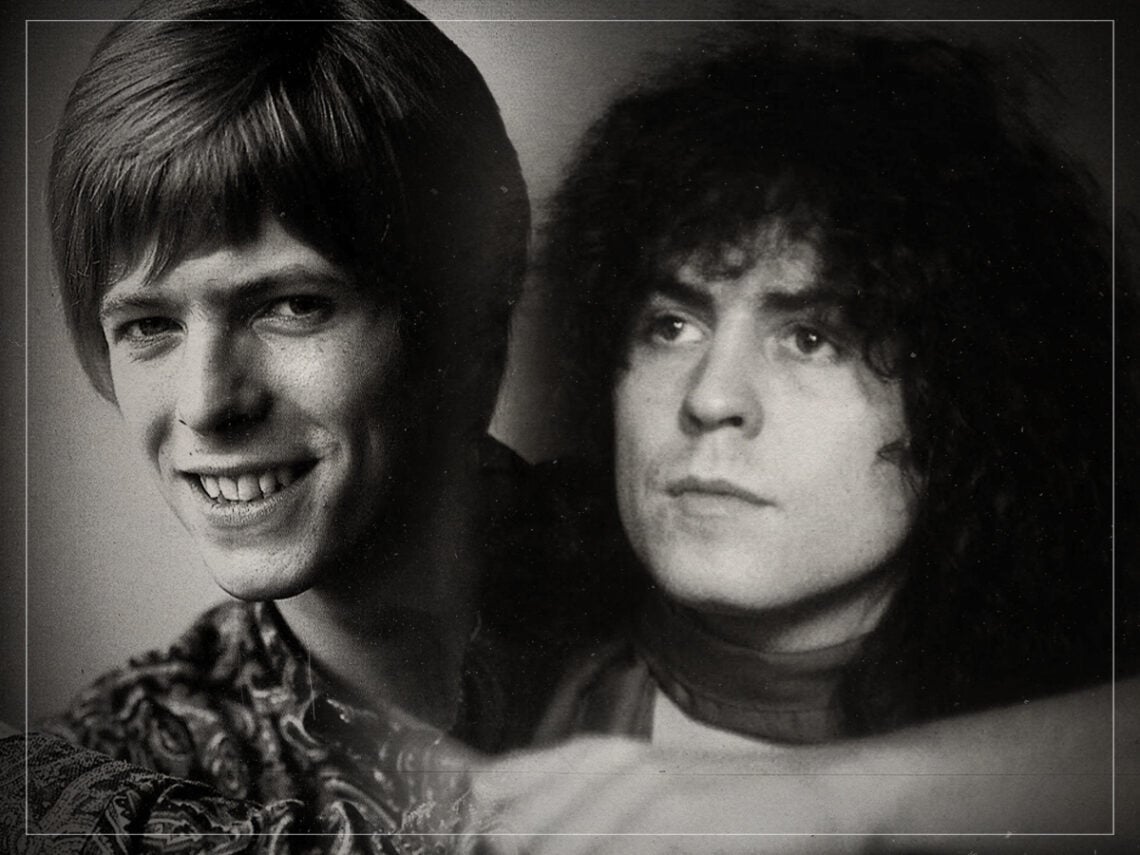
David Bowie’s “nonsense song” written in pursuit of Marc Bolan

Rarely was David Bowie found in the slipstream of another artist.
The perennial trendsetter, Bowie could always be found at the arrowhead of a cultural movement with a legion of followers close behind, studying his every move on how to become a great shapeshifting artist.
But there was, of course, a time when Bowie was nothing but a pre-fame, pimple-popping music fan, hustling his way into gigs and desperately feasting on whatever culture he could get his hands on. He was one of a sea of faces in the lively London mod scene, rubbing shoulders with fellow creatives who would also become famous off the back of what they were learning in those vibrant, youthful years.
One such companion was Marc Bolan, the glam-rock legend who formed a friendship with Bowie long before the burning lights of the big stage came calling for them. During that time, it was Bowie quietly taking Bolan’s lead, as the T Rex front man guided him through the colourful worlds of London’s bohemian cultures and formed the basis of what the world would later know as the elaborate, shapeshifting artist Ziggy Stardust.
“Marc took me dustbin shopping,” Bowie recalled of their very first meeting in the early 1960s. “At that time, Carnaby Street, the fashion district, was going through a period of incredible wealth. And rather than replace buttons on their shirts or zippers on their trousers, they’d just throw it all away in the dustbins. So we used to go up and down Carnaby Street and go through all the dustbins, around nine, ten o’clock, and get our wardrobes together.”
Turning rags into riches, Bolan opened Bowie’s eyes to a world of creativity that put adaptation and ingenuity at the very heart of it. So in the late ‘60s, when the glittering worlds of glam rock began to emerge under the leadership of Bolan and his enigmatic group T Rex, Bowie continued on in the same vein and began creating under the influence of his bin-rummaging mate.
For his group, Turquoise and Feathers, Bowie penned ‘Ching-A-Ling’, a track that was reportedly a Bolan rip-off. In his book The Complete David Bowie, Nicholas Pegg explained, “David was trying to find a nonsense song that you could build up sound with, like Marc Bolan’s.”
Adding, “You know, there are numerous ditties of Marc Bolan’s which really have very little content, but there’s this build-up of the sound. If it carried on building up, you might have something, but it didn’t work, and it was a rubbish song. Everybody knew it. But for some reason, Tony Visconti liked it, so it got recorded.”
In those early glam rock years, Bowie would have been testing the waters under the safety of Bolan’s leadership. But as he cemented his own songwriting style, he surpassed Bolan’s frequency and could never be labelled as a product of inspiration again.
By 1973, he had defined the glam rock era with The Rise and Fall of Ziggy Stardust and the Spiders from Mars and began setting the standards for the rest of the world to follow.
