


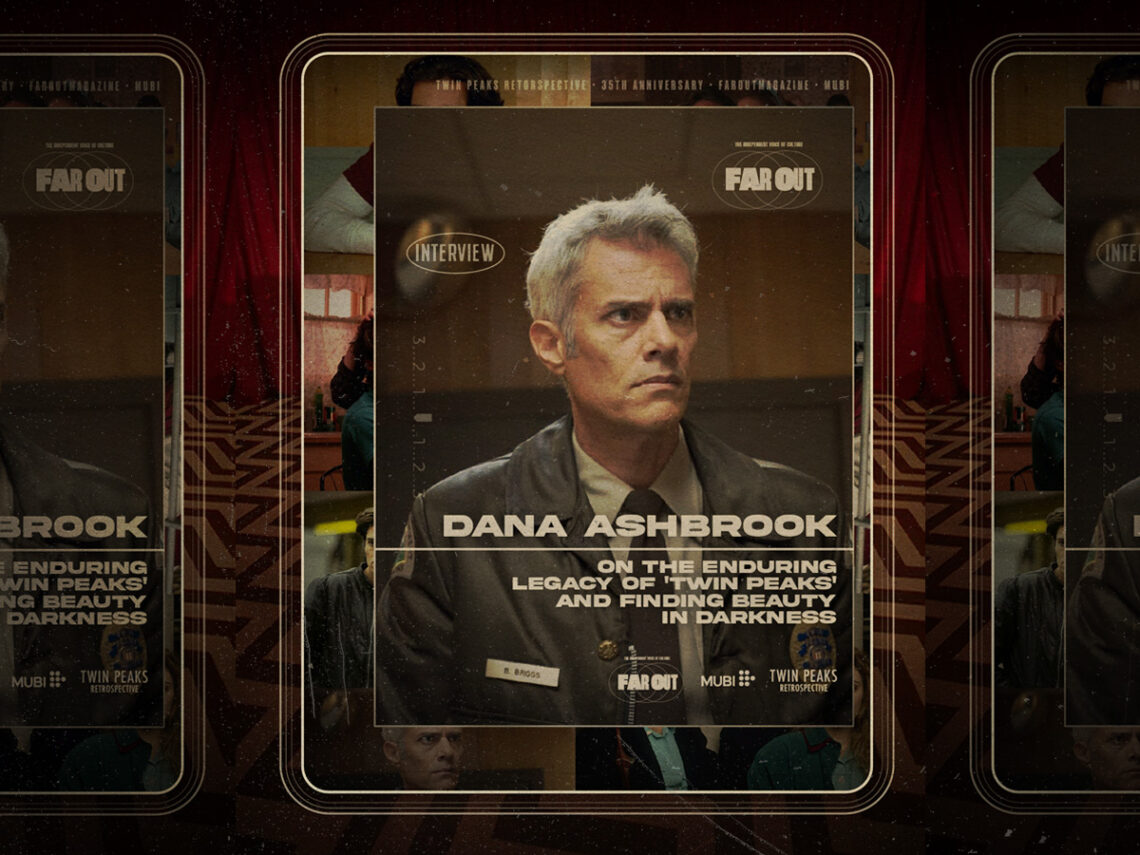
“It makes you think, it makes you feel”: Dana Ashbrook on the enduring legacy of ‘Twin Peaks’ and finding beauty in darkness

There’s a peaceful kind of tension that lives just beneath the surface of Twin Peaks, something that was captured in the very first episode through the melancholic yet comforting sight of a foggy town on the precipice of despair.
As the camera drifts over the titular town, accompanied by the sinking twang of Badalamenti’s score, we’re lulled into this false state of comfort that is only disturbed by the looming danger that sits just under the surface. It’s a threat that quietly ripples through you while also being somewhat soothing, with creators David Lynch and Mark Frost creating a perfect harmony between opposing moods; a balancing act of beauty and pain, comedy and tragedy.
From the beginning, unsettling moments are spliced with the colour and eccentricity of small-town life, the creators altering the framework of television through their disquieting portrait of suburban secrets and the unexpected hilarity within the darkness. It could be the sight of Leland Palmer slowly losing his mind and prancing around the Great Northern Hotel, or it could be the Log Lady and the cryptic messages she passes on from an old tree trunk, leaving you trapped in the unnerving feeling of wanting to laugh and cry.
The show nestles itself in this unique grey area, creating tension between the beauty of genuine goodness (something seen in characters like Agent Cooper and Sheriff Truman) and the madness that lurks slightly out of sight, bubbling up in moments of complete insanity as others lose their minds and teeter towards total self-destruction. But this is ultimately why the show has only grown in popularity over the last 35 years. Audiences still resonate with this blend of comedy and tragedy, something that I had the absolute pleasure of speaking to Dana Ashbrook about as he reflected on this very phenomenon and the enduring legacy of Twin Peaks.
The people of Twin Peaks are the heart of the story, adding a much-needed light to painful moments and a way out of the darkness, with many of the characters searching for answers and trying to make sense of unimaginable tragedy. The tonal disconnect of these polar opposite moods is what makes the show so captivating, a unique emotional clash embodied by Ashbrook and his portrayal of Bobby Briggs, the ultimate rebel with a cause.
While some might first dismiss Bobby as being little more than a cocky jock, he quickly defies each stereotype thrown his way as he reveals himself to be one of the most unexpectedly complex characters on the show. Despite appearing like a tough guy on the surface, we soon see a sensitivity beneath the façade, bringing out a more fragile side to him, something captured through Ashbrook’s expert portrayal of his surprising softness and unpredictable sense of humour.

When asked if he is afraid of attending his dead ex-girlfriend’s funeral, Bobby replies, “Afraid? I’m gonna turn it upside down!”. It’s not a reaction you’d expect in this situation, practically screaming in an out-of-the-blue way that feels jarring compared to the quiet solemnity of his father.
Ashbrook praised Lynch’s ability to find comedy in the darkest moments: “He was such a unique person that you can watch his stuff over and over again, and the humour that he has in awful situations,” the actor explained. “Like in the pilot of Twin Peaks when Sarah Palmer is screaming on the phone with Leland Palmer. He goes down that telephone cord, all the way down, while you can hear her screaming and screaming. It’s almost laughable by the end, because she stops and then starts again, and it’s just like, ‘Oh my God’. It’s uncomfortable and it’s visceral. It makes you think, it makes you feel.”
In the pilot episode, Lynch blends the suffering of an entire town with solace and comedy as they struggle to come to terms with Laura’s death. Grief is the most humbling and discombobulating of experiences, leading us to make nonsensical decisions that stem from the fact that death itself doesn’t make any sense.
The irrationality of Bobby’s character and many others in the show can be traced back to this one universal truth, with the erraticism of Bobby, Leland Palmer and even Nadine Hurley highlighting the comical madness that can spring from the worst of times – sometimes the darkest days land the funniest jokes.
When asked about why this seems to resonate with audiences even more today, Ashbrook said, “It’s probably because we all have that in us, right? I don’t know if we all have that super dark stuff, but I think everyone has some dark in there, right? And maybe by watching it manifest on television, you can live vicariously through it and not have to actually engage in dark behaviours.”
While there was a definite darkness to his work, Lynch was known for his uplifting and beyond-joyful presence in real life, something that was infectious and spread to those who had the gift of working with him and seeing his surrealist masterpieces unfold, a sentiment Ashbrook reiterated: “He was like nothing I’d ever seen before. I’d never been around someone who had so much joy in what they were doing and had such a complete vision that everyone shared. It was beautiful.”
Part of the beauty of Twin Peaks is that it works on an almost subliminal level, something that can also be linked to Lynch’s unique directing style. He often described his fascination with dreams and the hidden creative treasures they can unearth, something that he captured through the ethereal scores that worked in tandem with the surrealist images, creating an entirely new cinematic language.
“You know, he was super fun,” Ashbrook recalled of how Lynch let music inform the performances of the cast. “And he would talk about dreams and music a lot. He would have music piped in through his headset so he could hear the dialogue and hear the music that was perhaps going to be playing during the scene. And he would let us hear that too.”

Infusing the score into actors’ performances is a perfect example of Lynch’s one-of-a-kind approach, with the sound being equally important as the words in informing the tone of the series. It’s a quality the filmmaker carried with him throughout the rest of his work, with Lynch and Badalamenti often finding specific songs for a project before the script was even written, such as the haunting Club Silencio sequence in Mulholland Drive.
This approach extended towards many other areas of the production, too. While there is often a strange hierarchy on many film sets, Ashbrook explained how this was not the case when working with Lynch. The director would place himself on the same level as the actors and directly within the heart of each scene, almost as if they were all in it together.
The actor recalled a memory from the pilot in which “David would sit underneath the camera, right in the bottom. When Mädchen [Shelley] and I did the scenes in the pilot, in the car where we’re driving up to her house, and we see her husband’s truck is there, David was in the car with us. They just framed him out. I mean, it was like, close contact. We were all just like that. It was amazing.”
While some directors detach themselves from the emotionality of a scene, Lynch almost seemed to feel his way through it with the actors, quite literally putting himself in their shoes and making them all one and the same. Through his endlessly compassionate approach, Lynch could draw out performances that nobody else could.
When asked how this influenced his portrayal of Bobby, Ashbrook said, “We’re all children playing a child’s game, right? I’m the quarterback of the football team. I’m a drug dealer. I’m dating the prom queen. There were certain things that were all there, but it was mostly David telling me how to be cool, you know. David gives that comfort to let people be their authentic selves and let their freak flag fly. It gives people permission to not have to do anything the normal way.”
Twin Peaks transports you to a different moment in time, a feeling as though everything is beginning and ending, a simpler time where the cherry pie and coffee taste better. But the darkness is still there, just out of sight beneath the surface, and it’s something that still entices audiences today as we return to the simultaneous comfort and tragedy of the narrative and the murder of Laura Palmer.
When asked about a message people most need to hear from Lynch’s work, without missing a beat, Ashbrook offered, “Peace and love. I know his stuff can be interpreted as dark, but he was all about spreading peace and love. Just that. That’s a gift, and he wants that to go on and on and be out there for people that need it. He was one of a kind. Nobody else was like him.”
All episodes of Twin Peaks launch on MUBI on 13 June in the US, UK, Latin America, Germany, Turkey, Italy, Netherlands and India.
