


How music shapes the world of David Lynch’s ‘Twin Peaks’

In the town of Twin Peaks, nothing is sacred. While it might look picturesque with its breathtaking waterfall and expanses of coniferous trees, among the firs lurk the darkest depths of humanity and beyond, where cosmic forces and male evil wreak havoc on the innocent inhabitants.
A spectacular creation from the minds of David Lynch and Mark Frost, the show exposes the nightmares that can be found within suburban homes, and its enduring popularity comes from its perfect blend of horror and humour, walking the barely-there line between cosy and uncanny.
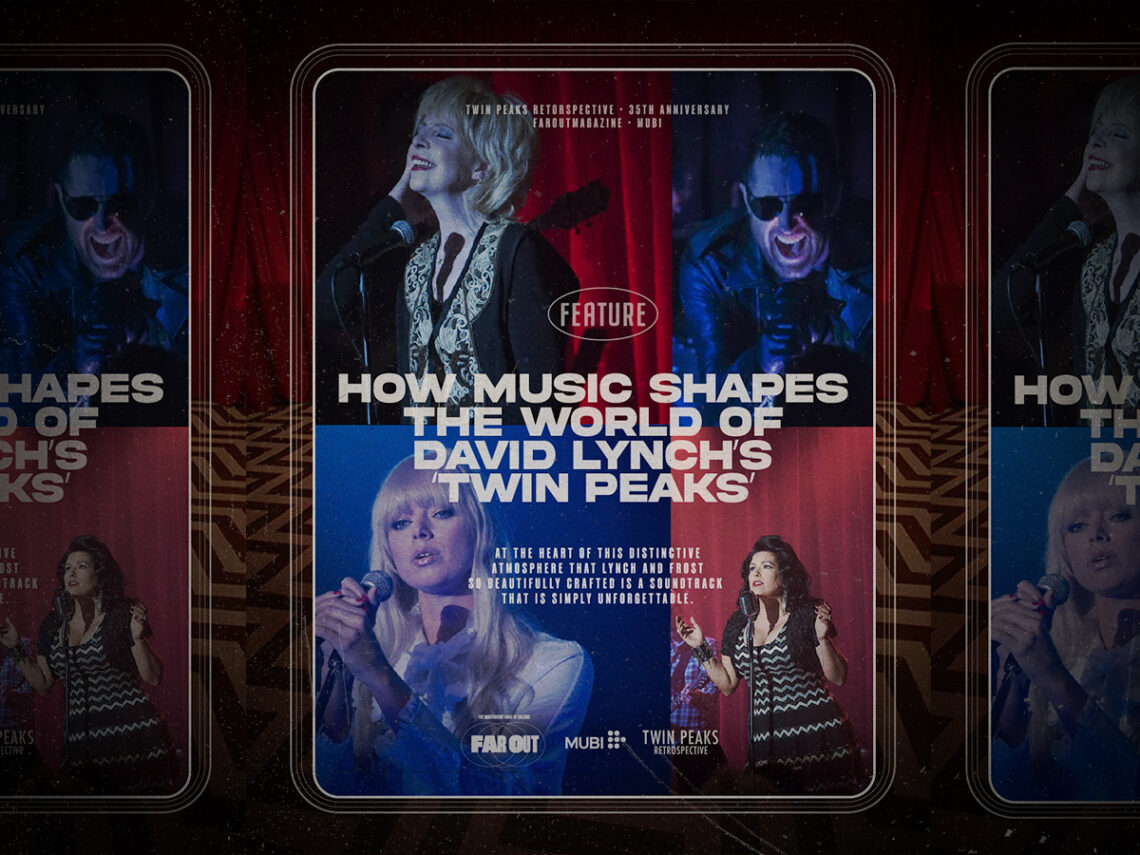
Adding to it, at the heart of this distinctive atmosphere that Lynch and Frost so beautifully crafted is a soundtrack that is simply unforgettable. Over the course of three seasons and a prequel film, Lynch employed various musicians to help colour the sonic world of Twin Peaks, with the most prominent being Angelo Badalamenti. He composed the iconic ‘Twin Peaks Theme’, which is arguably the greatest opening song in television history. It’s dreamy, romantic, and gently euphoric, moving slowly over images of the waterfall, the sawmill, and a bird, encouraging audiences to settle in for an hour of beauty, melancholy, and stomach-churning mystery.
You couldn’t fathom a better opening for the show, with Badalamenti’s combination of synths and guitars sweeping over the viewer with cinematic precision; you can almost feel the spray of the waterfall brushing your face as the notes reach their highest point. Besides the ‘Twin Peaks Theme’, Badalamenti also achieved greatness with ‘Laura Palmer’s Theme’, an utterly moving and hauntingly beautiful slice of music. The composer once explained how he created the piece, with Lynch standing by the piano and deeply feeling every note he played, guiding Badalamenti with his emotional reaction.
It moves between dark ambience and lush piano, with a brilliant climax (“Oh, Angelo, you’re tearing my heart out!”) being met with further darkness and despair. This piece encapsulates Laura Palmer’s story and condenses it into almost five minutes of a track reflecting her corrupted innocence, her attempts at finding happiness and escape, and her inevitable yet tragic demise.
The show features leitmotifs that frequently occur, depending on the character or situation playing out on screen, with the sneaky and somewhat calculating Audrey Horne perfectly soundtracked by ‘Audrey’s Dance’, which contains the seductive and mysterious energy she exerts. Then there are addictive cuts like ‘Freshly Squeezed’ and ‘The Bookhouse Boys’, which exude a heady jazz sound that adds to the sleaze and intrigue at the core of Twin Peaks.
Besides Badalementi’s instrumental compositions, we also get some terrific Julee Cruise performances throughout the show, with ‘Into the Night’ the standout. It’s a deeply atmospheric number that sounds like driving down a dark road, with Cruise’s fae-like voice possessing a sense of magic and otherworldliness that fits seamlessly into the spirit of the series, where supernatural forces come to play a prominent role.

Cruise appeared in several episodes of Twin Peaks as a singer at The Roadhouse, while also performing in the prequel film, Fire Walk With Me, and ‘Part 17’ of The Return. In many ways, it feels like she becomes a mouthpiece for Laura Palmer, whose death kickstarts the show’s narrative. She communicates a haunting and spectral presence, looming over the customers at the bar and acts as a stark reminder of the transience of life. When she sings ‘Questions in a World of Blue’, with lyrics penned by Lynch, it feels like Laura is communicating words that she cannot express: “Why did you go? Why did you turn away from me?. When all the world seemed to sing/ Why, why did you go?/ Was it me? Was it you?”
Music is also used as a device to communicate the pain and confusion as a result of Laura’s death when James performs his infamous rendition of ‘Just You’, which many fans of the show have highlighted as one of the most cringe-inducing moments. In a high-pitched voice, he sings the repetitive words “Just you and I/ Together, forever/ In love” with his guitar while his girlfriend, Donna, and Laura’s cousin, Maddy, watch and join in.
There is a moment of tension here as James grapples with his feelings for both Donna and Maddy, who look identical to James’ previous girlfriend, Laura. Donna displays a strong sense of realisation on her face as she acknowledges Maddy and James’ feelings for each other. Even after she has died, Laura is just as present in her friend’s lives and relationships, and this musical scene is as awkward as it is vital.
Perhaps one of the most unforgettable musical moments in Twin Peaks, however, comes during the final episode of season two, where Jimmy Scott performs ‘Sycamore Trees’ in the Black Lodge. It’s eerie and gorgeous, creating an intense and deeply cinematic atmosphere that allows audiences to absorb the chaos of the episode, inviting us to sit with the mystery and melancholy.
When Fire Walk With Me emerged, classic Twin Peaks trademarks like the theme song were still present, but Lynch and Badalamenti employed a more expansive palette this time around. As one of the director’s most devastating and horrifying films, the music reflects this brutal world where Laura is constantly subjected to abuse, paranoia, exploitation, and violence. There’s sleaziness in the form of the electrifying ‘The Pink Room’, which soundtracks Laura and Donna’s jaunts with creepy older men in a bar, while Badalamenti provides an unexpectedly brilliant and swaggering vocal performance on ‘A Real Indication’, which plays as Bobby stumbles into school after talking to Laura outside.
Skipping forward 25 years to season three, there is a decisive change in Lynch’s approach to music and sound design. There are more ambient pieces rather than the jazz cuts of the first two seasons, with composer and re-recording mixer Dean Hurley playing a prominent part in bringing the sounds of The Return to life. According to Hurley, who spoke to Far Out about the process of collaborating with Lynch, the filmmaker “was going into it like, ‘We’re going to be using less music and more ambiences and more tonal stuff that is not overt music—that just crafted the sound of season three in a very specific way.”
One of the most prominent musical aspects of The Return is the Roadhouse performances, with artists like Nine Inch Nails, Chromatics, The Cactus Blossoms, and Sharon Van Etten performing. These moments offer a unique glimpse into the town of Twin Peaks, where music plays such a vital role in bringing individuals together and communicating much of what goes unsaid.
“It just expanded that world a little bit,” Hurley explained. “So you kept popping in at the Roadhouse at the end of each episode, and it’s like, life goes on in Twin Peaks. There’s a different artist coming through town and playing in that space. And it’s a vibrant, alive space and characters meet there. It’s a hub for that town. It was just incredible how it wove everything together.”
Lynch was one of the greatest filmmakers to utilise music to the fullest extent in his work, and Twin Peaks is one of his finest displays of sonic genius. Helped by Badalamenti, Hurley, and Cruise, Lynch was able to create a world so idiosyncratic and singular, with the soundtrack to this seedy town encompassing all of its beauty, surrealism, strangeness, and pain.
All episodes of Twin Peaks launch on MUBI on 13 June in the US, UK, Latin America, Germany, Turkey, Italy, Netherlands and India.
