


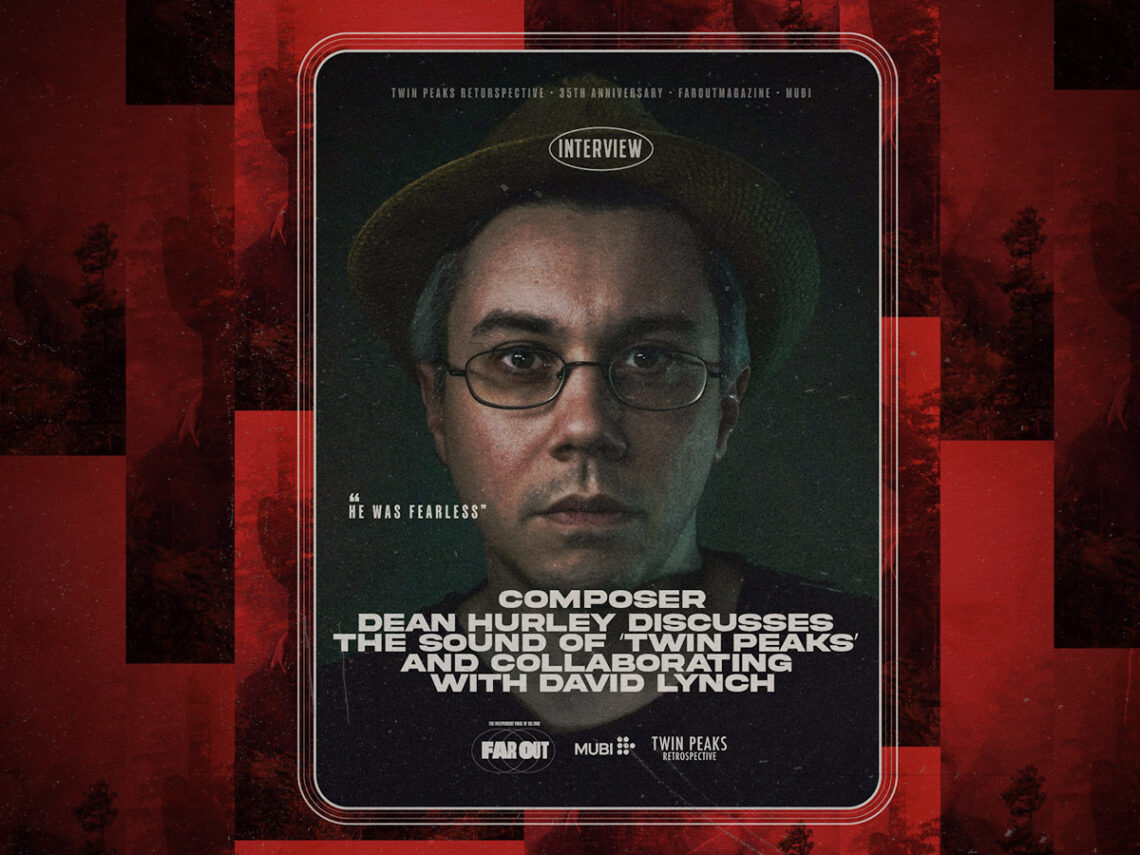
Dean Hurley discusses the sound of ‘Twin Peaks’ and collaborating with David Lynch: “He was fearless”

The sonic world of Twin Peaks has always been one of its defining characteristics. When the first season of David Lynch and Mark Frost’s groundbreaking show aired in 1990, it was the lush sounds of Angelo Badalamenti’s theme and the jazz-influenced leitmotifs that captivated many viewers, and the original soundtrack has since endured as one of the most iconic scores in television history.
The third season, released in 2017, took a much darker and more ambient approach, and while the creations of Badalamenti didn’t go anywhere, The Return would’ve sounded very different without the assistance of composer, re-recording mixer, and sound designer Dean Hurley.
Since the mid-2000s, Hurley has lent his skills to various Lynch projects, which all started when he successfully became the filmmaker’s new sound engineer at his studio. He fondly recalled meeting Lynch for the first time during his job interview, telling Far Out, “He didn’t ask me anything about my skill set—he just assumed that I was up there because I was qualified, and he was just trying to get to know me. Like, ‘Do I want to see this person every day?’”
For 13 years, Hurley ran Lynch’s Asymmetrical Studios, and during this time, he worked on projects like Inland Empire and Dior: Lady Blue Shanghai. This long period of collaboration served as the perfect primer for his extensive contributions to The Return, with the composer explaining, “There was all this in-between stuff that happened, and a lot of gathering sounds and general experimentation, music sessions, and everything. So by the time another big tent pole project would come up, we had all this material that we’d been developing.”
Hurley, who happens to share a surname with several characters from Twin Peaks, was perhaps destined to work with Lynch. He was a fan of the filmmaker’s work before he got the job (although he hadn’t seen the era-defining show at that point), but as soon as he started collaborating with him, Hurley realised that he would never work with someone so “fearless” and “open” again.

“I’ve worked with a lot of people since, and sometimes you can smell it—there’s this degree of fear. But I felt that David was able to eradicate that from his creation. He would just be very patient,” he explained. “Sometimes, things would not land, and that always made me really uncomfortable, because I had a great deal of fear of like, ‘Oh, God, this isn’t hitting right’. And he would just be very patient, and he would always call it ‘action, reaction’. He would calmly think of something, and he would say, ‘Why don’t we try this?’”
This sense of artistic bravery is one of the biggest lessons that Hurley has taken away from knowing the visionary Lynch, who sadly passed away at 78 in January 2025. The filmmaker’s legacy remains strong, however, and part of his enduring popularity comes from his easily identifiable surreal style, which is soundtracked by his flawless use of music and sound. Lynch, alongside Alan Splet, was in charge of sound design and music when he made his first feature, 1978’s Eraserhead, which is full of industrial and ambient cues. This film established the sonics for much of the director’s future cinematic world, and when Hurley came to work with him decades later, he drew from this pre-existing palette.
“I think the inspiration came from David. How can whatever I do make this more of him? Anything that I was contributing, it’s like a channeling thing, where you align your sensibilities to someone else’s.” He notes that he was mainly preoccupied with “ensuring that the whole thing felt like it was unequivocally [Lynch] and it was just the next chapter of this story from the same creators, David and Mark”.
Hurley recalled the earlier seasons’ use of “half speed orchestral stuff, where they would slow stuff down and be straddling the zone of music and sound design”, which is something he felt familiar with since Lynch used these techniques “throughout so many of his different films and projects”.
Yet, “Just reading the script, it was very evident, like you came out of it and you’re like, ‘This doesn’t sound like the original’. And David was very adamant, ‘This is not going to be the original’.”
The Return features a combination of haunting pieces from Hurley, Badalamenti, and Lynch, as well as a selection of pre-existing tracks and performances from a range of artists that Hurley helped select, such as Sharon Van Etten, Chromatics, and Nine Inch Nails. While the essence of what made the original two series is more than apparent in the third, Lynch was looking for a change, with Hurley revealing, “David was going into it like, ‘We’re going to be using less music and more ambiences and more tonal stuff that is not overt music, that just crafted the sound of season three in a very specific way.”
It was certainly challenging at times, especially because Lynch had such ambitious ideas. When it came to discussing the music for ‘Part Eight’, which contained the atomic bomb detonation, Hurley had to work with the director’s demands that the sound be “ear-crushingly loud”, despite the fact that the former knew viewers at home would just “turn it down”.

He explained, “It got my mind thinking, well, what can we do to get that intention across? So, that developed this strategy of distorting the music a little bit, because I think our ears pick up on these subtle demarcations and data in life. When something is distorted on a soundtrack, it does something to our physiological understanding of, ‘Oh, that’s dangerous. That sounds intimidating’. If you simulate your eardrums trying to clamp down on something, it’s almost telling your brain, ‘this is loud’ when it’s not necessarily volume loud. It’s just nonlinear loud.”
Hurley also experimented with frequency, taking on board an “innocuous comment” that editor Dwayne Dunham made about disliking “high frequency”. He took this as a challenge, almost. “I think there’s a modern sound design trend where there’s a lot of high-frequency components to things, and it’s just like, ‘You know what? I’m going to pretend like that’s not something I can reach for, and I’m going to make all my articulation and efforts with low-end energy, not high-end energy.’ And I think that ultimately ended up, in a weird way, crafting a lot of the approach and the eventual sound.”
The Return features an array of live performances at The Roadhouse from bands such as Trouble, which featured Hurley on drums and Lynch’s son, Riley, on guitar. By collecting footage of various artists to insert in different moments throughout the series, Lynch became “divorced” from the “television-type structure”.
Hurley elaborated: “He could use that music if the narrative part of things happened and he needed five minutes of filler. It made for a really awesome day on set, seeing this mini music festival.” The musical moments were more than simply “filler”, of course; “It just expanded that world a little bit. So you you kept popping in at The Roadhouse at the end of each episode, and it’s like life goes on in Twin Peaks.”
This rounded out Hurley’s experience as a vital part of The Return, and with his years of Lynch collaborations (he also worked on the filmmaker’s solo albums, such as Crazy Clown Time), he was the perfect person to finely craft the sonic world of Twin Peaks for a new season. The composer took away many valuable lessons from the filmmaker, but the biggest takeaway was perseverance: “That patient tilling the garden, understanding the patience, not having fear, not judging, not killing things too quickly, but really going along on the journey and the path of helping something evolve.”
All episodes of Twin Peaks launch on MUBI on 13 June in the US, UK, Latin America, Germany, Turkey, Italy, Netherlands and India.
