


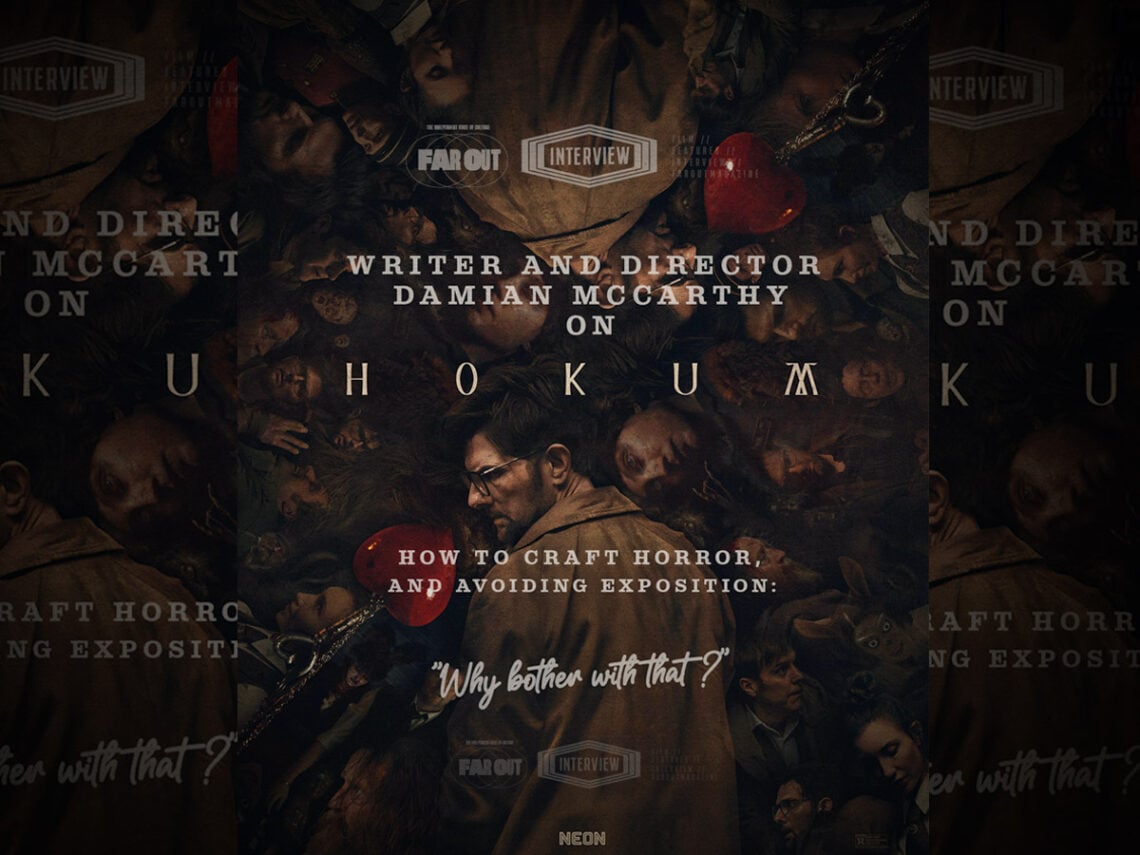
Writer and director Damian McCarthy on ‘Hokum’, how to craft horror, and avoiding exposition: “Why bother with that?”

Having established himself as one of the most distinctive new voices in horror with his first two features, Caveat and Oddity, writer and director Damian McCarthy is back with his latest one-word exercise in slow-burning terror and supernatural chills, Hokum.
While having two acclaimed movies in a row often earns a filmmaker a one-way ticket to Hollywood, McCarthy has stayed on home soil for his third consecutive Irish-set nightmare, although this time, he does have some American star power leading the cast in the always reliable form of Adam Scott.
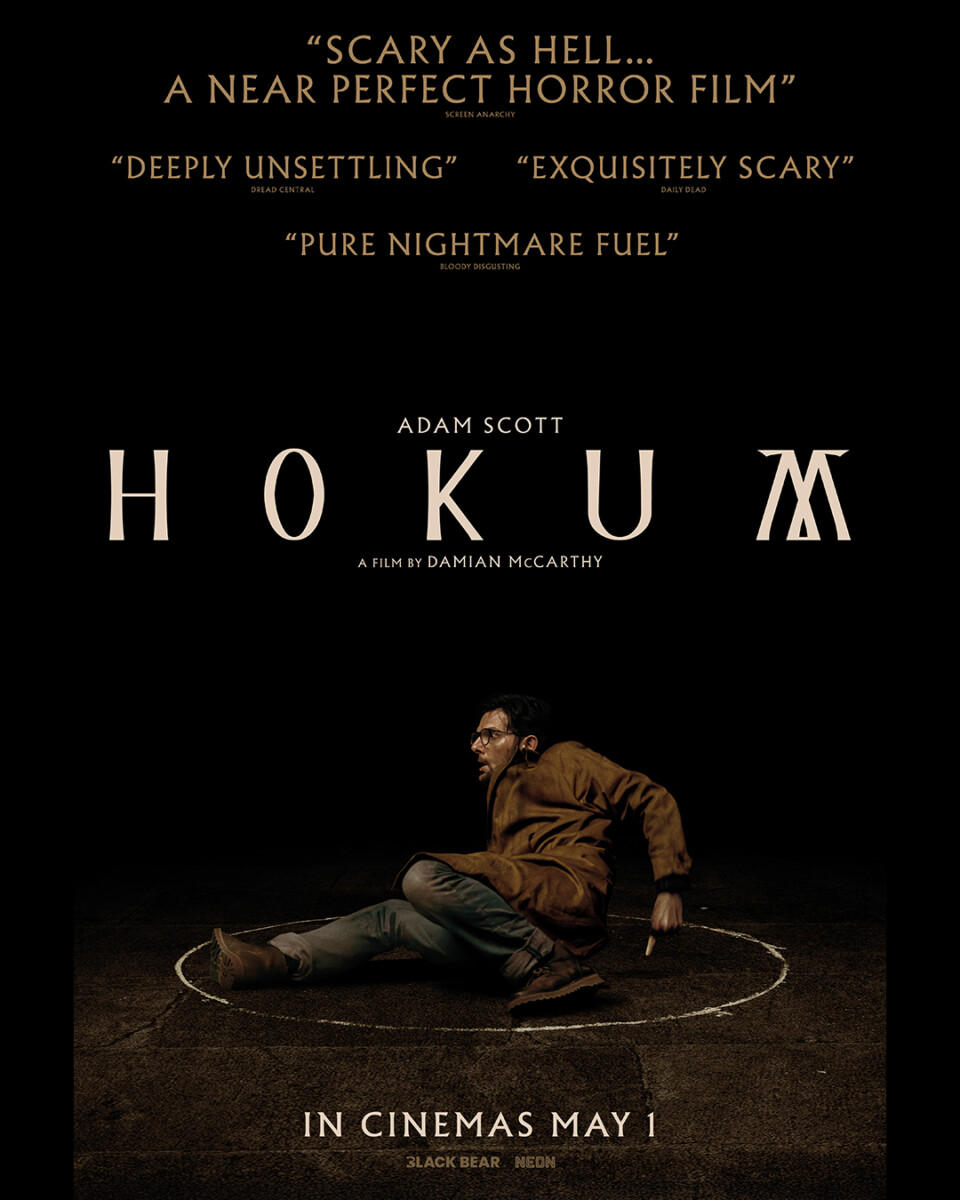
The actor plays Ohm Bauman, an author working on the final book in his Conquistador trilogy, who visits the hotel his late parents stayed in on their honeymoon to scatter their ashes nearby. However, since this is a horror flick, it’s far from your average hotel, with whispers of a witch being locked in the honeymoon suite upstairs.
Faced with locals who harbour dark and dangerous secrets, troubling visions, the sins of his past, the lingering trauma of a childhood moment that changed him forever, the prospect of residing in a hotel that really does play host to an imprisoned crone, and even psychedelically-infused beverages, Ohm’s trip to Ireland is anything but a relaxing getaway.
It is, in effect, a haunted house film, which is admittedly drastically underselling things, and as a lifelong horror aficionado, that broad concept was all that McCarthy needed to plant the seed of the idea in his head, with a single location and the spirits that loom within setting him on the path toward Hokum.

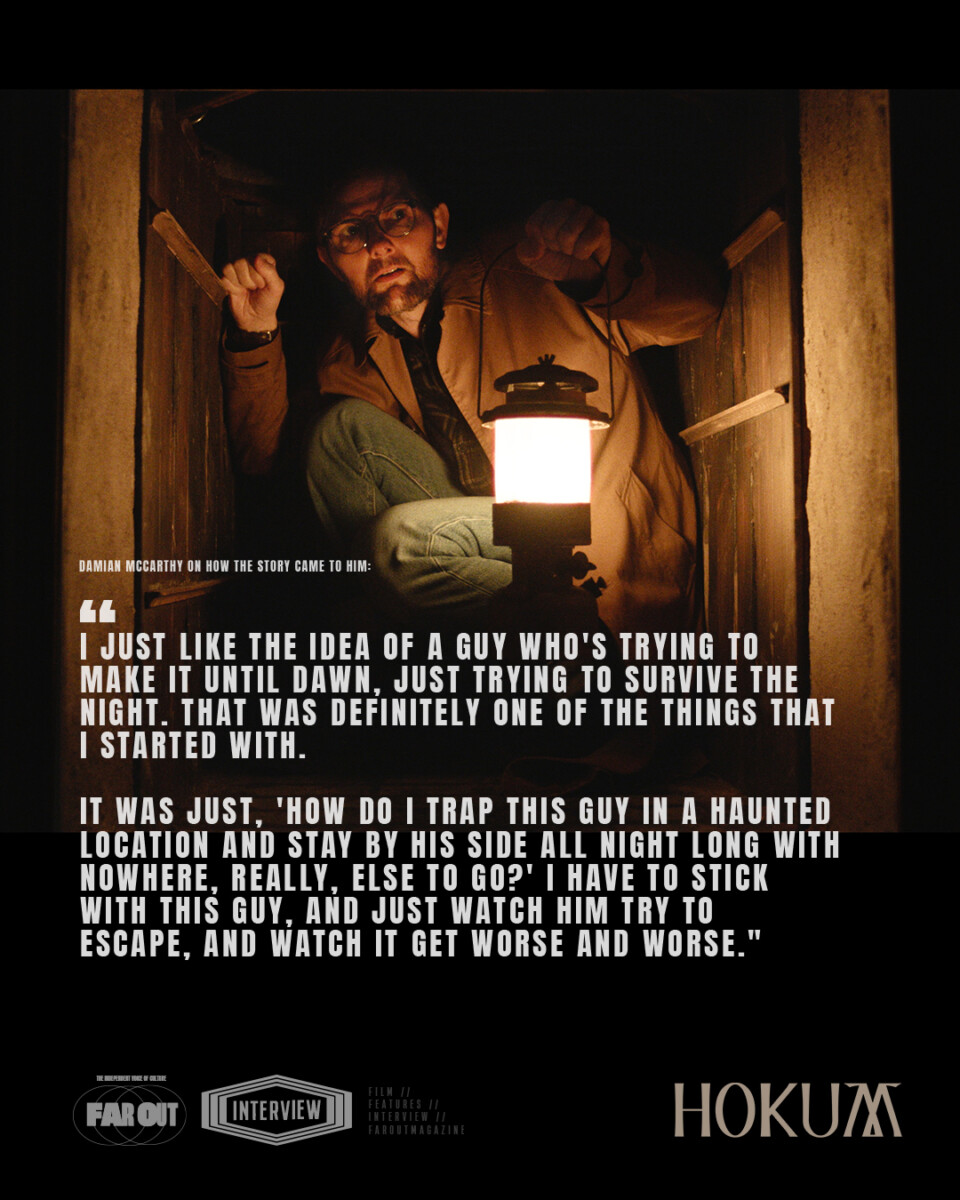
“I just like the idea of a guy who’s trying to make it until dawn, just trying to survive the night,” he told Far Out. “That was definitely one of the things that I started with. It was just, ‘How do I trap this guy in a haunted location and stay by his side all night long with nowhere, really, else to go?'”
That question informed everything else that followed, with McCarthy telling himself, “I have to stick with this guy, and just watch him try to escape, and watch it get worse and worse.” No spoilers, but it does get worse and worse, with the director acknowledging that one night of fear and misery was “definitely the beginning of the idea” behind his third feature-length effort.
In the past, McCarthy has pointed to watching Sam Raimi’s Evil Dead II for the first time as a watershed moment for him, both as a horror fan and an aspiring filmmaker. Much of Hokum‘s back half follows one character as they try to make it through a night of otherworldly goings-on in an isolated location, which isn’t entirely unlike Bruce Campbell’s second outing as Ash Williams, generally speaking.
“For me, I don’t know if I’d be making films if I hadn’t seen that; that was life-changing,” he admitted. “When I first saw it, I was like 16 or 17 and just watched it every single day for months and months. So this is kind of finally, even though it’s a very, very different film from that…”
He trailed off, but he didn’t deny that Hokum was at least a little bit inspired by Evil Dead II, either. “That film is wild, and it’s an excellent film, but tonally, it would be different,” adding, “Even though I always tried to lean into that fine line between comedy and horror, the way Raimi has always so brilliantly done.”
Hokum does have its funny moments, as any horror movie worth its salt should, but it also has a protagonist who can be, for lack of a better term, a bit of a dick. Ohm isn’t the most approachable or likeable guy in the world, which makes Scott’s casting ideal, because he’s found plenty of ways to turn unlikeable figures into people you can’t help but empathise with in one way or another.
On the other hand, it’s a tightrope to write an intentionally dickish main character, since there’s always the chance that audiences could be left wanting bad things to happen to them. Fortunately, not only did McCarthy have the utmost belief in his leading man’s performance, it was kind of the point, too.
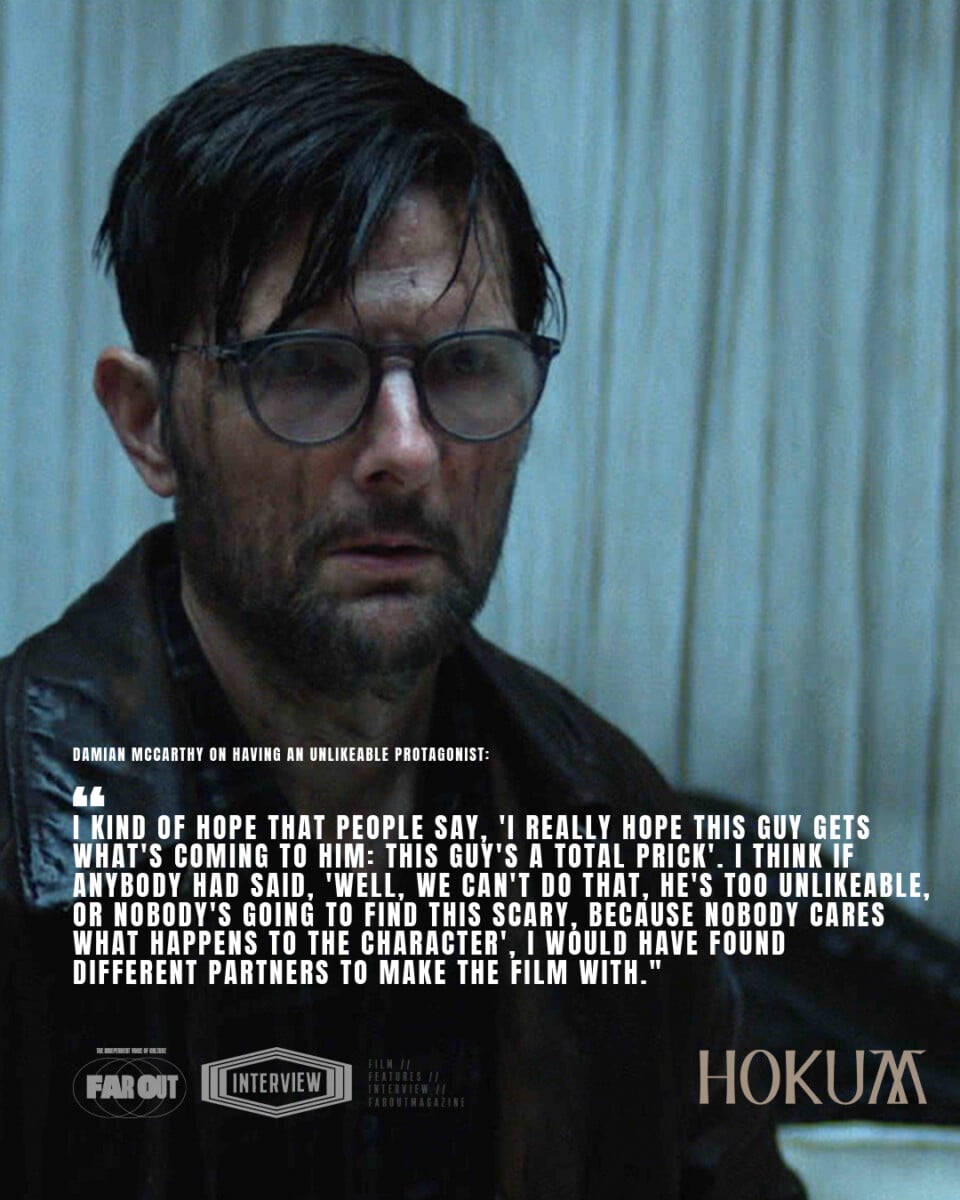
“That’s what I hoped would happen for the first act!” he replied. “I kind of hope that people say, ‘I really hope this guy gets what’s coming to him: this guy’s a total prick.’ I think if anybody had said, ‘Well, we can’t do that, he’s too unlikeable, or nobody’s going to find this scary, because nobody cares what happens to the character,’ I would have found different partners to make the film with.”
Fortunately, the producers and Scott were on the same wavelength as McCarthy, knowing that “the setup with this character is about trying to push the audience away,” which meant he could get away with being a dick. As the story progresses, though, the filmmaker is confident that those perceptions will shift.
“As long as he’s engaging, as long as the character is interesting, then hopefully people will stick with him, even if it’s in the hopes of seeing him punished,” he explained. “But by the time the film goes on, they learn a little bit more about why he is the way he is, they might go, ‘Actually, I wouldn’t mind seeing this guy get out of the situation now,’ you know?”
It was still a challenge to thread that needle, in terms of his script and Scott’s performance, but “we had the same idea of how to go about it,” which put them in perfect sync. Ohm isn’t your conventional horror lead, then, but his circumstances are incredibly familiar, something McCarthy gleefully embraced.
In Hokum, the hotel staff issues ominous words of warning, intoning that the honeymoon suite remains locked and off-limits because there’s a witch in there. Of course, everyone knows that at least one character is going to end up in the honeymoon suite eventually, even though it’s locked and off-limits because there’s a witch in there, but subverting that trope didn’t even cross his mind.
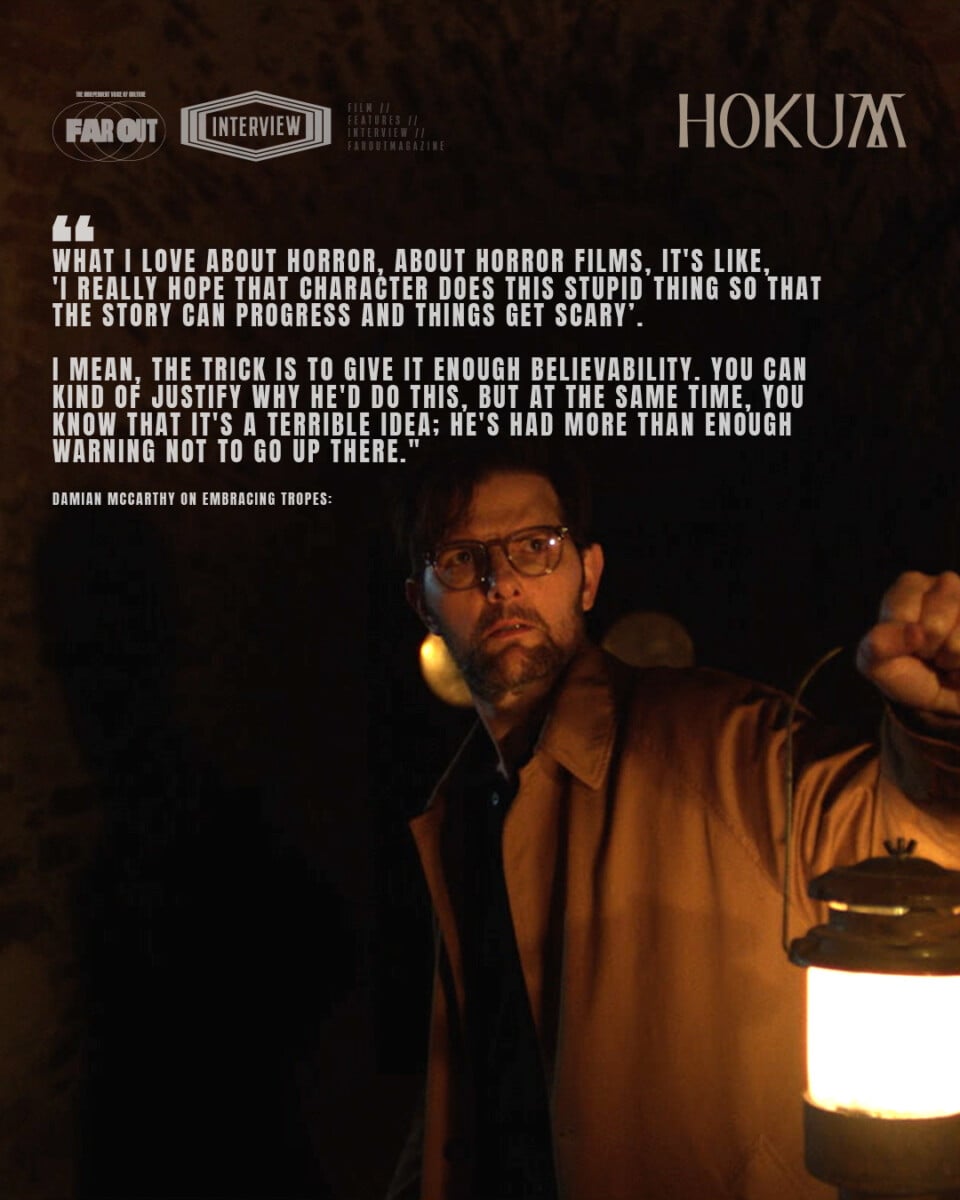
“That’s what I love about horror, about horror films, it’s like, ‘I really hope that character does this stupid thing so that the story can progress and things get scary,'” McCarthy reasoned. “I mean, the trick is to give it enough believability. You can kind of justify why he’d do this, but at the same time, you know that it’s a terrible idea; he’s had more than enough warning not to go up there.”
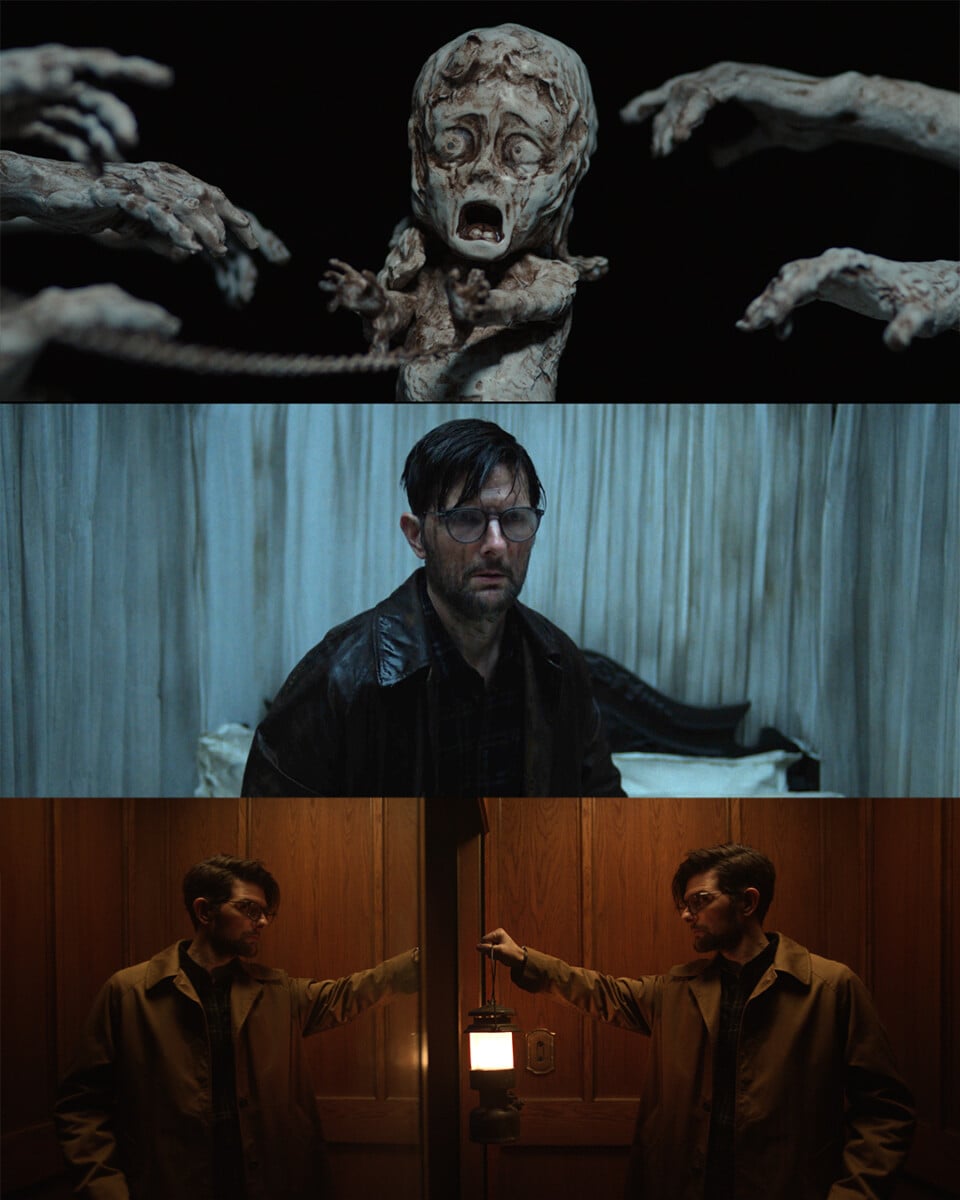
“But the audience wants this to happen,” he explained. “They go, ‘Yeah, this is such a bad idea. This is such a bad choice: I hope he makes it. I hope he makes that choice.’ I guess that’s the balance, that’s what you’re trying to figure out and make it believable.” Funnily enough, it’s not a spoiler to say that Ohm does, in fact, end up in the honeymoon suite, despite being advised otherwise.
Another subtly off-kilter aspect of Hokum is its timelessness. The hotel is dated, the cars are a bit dated, you never see anyone using a mobile phone, and the only piece of modern technology glimpsed onscreen is pretty much Ohm’s laptop and nothing else, with that implacable element something McCarthy is keen to incorporate into all of his films, for various reasons.
“I keep trying to do that with my films, to make them feel ever so slightly out of time,” he concurred. “I’ve been to a lot of film festivals over the years with these movies, and I love when somebody says, ‘When is this set?’ I like that, because maybe people might notice it on a conscious level, but I do think it’s there somewhere. It all kind of looks like it fits together, but there’s no specific time.”
Beyond his desire to “keep the audience off a little bit, visually,” it also has a lot to do with a particular scene he’d never want to shoot: “If Adam was to hold up a cell phone and go, ‘Oh, I can’t get service here.’ I couldn’t even be bothered filming it. Why even do that? Just skip that. Just pretend it’s a world where there’s no mobile phones.”
Not only that, but McCarthy is also playing the long game. If he were to shoot a scene where a character relies on their phone, which he doesn’t want to do, a decade from now, the technology will be outdated, and he’s making films that can be watched in the future while still feeling like they could be from any time, summating that “it’s little things like that I try to apply to the films.”
This isn’t quite encroaching on spoiler territory, but what we can say is that there’s an unexpected framing device that bookends Hokum tied to Ohm’s work, which is effectively the polar opposite of what happens in between. Aesthetically, it’s a disorienting way to begin a horror film that largely unfolds in an Irish hotel, but contextually, it makes perfect sense by the time the credits roll, and it says a lot about him.
“It was just to try to show that mindset, that maybe the way he begins writing something, it’s going to end one way, and then over the course of the film, and everything he goes through, he goes, ‘Well, maybe I could change the ending,'” McCarthy teased, and it’s something he can easily identify with.
“What’s happened to him is now going to influence that ending, and I would find that would happen to myself in real life, too,'” he elaborated. “As I’m writing, whether it’s something that’s happening to me in life, or whether it’s something I’m reading or something that I’m watching, that suddenly starts to influence how a script goes along. These things kind of just find their way into the stories.'”
It’s not quite art imitating life, but it’s not too far off. Another pitfall that Hokum was determined to avoid is one that’s blighted countless modern horrors: exposition and info dumps. Make no mistake, there’s plenty of mythology in the movie, but McCarthy trusts his audience to infer what they can from the breadcrumbs he’s left them, and let their imaginations do the rest of the heavy lifting.
“I watch a lot of horror films,” he noted. “And there is always that moment where maybe after the midpoint or somewhere, somebody shows up who knows everything that’s going on, and they explain it all for ten minutes, and then the story continues again. Now they know what they’re dealing with. I just thought, again, it’s like the mobile phone, why bother with that? Just set it up as quickly as possible.”
In Hokum, those cards are laid on the table: “At the start, there’s a witch that if she comes, if you cross her path, you could end up in chains, getting dragged off to hell: that’s it, we’re good to go, now let’s get on with the horror,” which is nothing if not a commendable approach to world-building and storytelling.
“It’s never interested me to over-explain these things,” the director declared. “It was the same with my other two feature films; you just hint at it, and the audience has brilliant imaginations anyway, they’ve seen more than enough horror films to be able to fill in all this stuff themselves.”
It isn’t just about Ohm encountering a witch, though. As the narrative moves forward, it becomes clear that his journey to Ireland isn’t only about reconnecting with his family’s past; it’s about confronting, resolving, and atoning for the grief and trauma that’s haunted him, in a figurative and literal manner, for decades.
That gives the character an evolution and an emotional throughline, which was one of McCarthy’s creative motivators from the beginning, instead of deciding one day that he wanted to make a movie set in a haunted hotel and then working his way backwards from there. “I like the idea that he’s haunted by what’s happened in his past,” he demurred. “Haunted by the loss of his mum.”
“But it was the idea of what if he was literally haunted? What if there was a ghost following this character around, and followed him all the way over here?” As you’d expect, things get worse. “I just thought it’s a very creepy idea that it’s not just his imagination, he actually does have something that is always on his heels, and he’s got to find a way to lay that ghost to rest, too, as the story goes on.”
Again, we’re skirting perilously close to spoilers here, but since McCarthy wrote and directed Hokum, we’re not going to stop him. “It’s there from the start,” he hinted. “It’s happening even before the movie, and the character knows it, too; the character knows that there’s something in his house before anybody mentions anything supernatural or even anything to do with what’s been going on back home.”
Speaking as someone who always gets a kick out of a character casually dropping the name of the movie they’re in into a conversation, if you’re of a similar mind, then you’ll be thrilled to know that someone in Hokum does indeed say the word ‘hokum’ at some point. As it turns out, that’s the reason the line of dialogue exists in the first place.
“It was always called Hokum,” McCarthy reflected. “Right from the very, very start, even right from the initial ideas, just trying to figure out what the story would be. I like that too, it’s like Full Metal Jacket or something, when a character mentions the name. That was very intentional, yeah.”
Interestingly, along with himself, the likes of Lee Cronin, Lorcan Finnegan, Corin Hardy, Kate Dolan, Richard Waters, and many others have turned horror into a hotbed of fertile creative ground for Irish filmmakers. Even though he’s one of them, McCarthy can’t quite explain why that’s become the case.
“I don’t know, and I have been thinking about a lot,” he admitted. “People have asked, and it is interesting that there’s a bunch of filmmakers at the moment, I’ve met a few of them in passing or had a couple of conversations with, but just for me as a horror fan, I’m delighted with it, because the more horror films that come out, the better.”
“I guess, because I’m Irish, it’s just that added bonus of seeing all this cool stuff being made at home,” and yet, he still isn’t sure why. “I’ve been thinking, maybe, is it because we all grew up watching American cinema like [John] Carpenter, Raimi, and this kind of thing? And now, we’ve learned how to make movies and have access to budgets to be able to do it, and it’s all that stuff that we were inspired by. I can’t exactly explain it, but I think it’s great. I hope it continues!”
Horror has been the bread and butter of his feature-length career so far, but as a viewer, at least, McCarthy is a man for all seasons. “It’s not just horrors I watch!” he helpfully clarified. “I love comedies, romantic comedies, and dramas. I’ll watch anything. Science fiction.”
He’s got “loads of ideas and scripts underway for things that are outside the horror genre,” but his focus is on “trying to get as good as I can.” If everything goes to plan each time out, then filmmaking is a constant upward curve, and he’s aware of that: “You always try to do what you did last, or take what you learned and apply it.” That said, he’s happy to remain in horror, for the time being.
The genre has been one of the industry’s most fruitful pipelines, with some of the biggest and most commercially successful directors in the business cutting their teeth in horror, with Raimi, James Wan, Peter Jackson, Adam Wingard, Andy Muschietti, and more becoming blockbuster and franchise mainstays.
For McCarthy, he wants to remain in the realm of original stories. “I, for good or bad, would just like to keep making my own stuff,” he said. “I’d like to stay with those and see if I can come up with something that’ll be revisited for years to come and that people will keep coming back to watch. That’s the ultimate goal.”
