


Cromagnon: The 1960s’ beginnings of industrial music?

The roots of industrial music typically begin with the sonic terrorism of Throbbing Gristle.
Formed in 1975, two of the avant-garde art collective COUM Transmissions’ Genesis P-Orridge and Cosey Fanni Tutti began making music experiments in a makeshift Hackney studio with television sound recordist Chris Carter and Hipgnosis artist Peter Christopherson.
Conjuring atonal blasts of sinewy electronics and eerie tape collages, Throbbing Gristle dubbed their experimental extremity ‘industrial music’ and sought to examine the post-industrial malaise festering across the UK through transgressive excavations of the evil and squalid buried deep in the national psyche.
So disturbing were their works exploring pornography, Nazi atrocities, war crimes, and the human propensity toward violence, Tory MP Nicholas Fairbairn lambasted Throbbing Gristle as “wreckers of civilisation” when excoriating their receipt of public arts funding. Yet, an acrid fume was permeating across both sides of the Atlantic.
Along with Cabaret Voltaire’s fuzzing robot angst scoring the urban hopelessness of their Sheffield hometown, New York’s Suicide were illustrating the city’s economic rigor mortis with their hissing belligerence of brittle synths and frontman Alan Vega’s entranced provocations. Industrial music would evolve as the 1980s rolled along. Throbbing Gristle would splinter into the various Psychic TV, Chris & Cosey, and Coil offshoots, and West Berlin’s Einstürzende Neubauten would take the industrial sensibility to a more cerebral and aurally unfiltered plane.
For better or worse, industrial music would add heavy guitars and/or pursue a variant of mechanised club dread destined for the alternative dancefloor that pushed groups like Ministry, Skinny Puppy, Front 242, and Nitzer Ebb as some of the biggest names in underground music by the decade’s close. In the 1990s, Nine Inch Nails’ distinct craft of abrasive metal attack and industrial affront thrust Trent Reznor as the Lollapalooza generation’s premier poster boy.
Like any genre, deeper sediments of influence can be found when digging into industrial’s foundations. Aside from the wealth of Beat literature, Dada theatre, and esoteric theories that shaped the genre’s dissident energy, a preceding litany of challenging composers and pieces from the school of musique concrète laid pivotal sonic foundations. The works of Pierre Schaeffer, Edgard Varèse, and Karlheinz Stockhausen all explored the electro-acoustic terrain that would establish the ideas and presentation of music reflecting the sounds of the industrial world and require non-traditional methods to translate it.
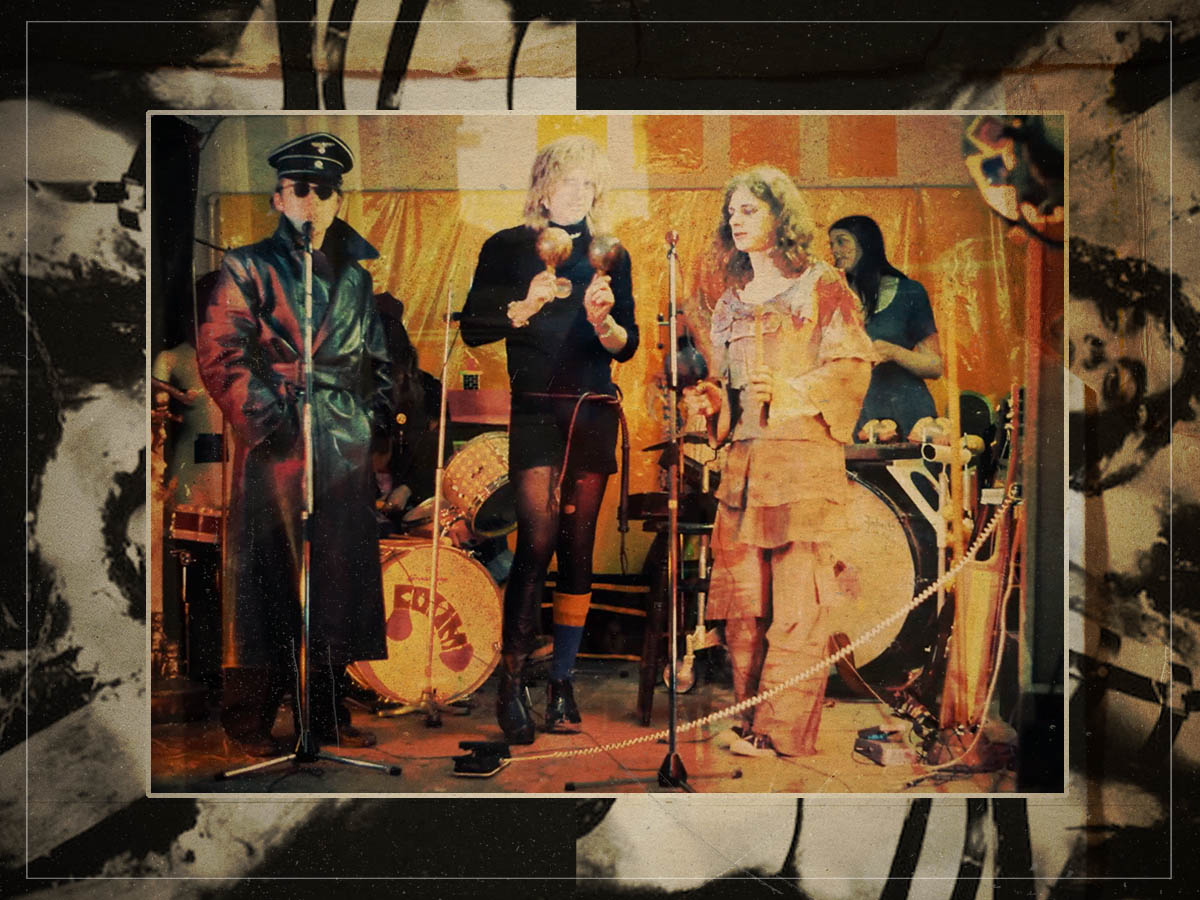
If keeping away from classical academia and exploring within the relative scope of popular music, it’s hard to deny Cromagnon’s essential industrial pointer. Operating on New York’s experimental fringes, multi-instrumentalists Austin Grasmere and Brian Elliot combined a love of Phil Spector, electronic effects, primitive sampling technology, and smatterings of caustic folk to cut one of the most aggressively weird and strangely futuristic records of the countercultural era.
Not that the pair were thematically concerned with chasing the sounds of modernism. As their name honouring the early European settling homo sapiens suggests, Cromagnon pursue a strange primitivity in their experimental noise, frequently banging together sticks and stones and even crediting one collaborator with the distinguished role of “honorary tribe member”. Amid their primordial concepts was a playful subversion that sought to unsettle ‘The Man’ in incredibly far-out ways befitting the era’s social upheaval.
“[Elliot] was going to have a large womb pulsating on stage with lights in it and whatever,” percussionist Sal Salgado recalled on WXCI 91.7 FM in 2002. “Made out of canvas, painted with veins and whatever, and just have it pulsating. And they were going to pump white noise through the speakers for like, the first half hour. His idea was that any federal or narcotics agent that was in the audience would be blown away, and he’d have to leave the area. So, just insane, you know?”
Such arresting ideas would be poured into their sole album effort. Dropped in 1969, Orgasm—sometimes titled Cave Rock on later issues—would coat their DIY psych with all manner of corroded electronic hue. Pitched-up voices, radio interruptions, scuzzed-out concrète, and a bagpipe atonally hooting in the centre of a monstrous cacophony of demonic howl, Orgasm, albeit with a much wryer smirk on its face, doesn’t so much as open the door for industrial. It tears through the dimensions of music itself, accidentally stumbling upon a bizarre and sonically heady rupture for all of the future Throbbing Gristles and Suicides to spill out of.
It doesn’t always work, but when Cromagnon aim their studio japery and gleeful amateurishness on target, Orgasm can unearth incredibly prescient and evocative soundscapes and scrambled intersects between the primal and the mechanised. With Elliot and Grasmere sadly having passed, their Cromagnon shenanigans live on as a beckoning footnote in industrial music’s twisting and storied history, a potent pool of pioneering influence that colours the future synth belligerents, whether they realise it or not.
