


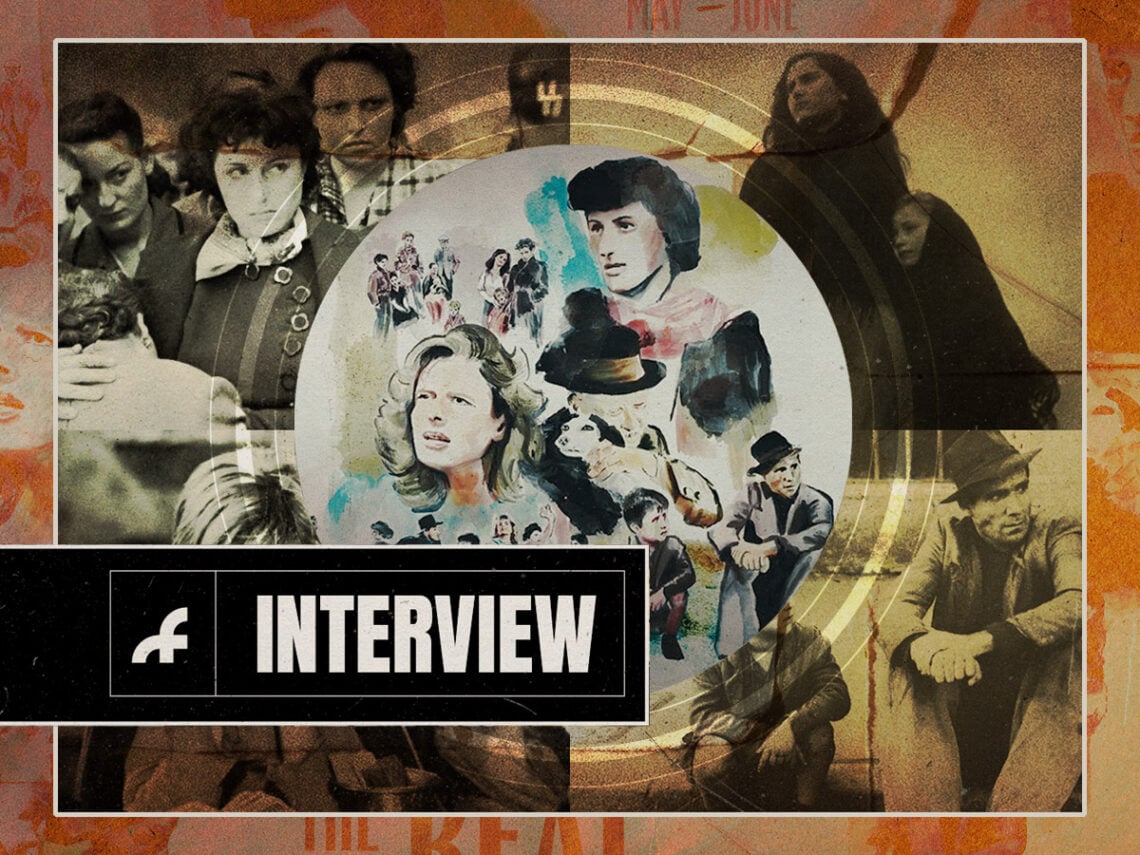
Chasing the Real: Giulia Saccogna breaks down the BFI’s Italian Neorealism season

The world of mainstream modern cinema is a place of baffling confusion, where stories are told with a blinding pace, and studios cynically disguise a commercial exercise to sell more merchandise as an earnest attempt at art. The corporate nature of the industry has, indeed, always been the case since Hollywood was formed at the turn of the 20th century, with cinema having long been used as a tool to tweak sensibilities and even as propaganda to instil patriotism and instate often troubling social values.
Such was the case in Italy during the years of fascist rule when Benito Mussolini was dictator from 1925 to 1943. The ‘White Telephone’ movies of the era promoted the country’s wealth and prosperity, focusing solely on the affluent members of society while flagrantly ignoring the very real social issues that impaired the lives of millions. Without any sort of artistic identity, these movies served the interests of the state alone, neglecting the alienated working class whose lives were not reflected on screen.
Once fascism ended in 1943 and Mussolini was killed in 1945, out of the ashes came Italian Neorealism, a cinematic protest against the previous generations of rule and cultural censorship. As Giulia Saccogna, the programmer for the BFI’s latest Italian Neorealism season, puts it: “Italian directors, newly freed from 20 years of fascist dictatorship, could finally express their critical view of society: reality appeared on screen for the first time”.
Focusing on some of the most seminal works of the movement, the two-month-long season will include screenings of such classics as Vittorio De Sica’s Bicycle Thieves and Luchino Visconti’s Ossessione, which have come to define the era with the nucleus of their tales relating the moral quandaries of the Italian people in a post-war world. Rebuilding society from its mere foundations, national cinema felt the need to hold a mirror to reality in order to move forward.
As Saccogna explains: “Italian neorealism brought contemporary social issues, and characters experiencing these issues, to the centre of the scene – for example, divisions in society, poverty and unemployment, pensioners struggling to survive, farmers organising the first strikes, women from the working class and poor fishermen, just to name a few”. Yet, while each film followed a similar collective conscience, there were no strict theoretical principles to their work, with Cesare Zavattini, the main theorist of neorealism, highlighting “we want, all together, to purify and renew”, clarifying the core objective of the movement.
Lasting only a decade, from the final years of WWII to the mid-1950s, Neorealism became the new language of Italian cinema, with Saccogna picking out Rome, Open City, Bicycle Thieves and La terra trema as the three key texts from the era. “These films by three very different directors – the canonical trio Rossellini, De Sica, Visconti – changed everything and, individually, are landmarks for different aspects of neorealism,” she stated, “Rome, Open City for its unvarnished recounting of the hardships of wartime; Bicycle Thieves as a human masterpiece by the two poets of reality, De Sica and Zavattini; La terra trema as possibly the purest example of neorealism with its whole cast of non-professional actors, speaking their local dialect, and the compositional rigour of each frame”.
Short-lived though the movement might have been, the ripples of Neorealism had considerable ramifications across the globe, transcending borders and “radically transforming the cinematic landscape worldwide”. Mere years after the movement drew to a close in Italy, just across the border in France, the innovative New Wave artists took the ingredients of its success and forged a new path of their own, with the great François Truffaut calling Roberto Rossellini “the father of the French New Wave”.

As Saccogna explains: “The French New Wave embraced neorealism as proof that filmmaking could be possible without an industrial structure behind it, while also sharing with it some aspects of the style: plots structured on digressions, open endings, exasperate variation of tones. Like neorealism, the French New Wave wasn’t a compact movement, and its filmmakers took very different directions”.
Yet, in a post-war world, cinema had very much become an international affair, with the burgeoning filmmakers of Hollywood cinema looking over to their European counterparts for inspiration as ripples of Italy’s pioneering movement made their way across the Atlantic. In Hollywood, such filmmakers as Jules Dassin, Elia Kazan and Nicholas Ray took direct inspiration, but it was in the flourishing world of independent cinema where Neorealism truly took flight.
“Neorealism had a vast influence on New Hollywood Cinema, notably on Martin Scorsese, and it was key to the development of the arthouse boom in the US in the ‘60s,” Saccogna notes, with the celebrated director of 1976’s Taxi Driver famously calling Neorealism “the most precious moment in film history”. He certainly wasn’t the only burgeoning filmmaker inspired by the honest depictions of reality seen in Italian cinema either, with John Cassavetes taking influence in his first feature film, Shadows from 1959 and Shirley Clarke’s documentary-inspired Cool World from 1964.
Casting oneself back through the corridors of history may sound like an alienating experience, but Neorealism shares a considerable amount with the modern world of independent cinema, with the likes of Kelly Reichart, Ken Loach and the Safdie brothers singing from the same hymn sheet as the Italian pioneers of the 1960s. Neorealism has, indeed, “always been ingrained in the fabric of independent arthouse cinema” and has most recently reflected its light in films like Alexander Payne’s Nebraska, Chloé Zhao’s Nomadland and Eliza Hittman’s Never Rarely Sometimes Always.
Still, nothing quite compares to the source, with there being no better film to engage with the styles of Neorealism than Rossellini’s Rome, Open City, which will be re-released in UK cinemas as part of BFI’s retrospective season. Released in 1945, when the movement was beginning to take hold of Italian culture, Rossellini’s film speaks to the devastation of war on the values of the country and was a “transitional film for a society coming out of 20 years of fascism”.
With new restorations and imported 35mm prints of classic works from the era “that haven’t been screened in the UK in over 60 years”, BFI’s Chasing the Real: Italian Neorealism season will give the movement its due time in the limelight. It’s a timely retrospective, too, with the plethora of political and social issues in modern Britain being largely ignored in the cinematic sphere in favour of sci-fi flicks and bombastic escapism. Born as a cinematic protest against generations of oppression and inadequate authentic representation, we could certainly take inspiration from the humble courage of Italian Neorealism.
Chasing the Real: Italian Neorealism is at BFI Southbank from May 1st – June 30th, with selected films also available to watch on BFI Player.
Rome, Open City is re-released by the BFI in selected cinemas from May 17.
