


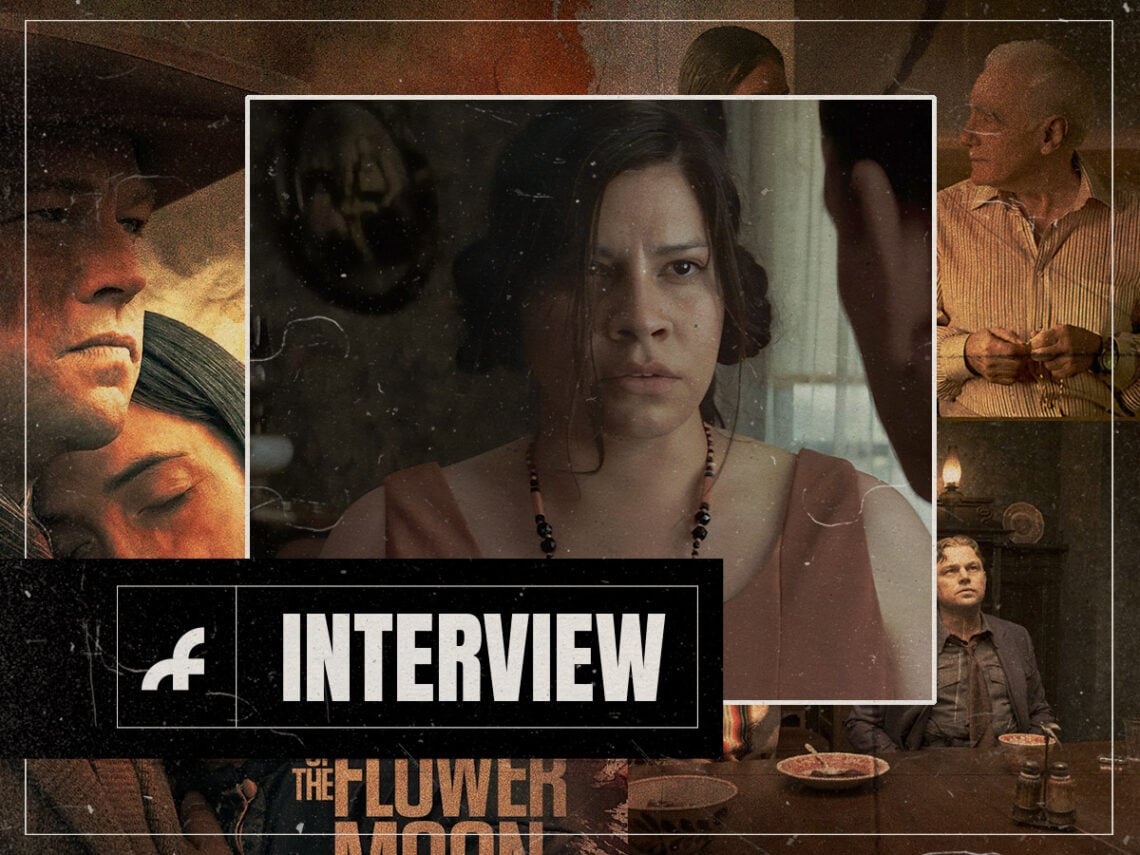
Cara Jade Myers talks Martin Scorsese and the indigenous authenticity of ‘Killers of the Flower Moon’

Unless they’re being accompanied by white saviours, as in Kevin Costner’s Dances with Wolves or shoved to the side in stories such as Alejandro González Iñárritu’s The Revenant, the accurate experience of Indigenous Americans is rarely represented on the Hollywood silver screen. Yet, in 2023, none other than Martin Scorsese sought to change this narrative, directing Killers of the Flower Moon, the story of the real-life genocide of the Osage tribe in 1920s Oklahoma.
An honest depiction of the indigenous genocide, Scorsese earned the trust of the Osage tribe before taking on the picture and demanded that his version of the story, adapted from the non-fiction book of the same name by David Grann, was as compassionate as possible. A key requirement of this was translating the Osage language for the big screen, employing indigenous actors Lily Gladstone, Tantoo Cardinal and Cara Jade Myers, among others, to play the lead roles.
While many of these actors had long been working their way in Hollywood, Myers, who plays the role of Anna, one of the sisters of Gladstone’s protagonist, had barely experienced the intensity of the industry limelight. “I’ve been in acting for about 16 years, and the roles for Native Americans are so limited. It seems like they only hire the same five people over and over again,” she told Far Out, “I auditioned a couple of times and kept auditioning and kept auditioning. So it’s definitely one of those things where it seems very sudden”.
Having only previously appeared in short films and minor TV episodes before taking on Scorsese’s epic, Myers was very much flung into the deep end of the filmmaking process. Yet, despite the stature of the Oscar-winning filmmaker, Myers was given considerable free reign to thrive in her role, revealing, “Scorsese was so detailed, but he was also very hands-off if that makes sense. When we talk to him about our characters and stuff like that, he’s very much like, ‘You’re the actor you build your character’”.
Where a lesser-known filmmaker still proving their worth might panic with directions, Scorsese seems like a far calmer soul, with Myers adding: “He gives you the freedom to explore and do what you want, and then he’ll tweak it and fine-tune it, which was very awesome. He is just so smart and he just knows immediately what to say or what to do to just get you to where he wants to be. His experience is just insanely invaluable, and he’s such a wealth of cinematic history”.
Such a measured approach to the filmmaking form worked considerably in Myers’ favour, too, who was keen to imprint her own identity on Anna, a character who struggles with her addiction to alcohol. “I’ve grown up in a family of alcoholics and addicted people,” the actor explained while outlining her approach to the character, “So, to me, that was such an important core aspect, I didn’t want her to be this stereotypical drunk Indian”.
Speaking to the lovingly nicknamed ‘Marty’ about this desire, she said, “I want her alcoholism to stem from pain. I don’t want it to stem from her being just this fun-loving party girl,” and the director was quick to oblige. “Having that permission and freedom really clicked and changed a bunch of things for me, so that has always stuck with me,” she added, “I think the inexperience in me was waiting for someone to tell me what to do, and he was like, ‘No, this is your character, you do it’”.
In turn, Scorsese learned how to approach the delicate source material, becoming “incredibly collaborative and understanding” in regard to the intonation of the Osage dialogue and the specific mannerisms of the Osage characters. “He realised then how important these different stereotypes were,” she explained, “He was very open to learning about our culture and doing it authentically, he wasn’t trying to make us in service of the story. He was very much having the story service to us”.

An odyssey that spans several years of 1920s Oklahoma, Scorsese’s Killers of the Flower Moon is reminiscent of his other 20th-century epics that seemed to define a place and time in American history. As such, it is fitted with a much-reported and minorly criticised three-and-a-half-hour runtime, which Myers admits should have been extended further, “I wish that it was longer,” she states, “But also, I kind of would rather it be a mini-series kind of just because there are so many details with the Osage that we didn’t get into”.
Despite the length of the film, Myers is given only a scattering of scenes to allow her character to thrive, being killed off as part of the sinister murder plot in the opening act of the movie. Knowing that her character would be killed off early on, Myers strived to make Anna “so full of life and so full of love for her family and her community that it was more tragic when she died…I wanted to show how much she loved her family and how full of life she was, and even in her state of drunkenness and anger, she was still just very fiery and full of life. So that way, in the end, when it’s so tragically cut short, people feel that loss of energy and that loss of life”.
The tragedy of Anna comes largely from the steady disintegration of her family unit as each one is slowly picked off by an invisible pack of capitalist vultures. The potency of this tragedy resonates vividly through the connection of the Burkhart sisters both on and offscreen. “We just had such an amazing rapport and time together, we really felt like sisters,” Myers affirmed, “Tantoo [Cardinal] was always amazing, and we’ve learned from her through all of her movies throughout history. Actually being able to hang out with her at her apartment and just talk about all the Hollywood shenanigans that she’s had to put up with, including the racism and the sexism, really put into perspective how special the movie was”.
Such rapport also developed thanks to the actors who took the part of the Burkhart sisters learning the Osage language, together with Robert De Niro and Leonardo DiCaprio. “I really struggled with memorising it and learning,” Myers said of her experience with the language: “There’s a scene, the picnic scene, where I have my fan in front of me, I have my lines right there. Because I had such a big chunk of Osage to say, I had it written up there, so if I lost it, I could just look”.
Yet, despite her struggles, Myers maintains that she would have liked to have seen more Osage dialogue in the movie, conjuring with the previous comments of De Niro. “I think the Osage dialogue adds such texture and richness that you don’t see in films,” she states, “More Osage is probably how it was back in the time, but I do understand that if you put too much into it, then it becomes like a foreign language film, which is kind of crazy”.
Up for a plethora of Academy Awards, including ‘Best Picture’ and ‘Best Director’ for Scorsese, Killers of the Flower Moon is also admirably represented in the acting categories, with Lily Gladstone and De Niro up for awards, even if DiCaprio failed to make the cut. But for Myers, it is Tantoo Cardinal who is the most criminally snubbed. “She has put up with so much crap for so long,” Myers says of the esteemed Hollywood actor who has been present in the industry since the 1970s, “She’s still talking to us and giving us her wisdom, and she’s so incredibly kind, and she’s done so many films that I feel like she deserves some recognition”.
It’s a reminder that with all the noise of Killers of the Flower Moon’s epic length and ambition, at the end of it all, it’s a story that gives a voice to the previously oppressed and finally sheds light on one of American capitalism’s most tragic victims.
