


‘Killers of the Flower Moon’ movie review: Martin Scorsese’s chronicle of oil, faith and manipulation

As the reserves of oil and underground fuel resources draw ever closer to an inevitable end, Martin Scorsese has cast his vision on how the whole ordeal started. Putting a microscope to the beginning of the oil explosion and its effect on the communities where crude oil lay waiting to burst out of the ground in a shower of black gold. In the case of Killers of the Flower Moon, we are focusing on the Native American Osage Nation of Oklahoma.
Alongside this exploration, the director weaves a narrative of criminal deceit and exploitation as per the non-fiction book of the same name by David Grann. In the 1920s, there was a series of mysterious murders of members of the Osage Tribe, which led to a significant investigation by a federal unit that would eventually become the FBI. Still, it took several deaths for the crimes committed to be taken remotely seriously.
Scorsese’s story begins with the Osage elders already aware that their children will likely learn the ways of white people and forget their lineage before oil suddenly bursts out of the ground. Its arrival is heralded, and the Osage dance around as it covers their naked bodies with slick wealth. Rather than show how the exploitative whites first came to Osage land after hearing about the oil burst, Scorsese instead flashes forward to find the Osage and the whites living side-by-side in Halifax, a city infrastructure already thriving with bars, stores, hospitals, and schools.
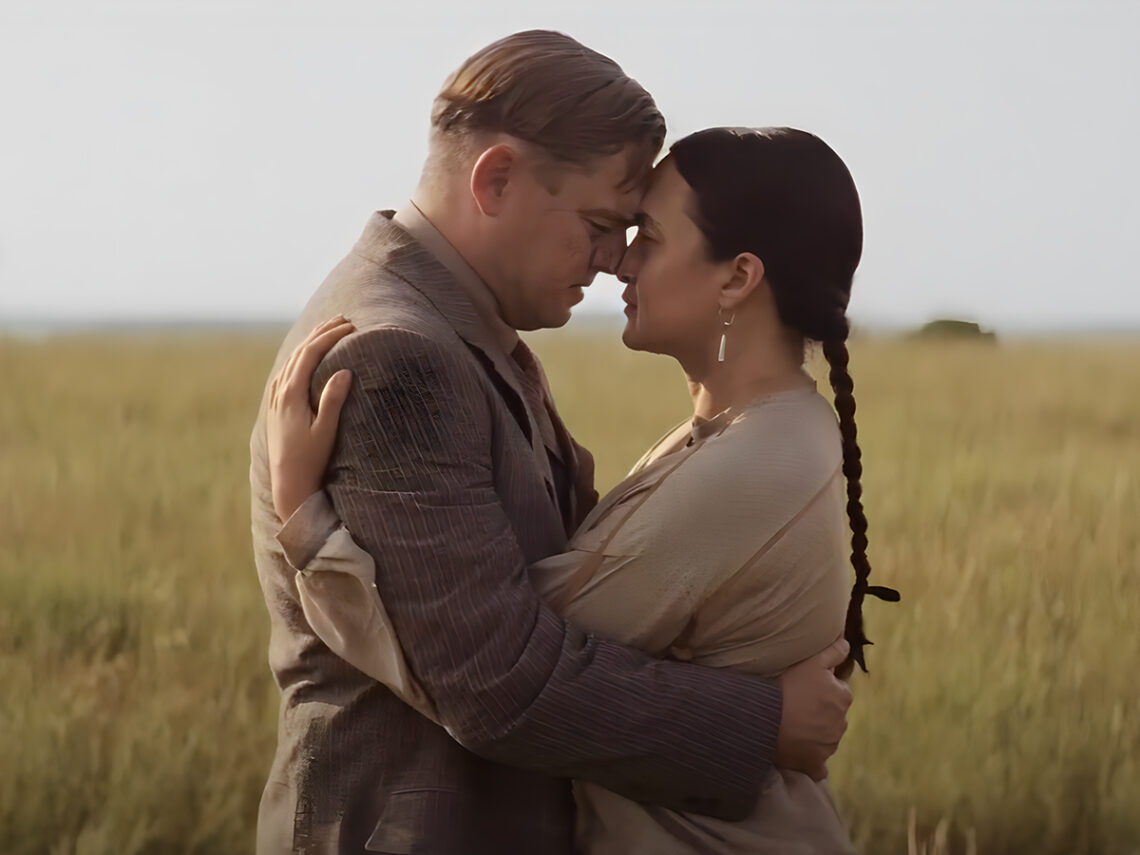
To the town enters an inadequate, greedy and too stupid-to-be-evil World War I cook, Ernest Burkhart (Leonardo DiCaprio), who has come to the town to work for his uncle, chief manipulator and supposed friend of the Osage people, William Hale King (Robert De Niro). While Hale has already taken advantage of the Osage, he has far bigger plans to line his pockets, wanting Ernest to marry Lily Gladstone’s full-blooded Osage woman, Mollie.
Hale intends to kill off the Osage people one by one until he, through his schemes and his friends and family, can inherit their wealth. Still, he has infiltrated their society to the point of trust and manipulated his nephew into doing his bidding. He takes out life insurance policies on those he will have murdered (making them look like suicides), essentially poisons Mollie by giving her the wrong medication for her diabetes and goes so far as to blow up an entire house full of Osage. He is hiding in plain sight as a so-called friend of the people, ready to profit from their destruction.
The new ‘civilised’ Osage nation is one of illness, depression, gambling, violence and alcoholism, so there’s no doubt that Scorsese delivers the well-trodden ‘white people are bad’ narrative. In fact, it is so well-worn that it is hardly a focus for Scorsese, who instead more keenly presents the personal deceit at hand. There’s a breakdown of relationship every which way you turn, whether from Ernest to Hale – who remarkably begin to resemble one another with DiCaprio employing De Niro’s trademark downturned grimace – or the distrust that grows between Ernest and Mollie as Hale yanks his leash and (literally) spanks his arse.
Faith has always played an essential part in most of Scorsese’s movies, and he uses it well in Killers of the Flower Moon. One might expect an overreliance on Native American ritual and belief, but the director refrains from overdoing it; when hallucinations and visions of the beyond are depicted, they are tasteful. There’s also the recognition of the Christian faith being taken less seriously by its whites, even compared with converted Native Americans, showing perhaps that the downfall of Western society was already well in place by the time the 20th century began.
There’s a terrific score of delicious basslines, harmonica solos and slide guitar with a soundtrack of period music also lending an air of realistic authority to proceedings along the way. As expected of Scorsese, every shot is perfectly crafted and brings the nature of the true-crime narrative to new cinematic heights. At three and a half hours long, Killers of the Flower Moon is utterly captivating, sensitive in its approach and an essential work in chronicling the power that the United States would eventually become.
