


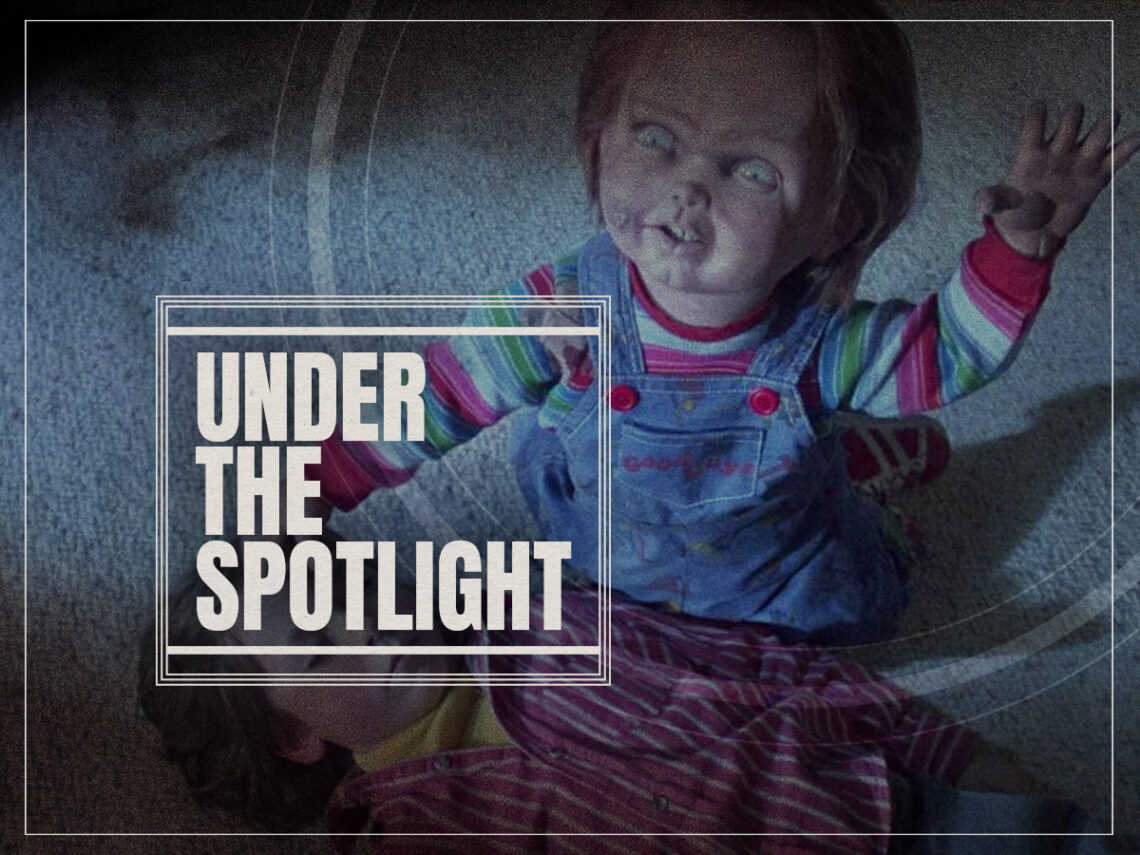
Under the Spotlight: the campy allure of Chucky in ‘Child’s Play’

“It is not a natural mode of sensibility, if there be any such. Indeed, the essence of Camp is its love of the unnatural: of artifice and exaggeration,” wrote Susan Sontag in her essay Notes on Camp. Campiness has defined many movies, for better or for worse. In some cases, accidental campiness results in simultaneous critical bashing and cult status, while in others, like the movies of John Waters, campiness becomes praised as transgressive and subversive.
It is no surprise, then, that Waters is a huge fan of the Child’s Play franchise, even appearing in Seed of Chucky and the television series Chucky. Since his inception, Chucky has become one of the most unforgettable horror villains, mainly due to the innate campiness of being a killer doll. The murderous doll phenomenon didn’t start with Chucky, the orange-haired, dungarees-wearing killer, but he certainly helped to popularise it. Before Chucky arrived in movie theatres with a charming smile that quickly turned evil, there was Talky Tina in an episode of The Twilight Zone and the creepy ventriloquist in Dead of Night. Yet, with Child’s Play, a doll with a murderous mind of its own made a lasting impression on the masses, his legacy still echoing through horror today.
We’re first introduced to Chucky in a toy store, where there are mountains of Good Guy dolls in yellow boxes with ‘He wants you for a best friend’ written on the front. After a criminal, Charles Lee Ray is involved in a tense standoff with a cop, he transfers his soul into one of the dolls, allowing himself to live on as Chucky. We then meet Andy, the child of a single mother who simply wants a Good Guy doll more than anything, and even though she isn’t financially able to provide one, she does what she can – even if that means buying one from a homeless man outside for a discounted price.
It doesn’t take long for Andy to treat the talking doll like his best friend, and soon enough, it goes off script, introducing itself as Chucky, Charles’ nickname. He first attacks Andy’s babysitter Maggie, who is also his mother’s best friend. While the plot is absolutely ridiculous, Chucky causes real terror, hitting Maggie with a hammer, leading her to fly out the window and fall to her death.
Chucky proves to be a terribly bad influence on Andy, who no one believes is possessed by Charles, even though Andy tries to tell people that Chucky has revealed his real name to him. Of course, no one is going to believe that a doll has been committing crimes and running around with a mind of its own, so poor little Andy is sent to a psychiatric hospital despite the fact he has only been telling the truth.
As events descend into even further stupidity, Chucky steals the show. When you see him running across the room wielding a knife, you can’t help but laugh at the silliness of his demeanour and the crazed look on his face. At the same time, the film succeeds in maintaining a genuine level of horror because with every shot of Chucky comedically running up the stairs or appearing at the door, there is still plenty of tension maintained. We never know exactly what Chucky is capable of, and he surprises us every time.
The innate ridiculousness of the narrative gives Child’s Play a certain level of camp charm, helped by the way that Chucky is presented as mischievous and outspoken. Some of his lines, like “You stupid bitch, you filthy slut! I’ll teach you to fuck with me!” and the iconic words he tells Andy, “Chucky says Aunt Maggie was a bitch and got what she deserved,” are pure camp gold. They’re the kind of lines you can imagine coming out of the mouth of a John Waters character in one of his depraved and over-the-top films.
Since the release of Child’s Play, there have been various sequels and spin-offs, and when Chucky is reunited with his former lover, Tiffany Valentine, in Bride of Chucky, the franchise fully gives in to its campiest elements. We’ve also seen clear homages to Chucky in other killer doll films, most notably M3GAN, which sees the AI-powered doll of the same name embark on a ruthless killing spree.
The difference with M3GAN, though, is that it lacks that spark that Child’s Play has. M3GAN is funny and creepy, but Child’s Play possesses a truly classic horror movie feel, laden with more suspense and tension. It might not be the greatest slasher of all time, but Chucky’s terrifying blend of humorous quips and ruthless ambition has made him an icon of both horror and camp cinema.
