


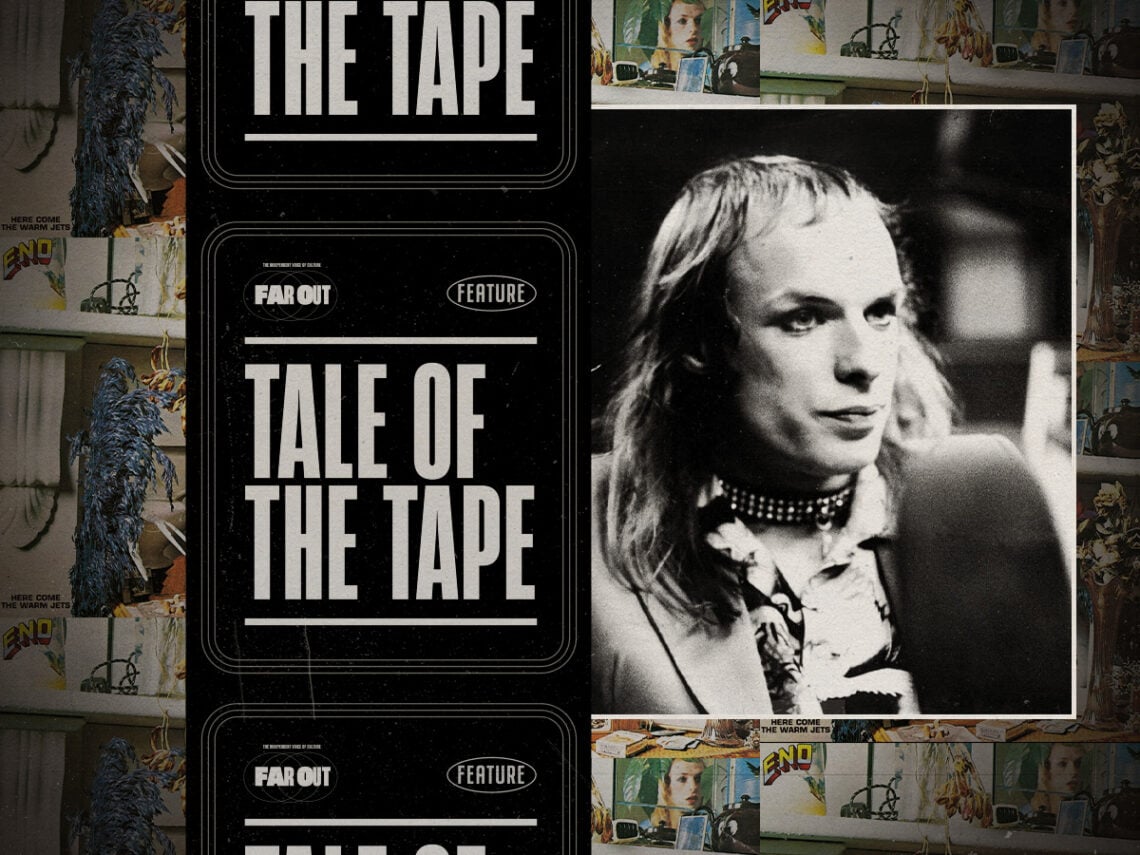
Tale of the Tape: The story of Brian Eno’s art-glam gem ‘Here Come the Warm Jets’

It’s often forgotten just how firmly glam Brian Eno stood in his early 1970s solo entrance.
For the best part of 50 years, Eno has served as ambient music’s Grandaddy, the undisputed titan of cerebral, sonic meditation, scoring the left part of the brain ever since 1978’s Ambient 1: Music for Airports kickstarted his immersions into sound’s layered expanses in earnest. From then on, the majority of Eno’s output has existed as intellectual fodder or soundtracks for exhibits, grounded in a sense of academic exercise befitting his reputation as a polymath thinker, just as adept at discussing politics and philosophy as he is coaxing the best out of David Bowie and Talking Heads on their career-defining LPs.
All noble stuff, and boasting one of the most lauded production CVs in rock and pop history, but longtime fans may pine for the shimmering zest of a record like 1974’s Here Come the Warm Jets. His first real solo LP after two drone experiments with King Crimson’s Robert Fripp, Here Come the Warm Jets wasn’t a Brian Eno album but an ‘Eno’ effort, the mononymous moniker the avant-pop entity draped himself with in all his kaleidoscopic intrigue as had struck its dazzling impact on his former Roxy Music days.
When casting the mind back to Top of the Pops’ glam golden age, if you haven’t thought of Ziggy Stardust’s limp wrist around Mark Ronson’s shoulders or T Rex’s preening glitter lighting teenage fires, the image likely conjured is Roxy Music’s retro-futurist burst of ‘Virginia Plain’, Eno radiating androgynous allure with his flowing blonde locks and dolled-up make-up, working away with his silver gloves the strange electronic tonalities of the EMS VCS3 synthesiser. It’s hard not to walk away from such an alien glitz the pop lore that surrounds his and frontman Bryan Ferry’s working relationship, that of Eno’s avant-garde tussle against Ferry’s charted course toward the pop mainstream.
There’s some truth to that picture. Ferry indeed wished to pare down Roxy Music’s looser explorations in favour of a tighter and more refined approach, an end result he’d start pulling in his direction for sophomore For Your Pleasure, despite the two firmly moulded by the great post-war asset of the British art school. Yet, as fantastic as 1973’s Stranded follow-up sits in the art-rock canon, it’s aurally evident that Eno’s scarpered, taking cuts like ‘The Bogus Man’ with him to stake his solo imprint on the glam world.
Roxy Music was always Ferry’s project, but Here Come the Warm Jets offers a pop ‘what if?’ as to how Stranded may have taken shape had Eno stayed put. He was already dreaming up novel studio practices and outside-the-box shenanigans when corralling his collaborators to London’s Majestic studios, including Fripp, all Roxy members minus Ferry, and Hawkwind drummer Simon King, paying mind to the eager clash of opposing personalities and delight in their creative sparks.
“When I was working on my album,” Eno told Phonograph Record at the time, “I’d deliberately construct these situations where I would find somebody with one musical identity and put him together with someone with a completely different musical identity, because I wanted to see what friction would happen between them.”
“The worst thing that could happen would be they’d simply go away and say, ‘Well, Eno’s a silly bugger, he should never have put us together.’”
Brian Eno


Such orchestrations are essential to Here Come the Warm Jets’ urgent, tumbling character. Far from the staid, ambient pools he’d creatively soak in by the end of the decade, Eno’s solo debut bursts with art-pop rush, all fizzing and wrestling with each other with dramatic alchemy. ‘Needles in the Camel’s Eye’ scoops up some of krautrock’s bristling textures for its driving clangour, eerie vaudeville hovers all over ‘Baby’s on Fire’, ‘Dead Finks Don’t Talk’ dwells in a charming tea party of Anglo-eccentricity, and the booming title-track points the way to his epiphanous conjurings that would later place Apollo: Atmospheres and Soundtracks into Pope Francis I’s private record collection.
Much like the personnel he’d creatively shove together for effect, Here Come the Warm Jets’ mosaic make-up teems with potent, peacocking plumage, a near-perfect slice of psychedelic glamour packed with an electricity he’d never quite bottle again.
A few more records would follow in the ‘Eno’ vein, Taking Tiger Mountain (By Strategy) stepping that bit further leftfield before Another Green World’s entrance into pastoral ambience, but while the chin-stroking consensus would have you believe that Ambient 1: Music for Airports is the defining gateway, Here Come the Warm Jets flexes Eno’s unorthodoxy and sideways creativity at play with the pop medium, wielding an art-glam gem that should stand tall in the famed producer’s stature as much as anything from the ambient experiments that will always cast an unfortunate shadow over his early work.
