


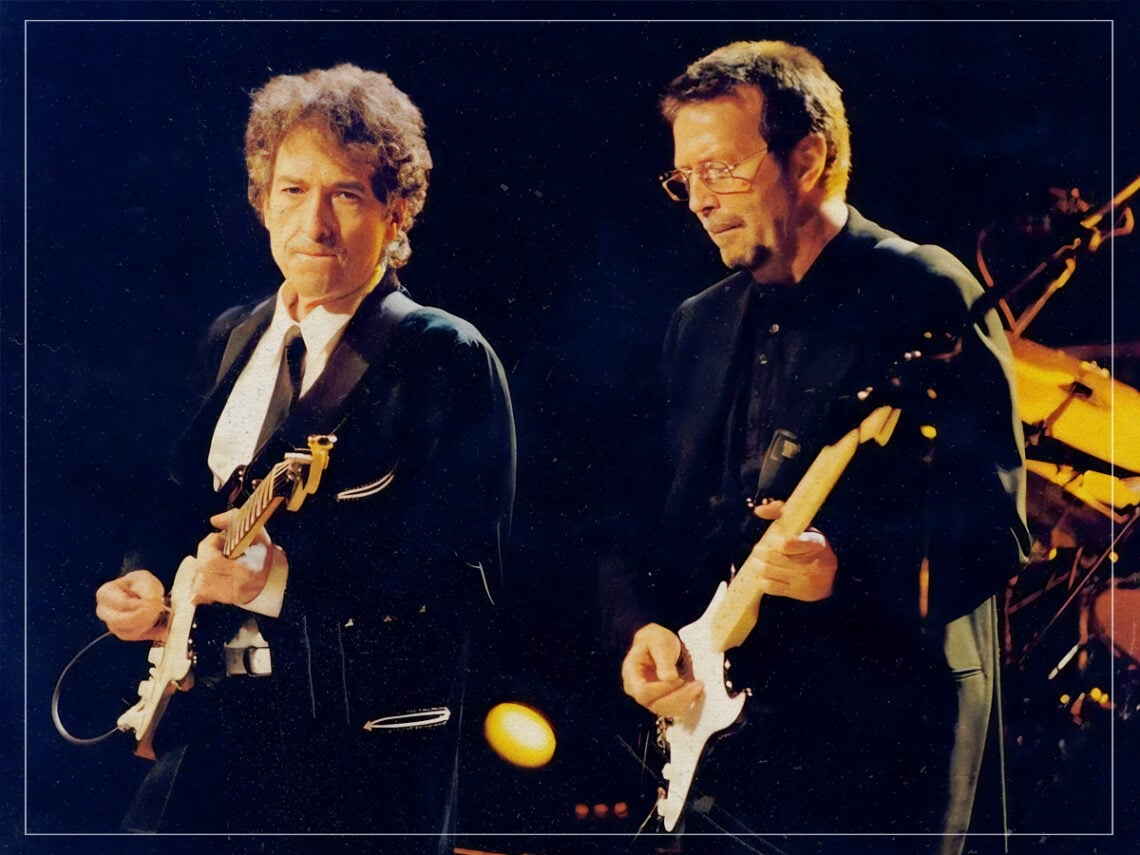
The one Bob Dylan song Eric Clapton called “the sum of his life’s work”

At the time when Bob Dylan first arrived in New York City, ‘The Village’ was flooded with the first drabs of folk players who had poured off the pages of beat literature into gingham shirts.
As a rule of thumb, they all performed pre-loved folk classics from time immemorial – murder ballads about victims forgotten in time, unrequited love songs from romantics long since passed, and enduring allegories without any known author.
Likewise, in the world of pop, the radio waves were chocked with singers taking on the works of Tin Pan Alley songwriters. This meant that true, visceral, cutting originality was in short supply. Being a pioneer was not really thought of as the mark of a master. Yet, those with something to say were beginning to think otherwise.
This prompted Dylan to comment, “I always kind of wrote my own songs, but I never really would play them. Nobody played their own songs, the only person I knew who really did it was Woody Guthrie.” And so, Guthrie became our hero’s hero. He was a beacon who showed that something deeper and different was possible. A few years earlier, Guthrie had proved what a Promethean force he was when he bucked traditions and penned the world’s first concept album.
As the outlier of a generation riddled with hardship, he cared not about money. Like many others, in the late 1930s, Guthrie fled to California in search of work. This was a fortunate move. He soon met his radio partner, Lefty Lou, and began playing on his show. But, by contrast, the collaboration would not lavish him with a fortune, and that was seemingly fine by him. He was the outlier of a generation willing to buck the commercial trend of singles in favour of a format that offered an artist more to say.

They wrote Dust Bowl Ballads together, and on the sleeve of subsequent records, they pressed the following statement: “This song is Copyrighted in the US, under Seal of Copyright #154085, for a period of 28 years, and anybody caught singin’ it without our permission, will be mighty good friends of ours, cause we don’t give a dern. Publish it. Write it. Sing it. Swing to it. Yodel it. We wrote it, that’s all we wanted to do.” From the get-go, this indicated his unique iconoclasm and daring originality.
That truly inspired Dylan. There are only two original songs on his self-titled debut record amidst a slew of old folk standards. One of those is ‘Song to Woody’, which he proclaims is the first he ever wrote. Eric Clapton claims that it remains the one that defines him.
He wandered into New York City, trying to dredge up something new and timeless. Such a dichotomy is tricky. “Then one day,” Dylan himself explains, “I just wrote a song, and it was the first song I ever wrote, and it was ‘A Song for Woody Guthrie’. And I just felt like playing it one night and I played it.”
Continuing, “I just wanted a song to sing and there came a certain point where I couldn’t sing anything, I had to write what I wanted to sing because what I wanted to sing nobody else was writing, I couldn’t find that song someplace. If I could’ve I probably wouldn’t have ever started writing.”
According to Clapton, he never stopped writing in this vein, mutating that initial inspiration in myriad ways but never truly losing sight of it. It was the spark that helped to shed his self-doubt. “He’s a poet. Basically he’s a poet. He does not trust his voice. (Bob) doesn’t trust his guitar playing. He doesn’t think he’s good at anything, except writing—and even then he has self-doubts,” Clapton explained in 1985.
The guitarist added, “Have you heard that thing he wrote about Woody Guthrie? That to me is the sum of his life’s work so far. Whatever happens, that is it. That sums it up.”
In some ways, perhaps it does. Dylan is a revolutionary wound up in the romanticism of the past, a mystic outlaw who, like the coolest character in a cheap western, came from out of town to grace us with something we never knew we needed. Clapton perhaps offers up a fitting name for this character in his glowing appraisal of Dylan’s lore: the “fantastic mysterioso”.
He lingers out in the shadows of progress, asking people to come join him in a new expansive world. But not everyone is capable. As the punk poet John Cooper Clarke once joked, “I love Bob Dylan but I hold him responsible for two bad ideas: a) the extended running time of the popular song and b) the lyric sheet. Both fine for Bob who usually occupied the extra time in agreeably entertaining ways.” Adding, “The rot, however, set in between 1968 and 1975 when the airwaves were clogged with over-manned combos of cheesecloth-shirted with names like Jon Hiseman’s Colosseum… the end is listless.” Thankfully, that has still never befallen old Bob, and his expansive journey began at the start, with ‘A Song for Woody Guthrie’.

Never Miss A Tale
The Far Out Bob Dylan Newsletter
All the latest stories about Bob Dylan from the independent voice of culture.
Straight to your inbox.