


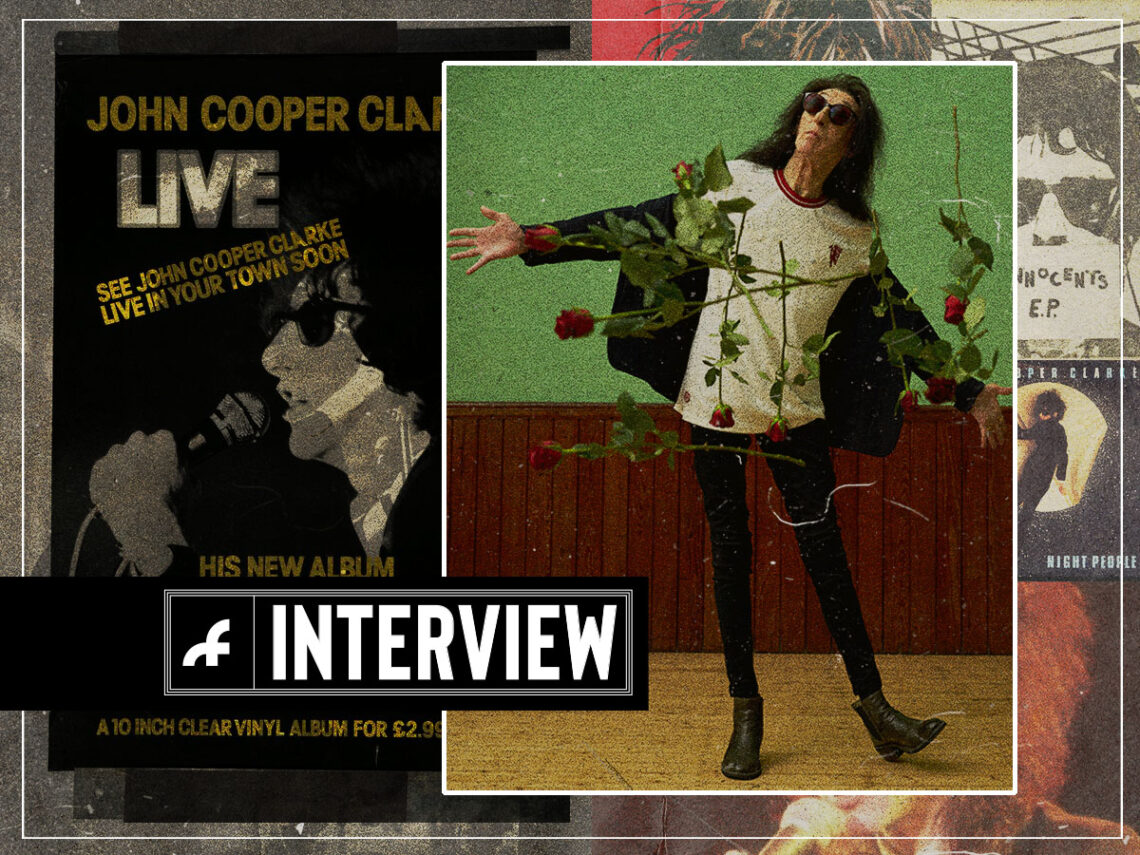
John Cooper Clarke on touring America in the footsteps of Bob Dylan: “I think that’s my favourite album, all told, ‘Highway 61 Revisited’”

John Cooper Clarke doesn’t look like a man who’d be a whizz with technology, picturing him behind a laptop is akin to a fleece-lined geriatric perching themselves on a park bench and whipping out a can of Monster Energy to casually quaff. Henry David Thoreau once wrote, “Beware of all enterprises that require new clothes”. The punk-poet abides by this and shuns the dichotomous disposition that tech would imbue upon his character. Quipping instead, “I don’t employ any artificial intelligence of any kind.”
So, it comes as no surprise, that for the first few minutes of my brief interview window with Clarke, as he tours the good, old USA, he’s beckoning assistance to be able to hear me over the transatlantic line. He’s not a Luddite and he’s a million miles from doddery, he simply isn’t practised in the art of international calls. “People say you should get a computer. I say, ‘Listen, I know how fucking great they are, that’s the very reason I can’t have one’,” he once told the BBC.
“I’d never get out the fucking house. I’d fucking die. You’d found me dead with a pizza box, with my arse in the air, and my pants round my ankles, in front of a flickering fucking computer screen. ‘Oh, he never went out after we bought him that computer screen, he never went out the door. The milk stopped being delivered and he fucking died’,” he concludes, imitating a rather disparaging griever. So, in short, some technical issues were to be expected. Then, suddenly, modern machines work their alchemical magic, and his enthralling Manc tones cut through as unmistakably as the killer in Columbo.
“Everything is fucking rosy”, he says. He’s on the road in America, making up for lost time owing to the fact his entry to the bulging mass of states was prohibited after he was caught with a purely decorative switchblade during a western phase – a reprimand he bemoans, claiming he could’ve done a lot more damage with a hammer, and yet if he was carrying one of them, people would’ve just thought he was a trendy labourer. So, he decrees: “I’m making up for lost time here. I’m becoming a transatlantic commuter, only held up by an epidemic.”
He comfortably slots right in around these parts. “It’s going great, full houses, and everybody is going out with a smile on their face from what I can gather. Very successful,” he happily declares. If anything, his vernacular is largely American anyway. “Without a doubt, these residual Americanisms are pottering around in my being at all times. Everything I like is American, so I love it here. It’s got it all, baby. I found it very upsetting not being able to visit. It’s great, and each time I’ve been, it has been a larger venue. But it takes a lifetime to become a household name in the States,” he says.
And, the slight difference in culture and drive for dominance over the global demimonde’s punk poetry scene, allows him to indulge his performative side. “Absolutely, it goes over the same. Plus, I instantly turn into an American here,“ he admits. “I’m not doing it right now because you’re English, but any excuse to speak in an American accent, that’ll do me.”
Who does he base his impression on, I ask? “Sinatra,“ he splurts without hesitation. “Sinatra’s speaking voice,“ he adds, before embarking on a recital, “‘Hey, waddaya mean?’“ clarifying, as though consciously ensuring that what I just heard was, in fact, a blend, “Sinatra and Larry Fine out of The Three Stooges. American, it’s every English person’s second language.”

But aside from accents, and his love of the place, there’s a central influence in the States that helped to inspire Dr Clarke towards poetry in the first and foremost. In the cycle of artistic influence, Alex Turner once said, “There is always that one band that comes along when you are 14 or 15-years-old that manages to hit you in just the right way and changes your whole perception on things.” Well, Clarke was that for Turner, and, in turn, Bob Dylan was one of the forces that pushed Johnny towards the stalling engine of wealth that is poetry.
However, he also illuminated the notion of the travelling poet of the people, doling out truth with a light wryness that made it bearable, and the mystic sentiment of a numen from faraway lands, in quirky clothes, occupying concert halls like the ghost of everything yet to come. This is the guise that Clarke happily adapts amid the relative anonymity of the States. He prowls around the record stores, cheesecake factories, and halfway houses, like a poetic pariah, before ascending to the spotlight of night and reciting his wit. He escapes into the ideals of America “tapping right into it all“.
Dylan is a sort of spirit guide he has carried for a long while. “Well, yeah, he’s made a big impact there,” Clarke explains, honouring one of his many American heroes. ”Although I would say that I haven’t got all of his records, simply because there’s thousands of them. How many albums has he done, three thousand? And I like just about all of them.” And that leads us to our previously proposed purpose of this very quick chat: to crown his favourite track by the original vagabond.
“I like that ride a mail train one on Highway 61 Revisited, ‘It Takes a Lot to Laugh, It Takes a Train to Cry’. He always has these arcane titles,“ he says before happily crooning the first two verses of the song down the phone in his dulcet, newly Americanised tones. ”And ‘Queen Jane Approximately’. I think that’s my favourite album, all told, Highway 61 Revisited.”
He muses further, “I’ve got to have more than one song,” he says, having already named two. ”His body of work is so immense, you can’t whittle it down to one favourite, that’s unnatural.” He doesn’t have to consider that sacred discography for long before other favourites come flying forth, nearly every time with an accompanying acapella serenade of the choice. “’Romance in Durango’ from that magnificent album Desire.“
He continues: “I like those ones that seem to be set in a border town. He does that real well. I think that’s what got him the part in Pat Garrett & Billy the Kid, he looked dead right in that. He seems to write a lot about Spanish-speaking chicks, and Spanish leather, he seems to have this thing about it, the Catholic world of Mexico, all that fatalism. And the Aztec ruins. ‘Past the Aztec ruins and the ghosts of our people, Hoofbeats like castanets on stone,’” he sings. ”It’s a great number!”
“’Spanish is the Loving Tongue’ is another one. Be-you-tiful. It’s got a kind of tango beat, it changes time signature halfway through and becomes a tango. Wow. Check that. A beautiful song,” he says. It’s this capacity to be characterful and dynamic that is always a trait that attracts the Bard. Not only in Dylan, but in his other heroes, Charles Baudelaire, the Ramones, and Nico.
Moreover, all of these artists found a way to weave their work into the zeitgeist, to somehow deploy their art as a societal yardstick. Dylan did this in a frenzy, unleashing songs at such a pace, that it is hard to comprehend and leaves Clarke somewhat bewildered. “Being prolific, though, was very important to his impact,“ he was throwing punches and you can’t afford to let your hands drop. “But it is a good thing that he didn’t stick to that kind of thing. He did it for long enough, that protest schtick. He just did it for long enough to make his point.”
And he did it verbosely too. This has made him a touchstone for many poets with his songs being closer to Homer’s epics than your usual platitudes of pop. But Clarke also thinks the flowing viscera of his words – hell hath no fury like Dylan’s pen scorned – is a singular force that you have to be very wary of attempting to imitate. “It’s great for Bob Dylan, but most people can say what they’ve got to say in two and a half minutes, and I don’t have a problem with that,“ Clarke warns.
“Look at ‘Stay’ by Maurice Williams & the Zodiacs, for instance, is two minutes, and I think that’s the shortest, good record ever. Or maybe they were beaten by the Ramones with the speed of their delivery? It’s all very well for Bob Dylan, it’s just a problem for most other people, two and a half minutes and you’ve heard enough from them,” he heartily laughs.
Dylan’s singularity and defiance against conformity is another tenet that Clarke has always relished. “Without a doubt, he’s a punk,“ the poet asserts. “The stuff he did with The Paul Butterfield Blues Band and going electric at Newport Folk Festival, where he got a kind of bad time, but he denies it. He comes off and someone is interviewing him, and he just denies it. Everyone has been having a go at him for playing a Telecaster, and he just denied the stick ever happened.”
Clarke himself quips that he used to deploy a similar tactic. “First, I deny it to myself and then I deny it to everyone else.“ But that’s now happily in the past, he says, “Oh, I don’t get any trouble anymore. My tickets aren’t cheap. So, who would buy one of them then give me a bad time?”. Indeed, the consummate Bond-like slickness of his performance makes sure of that too. He cruises about like a welterweight trapped in drainpipes, and regales awed audiences with his trademark mirth.
He’s happy to accept the compliment and kindly tosses one back in return, saying he loves the “Beatnick thing“ Far Out has got “going on“. As ever, he is a man of the people, and this is instantly evidenced once more when a burgeoning panic about his Dylan picks kicks in. “I’ll probably regret these choices as soon as we stop talking,“ he adds.
Continuing: “When I did Desert Island Discs, ever since I first heard it 140 years ago, I’d been revising my eight records, ‘Not that this. No, not that this.’ Then, I’m sat in the car with my man Johnny Green, about to do the show, and he says, ‘I bet you completely revise the list a minute before you go on, and he was bloody dead right.’ And I thought that would put it to bed. I thought I will never have to think about the list ever again even. Except, that’s not the case, now I think, ‘Why didn’t I put that one in’. The torture never stops.”
I reassure him, ‘along with Bob Mortimer’s appearance, yours is my favourite‘, I say. He’s genuinely elated. “Thanks Tom, that’s real great news. I love Bob Mortimer, he’s great, what a laugh. What a win.” And away he goes, chuckling with glee as he continues to rove around this world like manna from heaven, manifest in Farah gear and Chelsea boots, one of God’s own proverbial prototypes. As Nick Cave urges, ”Check out John Cooper Clarke and have your faith in humanity restored. A brilliant, brilliant man.”
You can find his forthcoming tour dates here.

Never Miss A Tale
The Far Out Bob Dylan Newsletter
All the latest stories about Bob Dylan from the independent voice of culture.
Straight to your inbox.