


What was the first ever concept album?

The concept album is in revival. Why is this? Well, because vinyl is in revival.
I remember all too well in the days of my youth uploading songs onto an iPod, with limited space and only a matter of time before an incoming phone call from an auntie wiped out the dial-up internet. With those incumbent restrictions, you had to cull the fat on a record and stick to the singles.
For a decade or so, the new in vogue medium of the iPod held huge sway over albums. Banging singles rather than the rigorous depth of a considerable LP was the status quo, to some extent. Even alternative bands were desperately trying to write hits.
But the tide has turned on this, and huge hit records over the last few years, like Arctic Monkeys’ lunar rock ‘n’ roll retirement home with Tranquility Base Hotel + Casino and Tyler, The Creator’s IGOR, and the whole persona/storyline of Ethel Cain have been in the concept album vein.
The modern rise of the concept album
Indeed, in an era of content overload, they offer a chance to showcase greater originality and attract a stronger sense of engagement from music fans aching for a little bit more than merely another toe-tapper. “Music, like all artforms, should be allowed to communicate freely,” Phil Elverum recently told the Independent. In his view, the rise of the concept album is a rejection of increasingly commercial confines.
While the concept album might seem like the most obvious avenue for a full-length pop LP – to curate the material into a linked sonic tapestry or novelistic work like most media before it – owing to the way technology and pop culture arose alongside each other, this was not necessarily the case.
The reason is evidenced by this archival and rather patriarchally worded article from the Guardian in 1929: “Gramophone records are a very expensive item, and the music-lover who is not particularly rich must often survey his small and slowly growing collection with feelings of pain.”
Radios, however, were far more commonplace and affordable. This meant that early pop music was predominantly single-based and radio-friendly. Moreover, the songs were usually only two minutes long so that DJs could talk more and establish their own careers. Thus, turning a simple track into a long over-arching album and shunning the immediacy of popular tropes was a no-go if you wanted to be successful (which, during the Great Depression, you most certainly wanted to be).
This was amplified further when the 45s first arrived over 70 years ago in 1949. Upon their arrival, even Gramophone records quickly became a school-yard-swappable single-oriented affair.
Craving a concept
However, these kids got older, wiser, and they couldn’t listen to wham, bam, two-minute blasts forever. They wanted something with a bit more substance for a change. These youngsters had grown up in the wake of World War II and all the nuclear panic that came along with it. They crazed culture that elucidated the uncertain zeitgeist when they came of age. This was something that two-minute dance craze records couldn’t offer.
Thus, the insatiable appetite for music’s first commercial rock stars meant that LPs, which were first invented in 1948, gained popularity. These longer records called for more introspection. After a while, folks like Bob Dylan found the endless variations of ‘Rock Around the Clock’ a little bit vapid. LPs allowed for greater depth and diversity.
Suddenly, not every song that a commercial artist put to record had to be a radio hit. While it took the Motown hit parade a while to catch on to this notion, the troubadours flocking to Greenwich Village were about to get arty with what you could do on a 42-minute LP, Dylan eventually putting out the first double album with Blonde on Blonde.
The socialist origins of the world’s first concept album
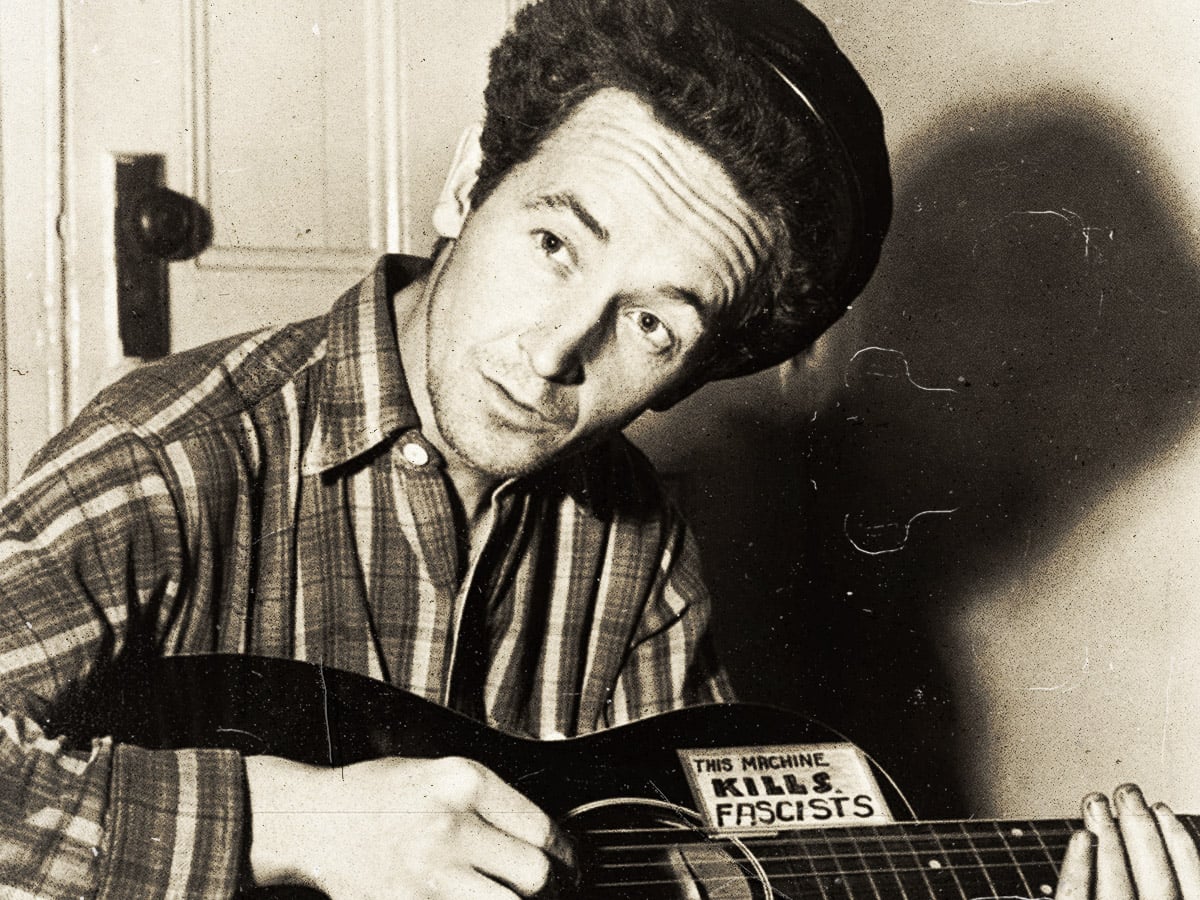
Alas, it was his hero who had already laid the plan out for him: Woody Guthrie. As the outlier of a generation, he cared not about money. Like many others, in the late 1930s, Guthrie fled to California in search of work. This was a fortunate move. He soon met his radio partner Lefty Lou and began playing on his show. But, by contrast, the collaboration would not lavish him with a fortune, and that was seemingly fine by him. He was the outlier of a generation willing to buck the commercial trend of singles.
Guthrie and Lou wrote Dust Bowl Ballads together, and on the sleeve of subsequent records, they pressed the following socialist statement: “This song is Copyrighted in the US, under Seal of Copyright #154085, for a period of 28 years, and anybody caught singin’ it without our permission, will be mighty good friends of ours, cause we don’t give a dern.”
It continued, “Publish it. Write it. Sing it. Swing to it. Yodel it. We wrote it, that’s all we wanted to do.”
What was the album actually about?
From the get-go, this indicated Guthrie’s unique iconoclasm. From then on, he became beloved, a sort of ‘Oklahoma cowboy’ as he was dubbed, and built up his legacy travelling the States disseminating his political messages in poetic tunes. He was now an icon – the first of a few who would follow in his footsteps.
You see, the message pressed alongside the album was not just a conceptual take on copyright laws; the whole record was a conceptual reflection on where America found itself. Dust Bowl Ballads was released as 11 songs on two simultaneously released three-disc 78 rpm records.
The set was a unified collection. Through various protagonists like Tom Joad, Guthrie’s luminary work tells the tale of the Dust Bowl and its devastating impacts in an almost journalistic way.
This was, in essence, a concept, and of that proof that comes from the unconventional way it was released on consecutive discs, pre-dating even the LP format that would naturally allow concept records to flourish. So, to some extent, every concept record that has followed is indebted to the fascist slaying Woody Guthrie, music’s first punk and a pioneer of the LP.
