


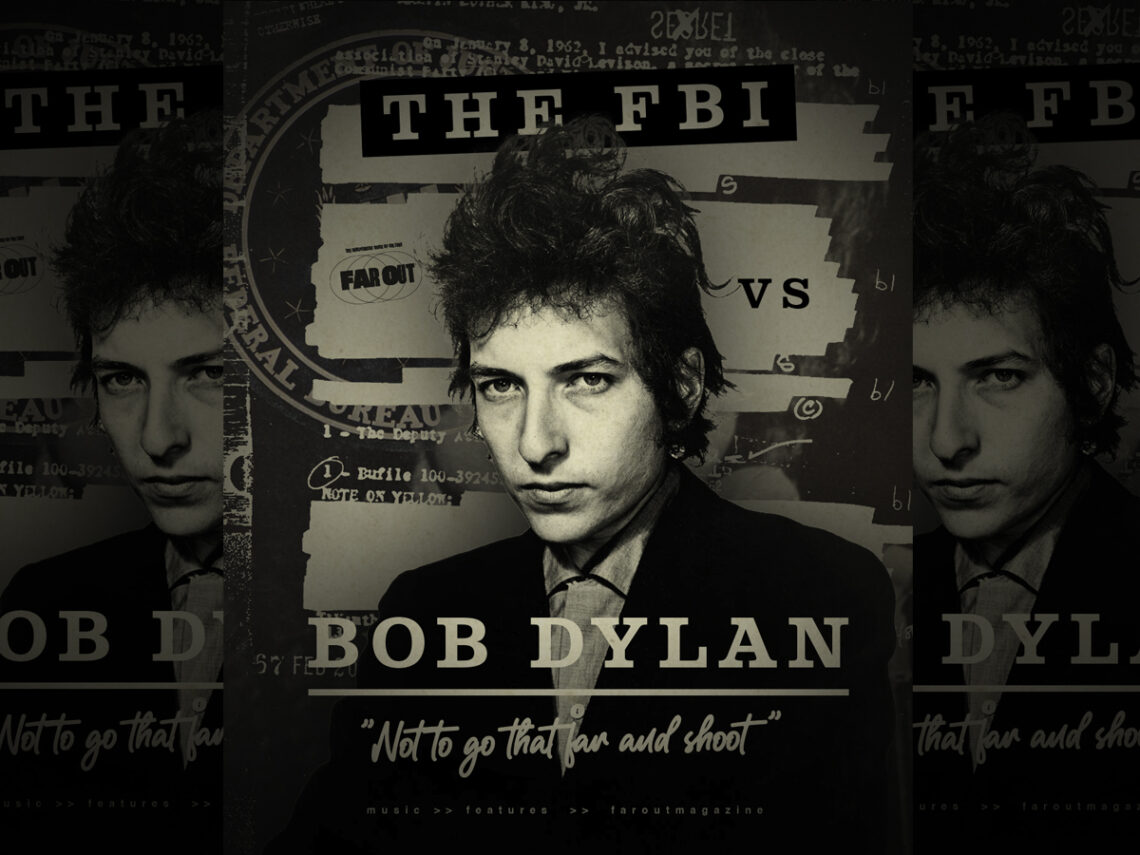
The FBI vs Bob Dylan: “Not to go that far and shoot”

“It is not an old people’s world,” a 22-year-old Bob Dylan told a room full of not-particularly-young onlookers during an acceptance speech at the 1963 ‘Bill of Rights Dinner’ hosted by the left-wing Emergency Civil Liberties Committee (ECLC). “I look down to see the people that are governing me and making my rules, and they haven’t got any hair on their head; I get very uptight about it.”
Dylan had apparently been drinking throughout the evening, and by the time his moment came to receive the Tom Paine Award for his defence of civil liberties through the arts, the young protest singer sounded less like the “voice of a generation” and more like a rambling uncle at Thanksgiving dinner, insulting half the people around him and struggling to make a coherent point.
It’s a scene that probably should have been featured in the 2024 Dylan biopic A Complete Unknown, which heavily focused on this time period, but it was likely left out for one pivotal reason, as Dylan infamously used this same occasion – less than a month after the assassination of John F Kennedy – to express his empathy for the president’s presumed assassin, Lee Harvey Oswald.
“I have to be to be honest,” Dylan told the ECLC membership, “I just got to be, as I got to admit that the man who shot President Kennedy, Lee Oswald, I don’t know exactly where—what he thought he was doing, but I got to admit honestly that I, too, I saw some of myself in him. I don’t think it would have gone—I don’t think it could go that far. But I got to stand up and say I saw things that he felt, in me—not to go that far and shoot.”
The crowd started turning on him at this point, booing the artist they’d gathered to celebrate in a scene much more dramatic and uncomfortable than the mild rebellion witnessed a year and a half later at the Newport Folk Festival. This event, by comparison, was the sort of gaffe and blowback that would nominate a celebrity for instant cancellation in today’s world of 24/7 reactionary media.
Fortunately for Dylan, who had only released two albums at this stage in his career, news spread a lot slower in 1963, and his own position as a sort of fringe figure in the mainstream consciousness made him slightly less susceptible to the sort of national backlash that he might have faced a year or two later, when there probably would have been angry mobs outside his apartment with proverbial torches and pitchforks. Dylan’s more immediate new foe, instead, was a considerably more dangerous one, in the form of the Federal Bureau of Investigation.
There were, unsurprisingly, a half dozen or so undercover FBI agents sitting in the audience during Dylan’s speech that night, and while they might not have entered the event with their sights firmly set on the folksinger, they came away with plenty of material to add to Dylan’s growing file.
As uncovered in a 2023 report by truthout.org, Dylan was adopted as a potential key piece in the FBI’s ongoing counterintelligence campaign against the Communist Party of the United States, a group which had already been pummeled during the McCarthy hearings in the 1950s, and was now further splintering into different sects. Reporting directly to FBI director J Edgar Hoover, the agents who witnessed Dylan’s speech suggested not only increasing surveillance around the singer, but using his words as a way to damage both his own reputation and that of the Emergency Civil Liberties Committee.
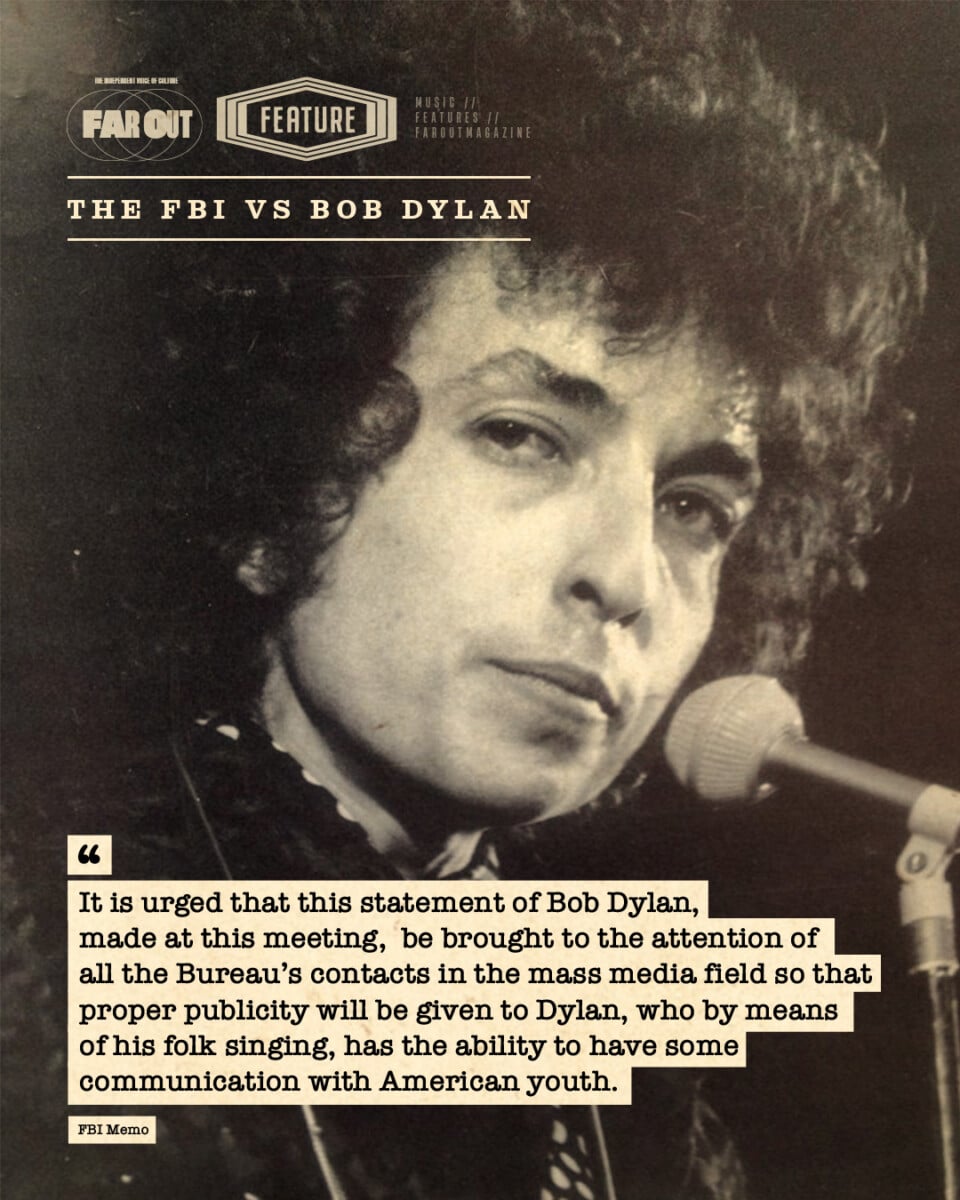
“It is urged that this statement of Bob Dylan,” one FBI memo read, “Made at this meeting, be brought to the attention of all the Bureau’s contacts in the mass media field so that proper publicity will be given to Dylan, who by means of his folk singing, has the ability to have some communication with American youth. In addition, publicity of this sort will point up the type of organization the Emergency Civil Liberties Committee is to honor an individual of Dylan’s mentality.”
This plot was carried out largely in the form of a recap of the Bill of Rights Dinner written by the right-leaning columnist Fulton Lewis Jr, whose story was syndicated in dozens of newspapers around the country. Even that article, though, didn’t use Bob Dylan’s blasphemous pro-Oswald statements as a headline or primary subject of focus. Instead, Lewis started out by highlighting the supposed pinko sympathies of other attendees at the dinner, including the “liberal egghead” author James Baldwin and two other “curly haired” Jewish-American activists named Levi Laub and Moe Fishman.
In some respects, the FBI’s attempts to catch Dylan in a “gotcha” moment backfired, as the demonisation of the entire ECLC effectively painted the Bill of Rights Dinner as one unified anti-American political gathering, leaving out the far more interesting divisions within the room that night. If the general public came away with any notion of Dylan as a dangerous left-wing figure, this only served to boost his status among his core listenership as the new 1960s counterculture really blossomed over the next two years.
This doesn’t mean that Dylan himself felt fine and dandy about the words he’d chosen at the ECLC dinner, however. Once he’d sobered up and taken stock of how much damage a faux pas could do coming out of his mouth, he decided to address the issue by using his preferred medium of the written word.
Dylan’s apology to the ECLC is a remarkable artifact of this early-career course correction, as the incredibly long letter reads like something out of Tarantula, dodging any sort of blunt or succinct “sorry” in favour of some free-association musings about his own weird brain, along with a gallant offer to return his award and/or cover the costs of all the charitable donations the ECLC had lost as a result of Bob’s antagonistic remarks.
“When I speak of bald heads, I mean bald minds,” Dylan wrote, making sure that his hairless supporters were the first to be set at ease. “When I speak of the seashore, I mean the restin’ shore. I don’t know why I mentioned either of them.”
From here, the walk-back becomes borderline comical:
“It is hard to hear someone you don’t know, say, ‘this is what he meant to say’ about something you just said. For no one can say what I meant to say; absolutely no one. At times I even can’t. That was one of those times.”
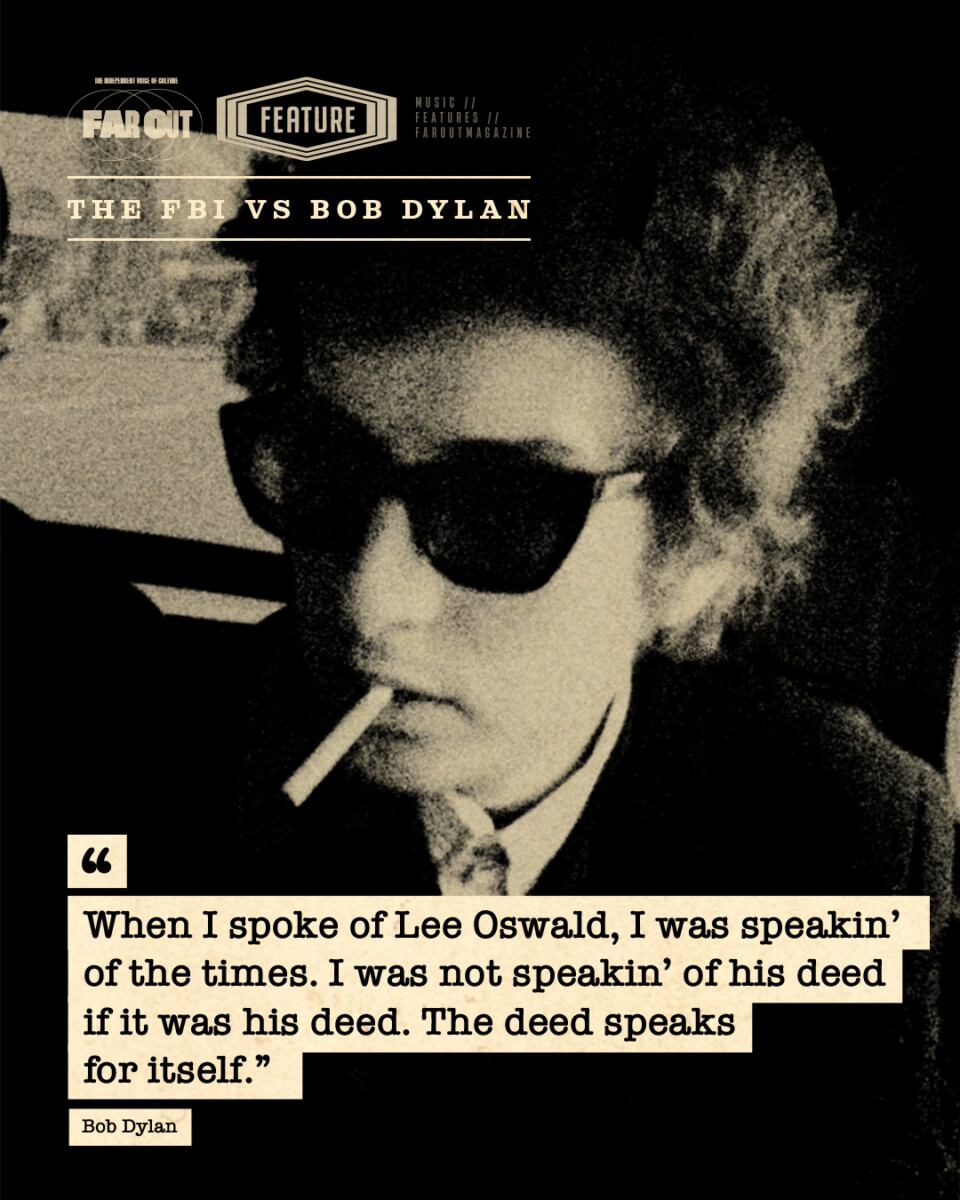
Explaining that he was a singer/songwriter who was basically out of his depth trying to give an extemporaneous speech, Dylan then briefly adds that “when I spoke of Lee Oswald, I was speakin’ of the times. I was not speakin’ of his deed if it was his deed. The deed speaks for itself.”
Dylan clearly saw the JFK assassination as a defining moment for his generation, but not in the way many Americans did – as some sort of crashing down of the country’s innocence. Dylan didn’t consider anyone in government particularly innocent prior to the event; a subject he would revisit in much greater detail over 50 years later on his song ‘Murder Most Foul’, a 17-minute exploration of the assassination and its aftershocks.
Meanwhile, for Dylan, still living in a young person’s world in 1963, the embarrassment and frustration of the ECLC incident seemed to confirm the instincts he’d already been feeling; to reject his place as a member in any sort of organised political movement or organisation that would have him as a member.
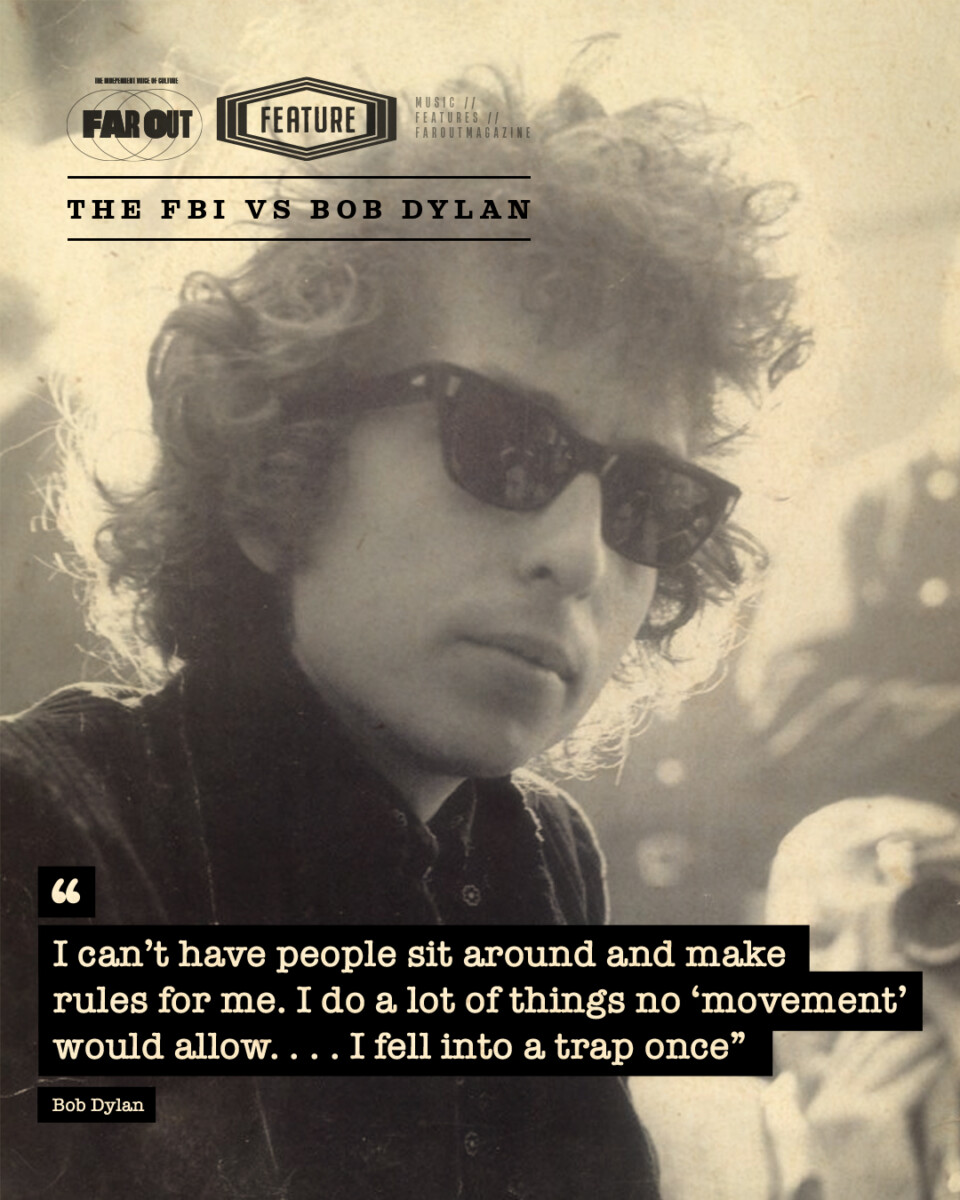
In a 1964 interview with the New Yorker’s Nat Hentoff, Dylan said that he “can’t have people sit around and make rules for me. I do a lot of things no ‘movement’ would allow. . . . I fell into a trap once—last December—-when I agreed to accept the Tom Paine Award from the ECLC. . . . They were supposed to be on my side, but I didn’t feel any connection to them,” he said, noting that many of the people in the audience, who’d been part of the labour movement in the ‘30s, were now wearing diamonds and furs.
Dylan recounted how those same attendees “looked at me like I was an animal” when he mentioned feeling a sense of understanding for Oswald. “They actually thought I was saying it was a good thing Kennedy had been killed. That’s how far out they were. . . . I was supposed to be a nice cat. I was supposed to say, ‘I appreciate your award and I’m a great singer and I’m a great believer in liberals, and you buy my records and I’ll support your cause.’ But I didn’t, and so I wasn’t accepted that night.”
The FBI was accustomed to hunting down its supposed celebrity enemies by unearthing their social affiliations and playing the “guilty by association” strategy. This made Bob Dylan a tough fish to hook. While he could easily put himself in the headspace of a Lee Harvey Oswald, he despised being directly affiliated with just about anything outside his own art, and as a result, he eventually became bigger than any group or organisation that tried to champion him.

Never Miss A Tale
The Far Out Bob Dylan Newsletter
All the latest stories about Bob Dylan from the independent voice of culture.
Straight to your inbox.